

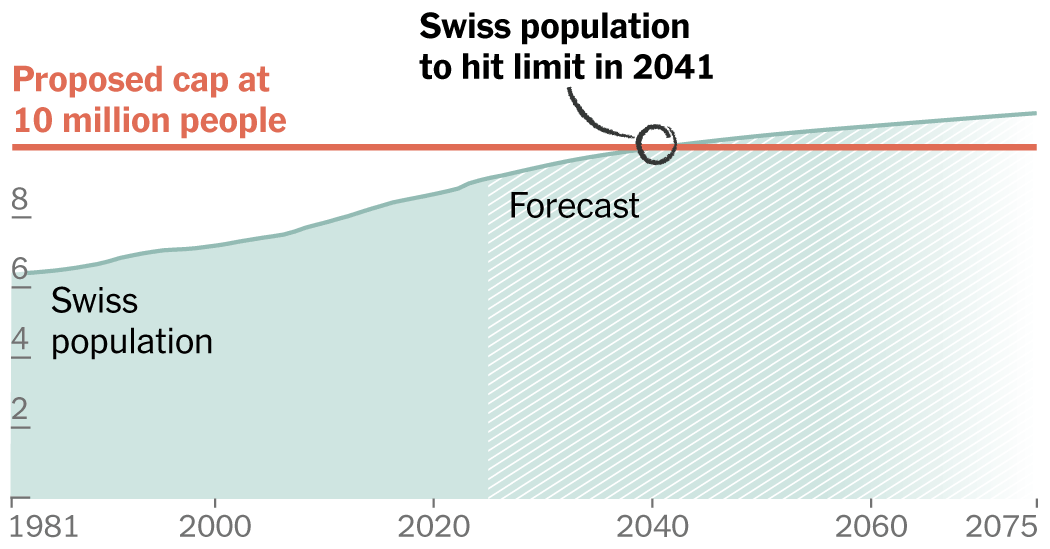
About 9.1 million people live in Switzerland — approaching too many, for many Swiss people. On Sunday, the country will vote on whether to take measures to cap its growing population at 10 million.
The result could have huge implications for the Swiss economy — and for the composition of the country for decades to come.
If voters approve the initiative, it could reshape a rapidly aging country that depends heavily on talented foreign workers. Business leaders warn it could cause critical labor shortages over the next 15 years, when as many as half of Swiss workers are set to retire.
The right-wing party that proposed the cap, the Swiss People’s Party, predicts it will help clear traffic jams and soothe high housing costs, while preserving the country’s language traditions and agrarian roots.
Switzerland’s seven-member governing council, which includes two representatives from the People’s Party, officially opposes the measure. It commissioned a Swiss consulting firm, Demografik, to predict how a population cap would change the country. The firm modeled a scenario in which Switzerland’s population reached 10 million in 15 years, and its government was then required to make drastic moves to bring it back down.
The firm found those measures could have wrenching effects on Switzerland’s society and its economy, and on the country’s relationship with its neighbors in Europe. The measure’s sponsors reject those findings, claiming most migrants are not actually filling high-demand, specialist jobs.
Here are three of the effects the study foresaw.
Stop most immigration
Migration, not birthrates, is driving Switzerland’s population growth, and migration is what the initiative aims to stop.
Nearly a third of Swiss residents were born abroad. The cap would block an estimated 1.2 million people from arriving in Switzerland by 2075, the study projects.
Based on historical trends, most of the people barred from moving to Switzerland would be other Europeans — as opposed to asylum seekers from the Middle East, Africa or elsewhere, against whom many European countries saw a backlash. That’s the nature of Swiss migration: It has largely come from neighboring countries, like Italy and Germany.
Some residents complain migration has threatened their way of life by, for example, replacing the sounds of Swiss German in town squares with the “high German” that is spoken in Germany. And the Swiss People’s Party has complained that Muslim immigrants threaten “our Western values,” even though the number of newcomers from Muslim-majority countries is outstripped by those from other parts of Europe.
Switzerland currently has an agreement with the European Union that allows for free movement between Switzerland and its neighbors. The cap could force it to terminate that deal if the population exceeds 10 million, which would in turn endanger its other pacts with the E.U.
Make an aging population even older
The 10 million cap would further increase the proportion of older residents, the study found, with large effects likely on social welfare programs.
Immigration has made Switzerland younger, on balance. Swiss birthrates are low, beneath the European average, and the native-born population is rapidly hitting retirement age. Most new arrivals are in their working prime. A halt to migration would mean fewer working-aged people to generate economic growth and tax revenues.
Last year, for the first time, Switzerland had more residents 65 or older than under 20. The study concluded the cap would exacerbate that dynamic. It warned those shifts could force painful changes to the pension system, and possibly make everything in the country more expensive as a result.
Drain talent in critical parts of the economy
Those missing migrants could leave an outsize hole in the Swiss work force, particularly in its border regions, business groups and the study authors warn.
Switzerland leans heavily on foreign workers for critical sectors that often require advanced training, like pharmaceuticals and information technology. A loss of brainpower in those sectors could dull Switzerland’s innovative edge, which has long helped power its economy.
Many of those jobs will be difficult to automate or replace with artificial intelligence, like ones in hospitals and hotels. Some migrant-heavy fields are already suffering from labor shortages, notably health care.
“If they keep out the well-trained people, then they have a problem filling certain positions,” said Stefanie Bailer, a political scientist at the University of Basel. “All those German doctors and so on – you will have a massive problem if they don’t come anymore.”
That void could leave the country’s looming wave of retirees in a tough spot. There could be fewer workers around to step into their jobs — and fewer to provide the medical care they will increasingly require as they, and the country, age.
“It will make a situation that was already critical even more critical,” said Manuel Buchmann, the lead author of the Demografik study.