

Dhaka, Bangladesh – It was almost midnight, but tens of thousands of people were still gathering for a campaign rally in Gazipur, a garment manufacturing hub north of Bangladesh’s capital, Dhaka.
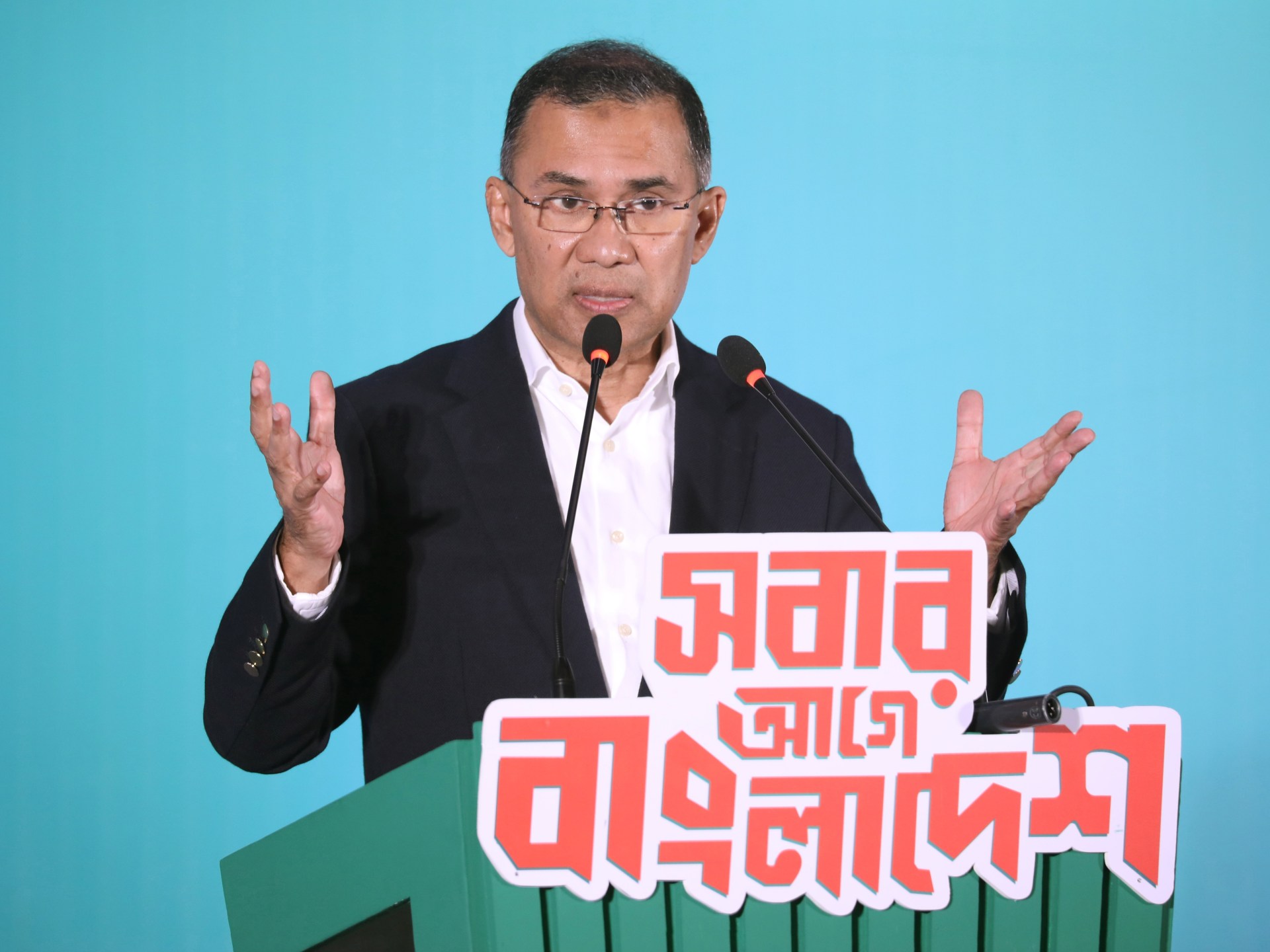
Many had been waiting for hours to hear Tarique Rahman, who succeeded as the chairman of the Bangladesh Nationalist Party (BNP) following the death of his mother and Bangladesh’s first female prime minister, Khaleda Zia, in December.
Recommended Stories
list of 4 itemsend of list
BNP leaders saw the turnout as evidence that their party, long oppressed under 15 years of ousted Prime Minister Sheikh Hasina’s government, was able to mobilise supporters and rebuild its strength as it seeks to return to power in the February 12 general election.
Hasina’s Awami League party was banned from politics last year by the interim administration of Nobel laureate Muhammad Yunus, leaving the BNP a frontrunner in Thursday’s vote. Its main rival is Jamaat-e-Islami (also known as Jamaat), a resurgent Islamist party, which has allied with the National Citizen Party (NCP), formed by former student leaders of the 2024 uprising that toppled Hasina.
Since returning to Bangladesh on December 25 after nearly 17 years of exile in the United Kingdom, Rahman, 60, has been at the centre of the BNP’s election campaign, which ended on Tuesday. His rallies drew large crowds, with his presence reassuring supporters of the party’s revival after the arrests, internal splits, and its distance from voters during Hasina’s government.
The symbolism of his return – visible, accessible, and leading from the front – carried its own power, tapping into a grassroots base that traces back to his father, General Ziaur Rahman, a former military leader whose legacy shaped the BNP before his assassination in 1981.
Yet the enthusiasm has increasingly been accompanied by unease, resulting in an election campaign defined as much by anticipation as by doubt.
Leadership test: From exile to command
For nearly 17 years, Rahman effectively led the BNP from exile in London, relying on intermediaries and virtual communication, while much of the party’s senior leadership, including his mother, Khaleda, faced arrests, court cases and political restrictions in Bangladesh. His return brought his authority closer to the ground, but it also exposed the difficulty of converting symbolic leadership into effective organisational control.
One of the immediate challenges the BNP faced was enforcing discipline within the party. Some 92 candidates are contesting against official BNP nominees in 79 of the country’s 300 constituencies, highlighting persistent factionalism at the local level.
“This seems higher than at any previous time,” said Al Masud Hasanuzzaman, an analyst and professor of political science at Jahangirnagar University.
Moreover, a recent study by Transparency International Bangladesh found that 91 percent of political violence recorded since August 5, 2024, involved BNP activists, a statistic that raises further questions about the party’s internal control.

Political analyst Dilara Chowdhury, who has studied the nationalist politics of Rahman’s parents, said the lack of discipline within the BNP became increasingly visible during this year’s election campaign.
“This is a major weakness,” Chowdhury told Al Jazeera. “He [Rahman] has not been able to establish discipline within the party so far. Rebel candidates have emerged and, in many cases, they are openly challenging the central leadership.”
While Hasanuzzaman frames Rahman’s reliance on family legacy as an advantage in the election, Chowdhury sees it as a source of heightened expectation – and pressure.
“To outshine leaders like Khaleda Zia and Ziaur Rahman is never easy,” Chowdhury said. “I do not think he has yet demonstrated that level of charisma.”
Chowdhury said the election is the first decisive test of Rahman’s leadership. “If he can lead the party to victory despite all these challenges, that would mark his first real success as a leader in his own right.”
‘Very little homework’
Rahman’s public messaging has also drawn scrutiny. Analysts say his speeches, often combining ambitious promises with factual inaccuracies, erode confidence, especially among undecided voters.
Fact-checks of several of his claims have been widely shared online.
At a rally in the southern district of Faridpur, Rahman said the area produces large quantities of soya beans. The claim was quickly challenged, as soya bean is not a major crop there, with cultivation concentrated mainly in Bangladesh’s southern coastal belt.
In another instance, a viral graphic mocked several of his pledges as either already implemented or recycled from the 2001-2006 BNP-Jamaat-led government, including declaring the coastal city of Chattogram as the country’s “commercial capital”.
Analysts and party insiders say such episodes point to gaps in Rahman’s research and leadership, and complicate his efforts to project himself as a national leader who is prepared.
“Yes, he makes mistakes in speeches,” admitted a BNP leader in southern Bangladesh, speaking on condition of anonymity. “But he was outside the country for a long time. We believe he will improve.”

Analyst Chowdhury said his lack of preparation was an issue.
“He has taken charge of the campaign, but there is very little homework,” she said. “He ends up saying many things that are simply wrong, like claiming he will plant 500 million trees. That is not a credible proposition.”
Chowdhury also questioned the feasibility of Rahman’s flagship policy proposals, including a “family card” to provide monthly cash to women and the unemployed. “Once you talk about family cards, the obvious question is where the money will come from,” she said. “And if you provide allowances to the unemployed indefinitely, there is a risk the economy becomes less productive.”
Rahman’s anticorruption rhetoric has also failed to instill confidence among people, Chowdhury said. “He is saying he will eliminate corruption, while he has nominated 23 loan defaulters for the election.”
In a televised address to the nation on Monday evening, Rahman sought to address such concerns, acknowledging past failures under the BNP’s government and pledging a hard line on corruption.
“There is no alternative to making the state and government accountable to the people,” he said. “If entrusted with power, a BNP government will be as firm as possible in controlling corruption and restoring the rule of law – this is our commitment to the nation.”
Khan Sobayel bin Rafiq, a political commentator and former military officer, pointed to the gap between Rahman’s personal appeal and the BNP’s ability to counter longstanding narratives about corruption within its ranks.
“Young voters aged between 18 and 26 did not witness BNP rule,” Sobayel told Al Jazeera. “Many of them have internalised the idea that BNP represents corruption and ‘chandabazi’ [extortion]. The party has not been able to decisively turn that perception around.”
Sobayel, who describes himself as a victim of Hasina’s hardline policies, himself spent 11 years in forced exile in Malaysia after he, as a member of a military committee investigating a 2009 mutiny by soldiers from the Bangladesh Rifles regiment, refused to endorse what he called a “fabricated investigation report” pushed by the government.
Thomas Kean, a consultant for Bangladesh and Myanmar at the International Crisis Group, thinks Bangladesh is unlikely to return to the kind of repression seen during Hasina’s long years in power. But he also warned that perceptions about the BNP at the grassroots level continue to shape the public’s trust.
“The leadership appears to recognise that something has fundamentally changed in Bangladesh,” Kean said. “At the same time, allegations of extortion and criminal activity – whether accurate or not – have damaged the party’s image, particularly among younger voters.”

‘Loyalty over meritocracy’
On Friday, while unveiling the BNP’s election manifesto at a luxury hotel in Dhaka, Rahman spoke about the importance of placing “the right person in the right position”.
Analysts, as well as some party insiders, said they were unsure about whether that principle was reflected in how his campaign team was assembled.
A BNP leader, speaking on condition of anonymity owing to the sensitivity of internal party matters during an election, said Rahman’s public communication shifted after his return, shaped by advisers who accompanied him during his years in exile.
“He brought his close aides from London, who, like him, had been away from Bangladesh for 17 years,” the leader told Al Jazeera. “A lot has changed in that time, and there is a perception that they have struggled to grasp the changed realities.”
The party insider said Rahman’s interactions with people are being tightly managed, limiting his exposure to grassroots feedback despite his extensive travels across the country. “Although he is travelling all over Bangladesh, he remains isolated from ground reality,” the BNP leader said.
The party insider also alleged that Rahman “opted for loyalty over meritocracy”.
“You can run a party with people who are loyal to you, but not a government. This is his biggest challenge. If he wants to govern, he will need to promote meritocracy and bring in professionals who can offer sound advice – and that has been missing so far.”
Analyst Chowdhury agreed, saying the issue has created tensions within the BNP, with many local leaders who endured arrests and hardships during Hasina’s government feeling sidelined. This could undermine Rahman’s appeal, particularly among younger voters.
“While he was in London, the people around him there are now being given more importance than those who stood by him inside the country,” she told Al Jazeera. “There is a conflict between these groups.”
Will dynasty undermine political legitimacy?
Asif Mohammad Shahan, a professor of development studies at Dhaka University, thinks Rahman is in “a difficult position”.
“If the party does not win by a landslide, he will be blamed. If it wins comfortably, people will say it was expected. There is no clear win for him,” he told Al Jazeera.
Central to both his appeal and the criticism he faces is Rahman’s lineage.
As the son of former President Ziaur Rahman and three-time leader Khaleda, he embodies a political dynasty that many younger voters say they want to move beyond, even as that legacy continues to mobilise people across the country.

BNP leaders, however, reject the idea that being part of a dynasty undermines political legitimacy.
In a recent interview with Al Jazeera, BNP Secretary-General Mirza Fakhrul Islam Alamgir argued that political inheritance is common across South Asia and should not disqualify a leader if he is “capable, accountable and subject to public scrutiny”.
Analysts take a more nuanced view, despite seeing Rahman as a leading contender for the premiership.
Sobayel bin Rafiq, the former military officer, distinguishes the individual and his organisation. “Tarique Rahman as a person and the BNP as a party are two different things,” he said. “I want to see him as the prime minister. But overall, the party’s performance as an organisation has not been strong.”
Analyst Chowdhury points to a different reality.
“It seems a segment of the civil and military bureaucracy may support a BNP victory because they see it as a return to a familiar status quo, where they can protect their vested interests,” she said.
For Rahman, however, the election is not just a contest for power, but a referendum on whether his return from exile marks a genuine break from the past or merely a familiar cycle under a new leadership.
“If any unintentional mistakes were made while governing the country in the past, I sincerely apologise to the people,” he said in his address to the nation on Monday. “Learning from those mistakes, and building on our achievements, we want to create a safe Bangladesh for the present and future generations.”