

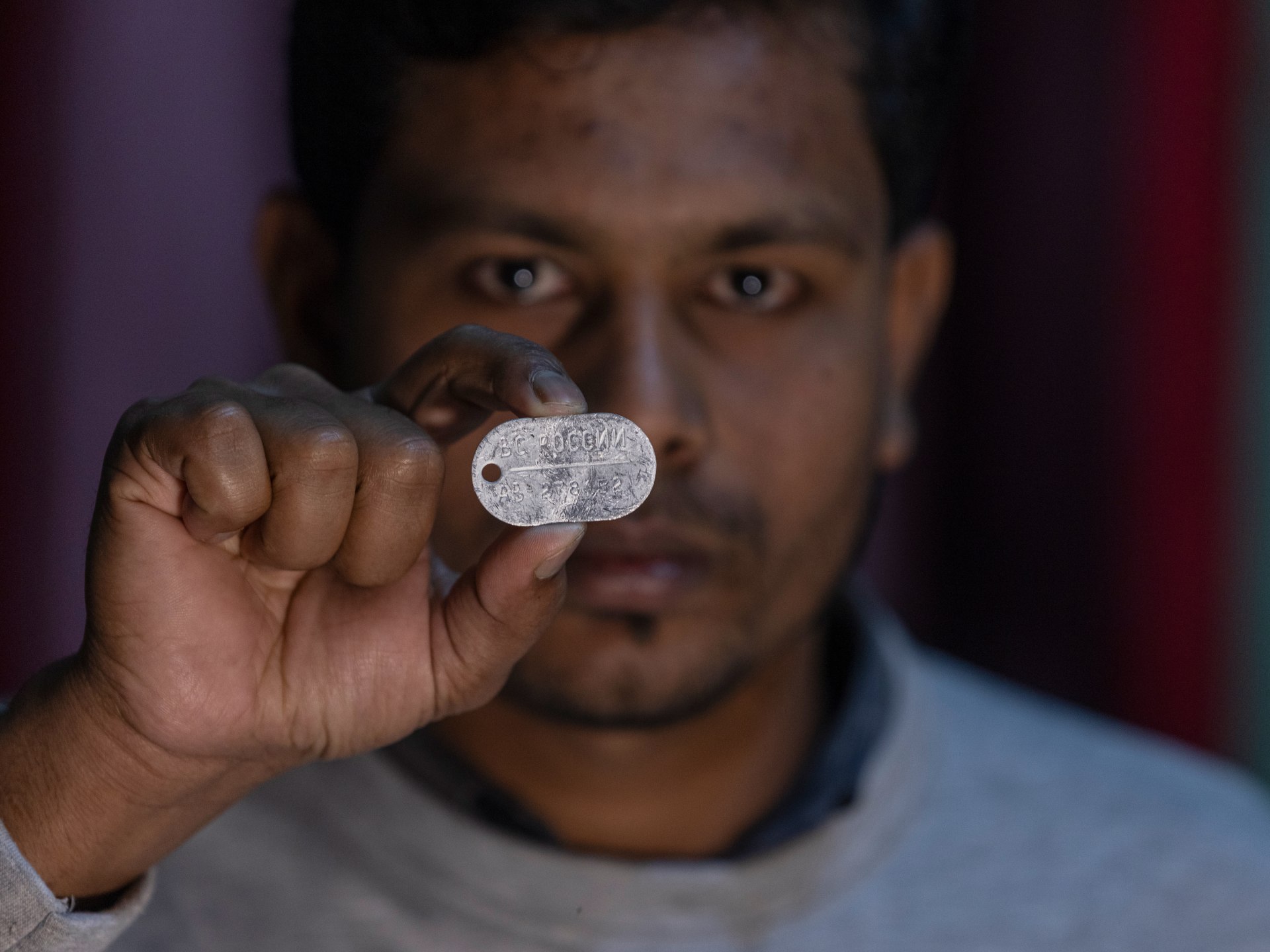
A labour recruiter persuaded Maksudur Rahman to leave the tropical warmth of his hometown in Bangladesh and travel thousands of miles to frigid Russia for a job as a janitor.
Within weeks, he found himself on the front lines of Russia’s war in Ukraine.
Recommended Stories
list of 4 itemsend of list
An investigation by The Associated Press news agency published on Tuesday found that Bangladeshi workers were lured to Russia under the false promise of civilian work, only to be thrust into the nearly four-year war. Many were threatened with violence, imprisonment or death.
AP spoke with three Bangladeshi men who escaped from the Russian military, including Rahman, who said that after arriving in Moscow, he and a group of fellow Bangladeshi workers were told to sign Russian documents that turned out to be military contracts.
They were taken to an army camp for training in drone warfare techniques, medical evacuation procedures and basic combat skills using heavy weapons.
Rahman protested, complaining that this was not the work he agreed to do. A Russian commander offered a stark reply through a translation app: “Your agent sent you here. We bought you.”
Rahman said the workers in his group were threatened with 10-year jail terms and beaten. “They’d say, ‘Why don’t you work? Why are you crying?’ and kick us,” said Rahman, who escaped and returned home after seven months.
The families of three other Bangladeshi men who are missing said their loved ones shared similar accounts with relatives.
AP said the workers’ narratives were corroborated by documents, including travel papers, Russian military contracts, medical and police reports, and photos. The documents show the visas granted to Bangladeshi workers, their injuries sustained during battles and evidence of their participation in the war.
The three Bangladeshi men told AP they were coerced into front-line tasks against their will, including advancing ahead of Russian forces, transporting supplies, evacuating wounded soldiers and recovering the dead.
Men from other South Asian countries, including India, Nepal and Sri Lanka, have also complained of being duped into signing up to fight by Russian recruiters promising jobs. Officials in Kenya, South Africa, Jordan and Iraq said the same has happened to citizens from their countries.
Some Bangladeshi workers were lured into the army with promises of positions far from the front line.
Mohan Miajee enlisted in the Russian army after the job that initially brought him to Russia – serving as an electrician for a gas-processing plant in the remote Far East – was plagued by harsh working conditions and relentless cold.
While searching for employment online, Miajee was contacted by a Russian army recruiter. When he expressed his reluctance to kill, the recruiter said his skills as an electrician made him an ideal candidate for an electronic warfare or drone unit and not combat.
Miajee was taken in January 2025 to a military camp in the captured city of Avdiivka in eastern Ukraine. He showed the camp commander documents describing his experience and explained that his recruiter had instructed him to ask for “electrical work”.
“The commander told me, ‘You have been made to sign a contract to join the battalion. You cannot do any other work here. You have been deceived,’” he said after returning to his village of Munshiganj.
Miajee said he was beaten with shovels, handcuffed and tortured in a cramped basement cell and held there every time he refused to carry out an order or made a mistake. Because of language barriers, for example, “if they told us to go to the right and we went to the left, they would beat us severely,” he said.
Neither the Russian Ministries of Defence and Foreign Affairs nor the Bangladeshi government responded to a list of questions, the AP report said.
The families of some of these men filed a complaint with police in Bangladesh and travelled on three occasions to the capital, Dhaka, to pressure the government to investigate.
Salma Akdar has not heard from her husband since March 26. In their last conversation, Ajgar Hussein, 40, told her he had been sold to the Russian army.
Hussein left in December 2024, believing he was being offered a job as a laundry attendant in Russia, his wife said. For two weeks, he was in regular touch.
Then he told his wife he was being taken to an army camp where they were trained to use weapons and carry heavy loads up to 80kg (176lb). “Seeing all this, he cried a lot and told them, ‘We cannot do these things. We have never done this before,’” his wife said.
For two months after that, he was offline. He reappeared briefly to explain they were being forced to fight in the war. Russian commanders “told him that if he did not go, they would detain him, shoot him, stop providing food”, she said.
Families in the village confronted the recruiting agent, demanding to know why their loved ones were being trained for war. The agent replied dismissively, saying it was standard procedure in Russia, insisting that even launderers had to undergo similar training.
Hussein left a final audio note for his wife: “Please pray for me.”