

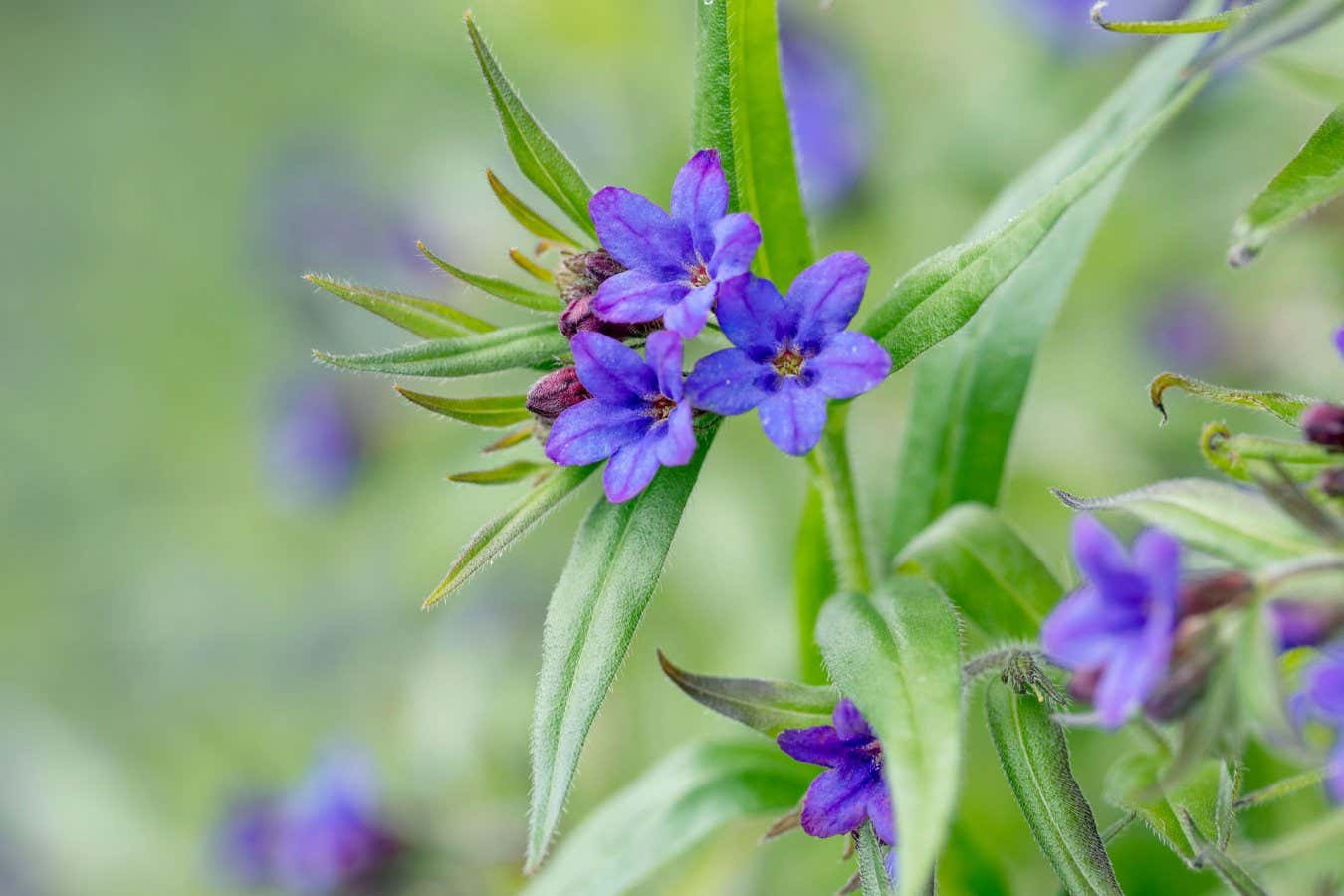
Genome duplication has occurred in many flowering plants, such as the purple gromwell
David Chapman/Alamy
Extra copies of genetic instructions may have helped flowering plants survive mass extinctions, including the catastrophe that saw off the dinosaurs.
New findings suggest that angiosperms – flowering plants like daisies, grasses and fruit trees – may have survived major environmental and ecological upheavals in Earth’s prehistory thanks to accidentally duplicated genomes. Normally, such surplus genomes are an evolutionary burden, but during chaotic periods they may have helped angiosperms flourish into the dominant plant life we see today.
Typically, organisms that reproduce sexually have two copies of their chromosomes, one from each parent. But plants – and especially angiosperms – often have more than two, a condition called polyploidy, resulting from the genome failing to halve in the reproductive cells. Plants like potatoes and some wheat varieties have four copies of their chromosomes. Others might have eight copies or more.
A third of angiosperms today are polyploid, says Hengchi Chen at the University of Göttingen in Germany. But previous analyses of the deep evolutionary history of polyploidy have suggested that old duplications are fairly rare.
“Most polyploid organisms went extinct during long-term evolution,” says Chen.
He and his colleagues wanted to know why many genome duplications in angiosperms dwindled out millions of years ago and why others took root. They analysed the genomes of 470 angiosperm species to develop an evolutionary tree. Across roughly 150 million years of evolution, the team detected and dated 132 occasions when genomes duplicated long ago.
These duplications clustered into nine prehistoric periods between 108 million and 14 million years ago. Almost all of them coincided with major environmental or geological events, such as climate change, changing oxygen levels or mass extinctions – including the asteroid impact at the end of the Cretaceous Period that killed off the non-avian dinosaurs. In times of global chaos, polyploid plants seemed to have a heyday.
Most of the time, polyploidy can be a major disadvantage, stunting growth or making it difficult or impossible to successfully mate with non-polyploid relatives. But times of turmoil may have set the stage for polyploid plants’ unlikely success through multiple factors converging together.
For example, extreme heat or cold may have increased the chances of a misfiring during reproduction, says Chen, encouraging the rate of polyploidy to rise in the first place. Polyploids can also have a boosted resilience to stress factors like drought and salt exposure, and their extra genes might evolve new functions in a rapidly changing world. What’s more, changing ecosystems have new opportunities as competitors vanish.
“The originally minor, polyploid individual that hides in the corner of the population somehow gets access to more resources, and it can also have this fitness advantage for the stress,” says Chen, leading to greater survival.
Angiosperms’ hyper-flexible, redundant genomes may be key to their success as a group, he says.
Pamela Soltis at the Florida Museum of Natural History in Gainesville is curious how larger sampling over a wider diversity of angiosperm species might affect the results. “Despite the fact that this analysis is huge compared to previous work, 470 species is still only a very small fraction of angiosperm species,” she says.
The total is close to 400,000, but new genomes are becoming available at “a very rapid pace”, says Soltis.