

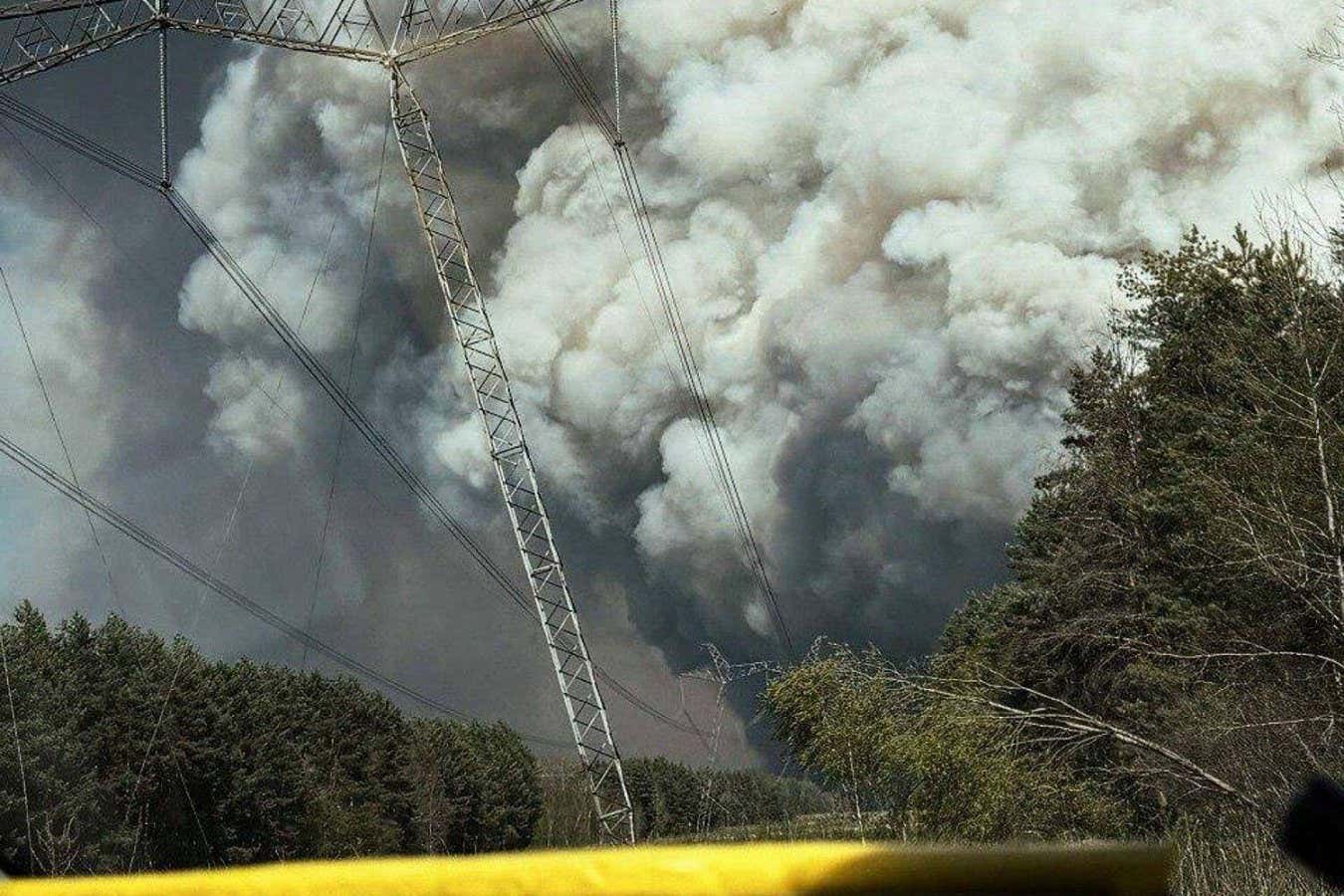
A forest fire is burning in the exclusion zone around the Chernobyl nuclear power plant in Ukraine
Associated Press / Alamy Stock Photo
A large forest fire is spreading through the Chernobyl exclusion zone after a drone struck the area yesterday. Though the fire is serious, those on the ground say the risk of radioactive contamination outside the area is minimal.
The Chornobyl Radiation and Ecological Biosphere Reserve (CREBR) wrote in a Telegram post that around 12 square kilometres of land, located to the south-east of the Ukrainian town of Chernobyl and the nuclear plant’s former cooling ponds, are burning due to a drone crash – but didn’t give details on the type or origin of the device. As of Friday afternoon, some 331 people and 75 pieces of equipment are involved in the emergency response.
“It’s really big. Guys who are working on [the] fire line are breathing air with high concentration of radionuclides,” says Denys Vyshnevskiy at the CREBR. “After the shift, they check concentration radionuclides in the body.”
Vyshnevskiy says that 5 to 10 kilometres from the fire, the radiation levels are normal, and there is little risk of contamination outside the exclusion zone.
Other estimates using satellite images seen by New Scientist suggest that the area of the fire has actually grown to 24.4 km².
Olena Burdo at the Institute for Nuclear Research in Kyiv, Ukraine, was near the site when the fire started, but saw only smoke because the affected area was closed to scientists at the time by the military. She also thinks there is very little risk of radioactive contamination outside the zone.
The State Emergency Service of Ukraine (SES) said in a Telegram post that tackling the fire is complicated by dry weather, strong winds and the presence of land mines. “The fire is rapidly spreading across the territory,” it wrote. Vyshnevskiy says the hope on the ground is that rain expected this evening will aid firefighters.
The SES said that some areas are too dangerous for firefighters to access because of land mines, so are being left temporarily while efforts are concentrated elsewhere.
The Chernobyl exclusion zone is frequently overflown by Russian drones en route to Kyiv and other targets within Ukraine. Last year, a Russian drone struck the New Safe Confinement shelter, which protects the highly radioactive remains of the 1986 disaster, blasting a hole all the way through its multi-layer construction.
Footage from that night shows fire and smoke billowing from a gaping hole – luckily, it was far enough towards the edge of the building that debris didn’t fall onto the fragile reactor or sarcophagus below, which could have caused collapse and stirred up dangerously radioactive material.
Topics: