

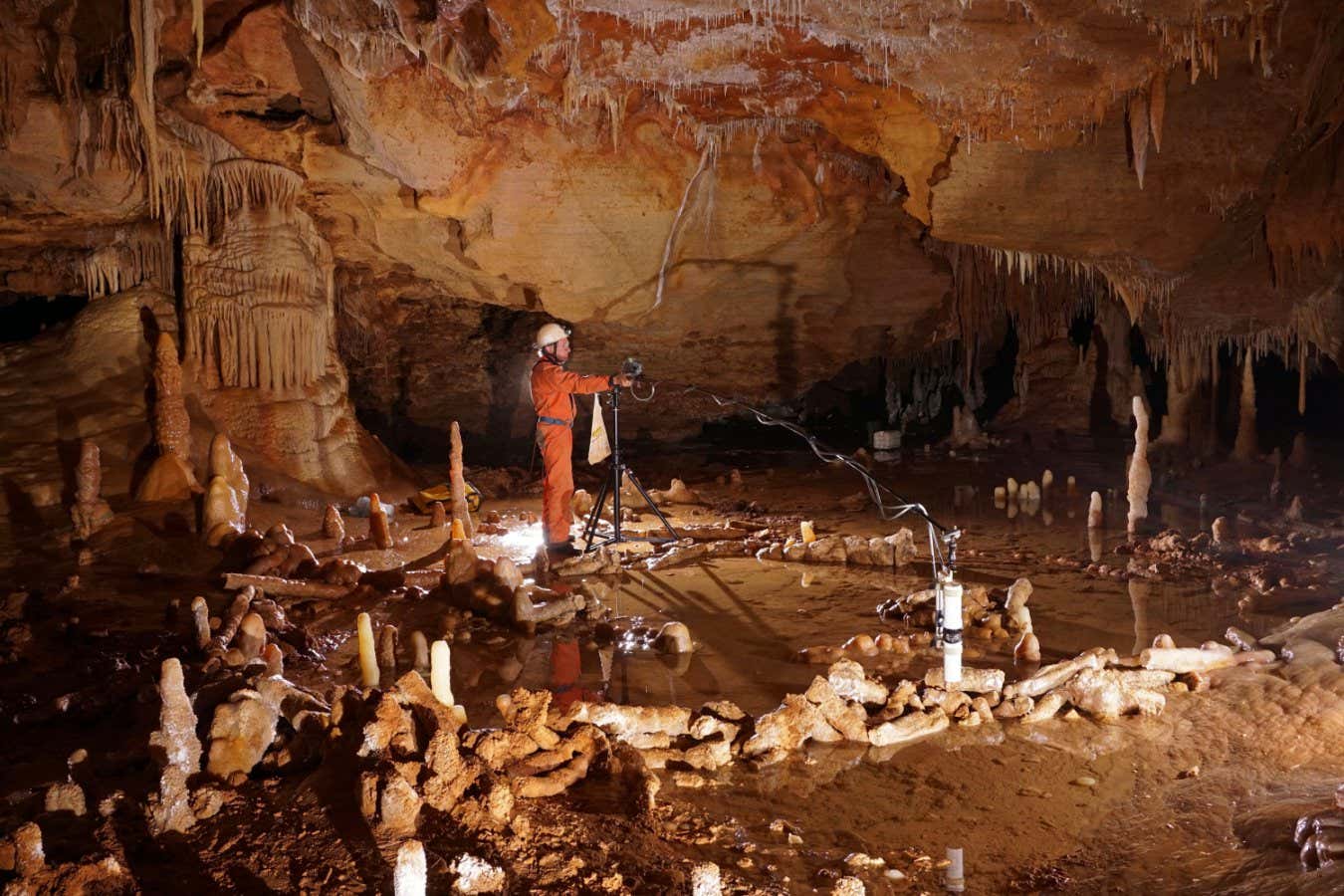
Bruniquel cave in France contains circular structures made of broken stalagmites
Etienne FABRE/SSAC
Around 175,000 years ago, Neanderthals ventured deep inside a cave in what is now France, broke off stalagmites and used them to build mysterious circular structures. Later on, bears moved in and obliterated almost all of the footprints and other traces they left on the cave floor – apart from an impression in clay that could be the kneeprint of a kneeling Neanderthal.
“It’s just a hypothesis,” says Sophie Verheyden at the Royal Belgian Institute of Natural Sciences. “To be sure of that, we need a lot of imprints of knees to compare it to.”
The stalagmite circles were discovered in the 1990s in Bruniquel cave, near Toulouse in south-west France, and described in a 2016 paper by a team including Verheyden.
While ancient human footprints are well known and well studied, ancient kneeprints have never been investigated before, as far as Verheyden is aware. To start doing this, she and her colleagues plan to ask people to kneel in a variety of clays to see what impressions are left.
There is no doubt that the cave impression is ancient, says Verheyden. It has been covered and preserved by a thin layer of calcium carbonate – the same material that formed the stalagmites. A bear specialist has also examined it and concluded it isn’t a bear print.
It might even be possible to find conclusive evidence in the form of Neanderthal DNA associated with the impression. Verheyden has just met with Mareike Stahlschmidt at the University of Vienna, Austria, who has shown that DNA can diffuse into calcite – a form of calcium carbonate – and be preserved by it. “For Bruniquel cave, I would say it is worth a shot,” says Stahlschmidt.
Forensic studies of kneeprints have shown that they can contain DNA from skin cells, hair or blood, she says. Normally, this degrades rapidly, but if the kneeprint in the cave was rapidly mineralised, some might have been preserved.
Since Homo sapiens wasn’t in Europe around 175,000 years ago, the people responsible for the stalagmite circles must have been Neanderthal. “We don’t know of any other humans present at that period,” says Verheyden.

A possible Neanderthal kneeprint in the Bruniquel cave, France
Sophie Verheyden
Earlier this year, her team reported that the entrance to the cave collapsed at least 140,000 years ago and remained closed until its rediscovery by cavers in 1990, so researchers are confident all the artefacts within it are Neanderthal in origin.
Some of the broken stalagmites are more than 20 centimetres thick at the base, Verheyden says, so they’re unlikely to have been snapped off by passing bears. What’s more, her team has recently been able to locate the bases of a handful of the broken-off stalagmites and date the breakage to around the same time that the stalagmite circles were built. Both the structures and the broken stalagmites were dated by measuring radioactive isotopes in the calcite growths that cover the rock in the caves.
“The age is a strong argument because it’s simultaneous with the construction of these structures,” says Verheyden, who presented her findings on 4 May at a meeting of the European Geosciences Union in Vienna.
So it appears that Neanderthals went to much effort to break off the stalagmites and then use them to build the circles, the largest of which is around 7 metres in diameter. The obvious explanation is that they were the base of shelters – except that they are found more than 300 metres into the cave, where it is pitch black.
“You need to be sure of your light when you go 300 meters underground,” says Verheyden. Traces of fire suggest the circles were lit, but it still seems unlikely that Neanderthals lived there day to day.
The location of the circles has led to speculation that their purpose was cultural or religious, rather than practical. “It’s very attractive to directly go for this explanation, but as a scientist, of course, you look for objective arguments,” Verheyden says.
Her team is developing ways to “fingerprint” the stalagmites based on their mineral composition, so they can see where in the cave the broken ones came from and if, for instance, stalagmites were brought from distant parts of the cave – or even other caves – to create the circles.
For example, it is known that some Mayan peoples collected stalagmites from deep within caves for use in fertility amulets, says Verheyden, rather than simply collecting those near the entrances. So being able to pinpoint the source of the broken stalagmites could reveal clues to the builders’ intentions.
The team is always trying to find ways to look through the layers of calcium carbonate covering parts of the floor. There could be a lot of Neanderthal footprints and impressions that were filled with calcium carbonate before the bears took over the cave.
“We have a lot of hope,” says Verheyden. “Every time we go in the cave, we discover new stuff, even after 10 years.”
New Scientist regularly reports on the many amazing sites worldwide, that have changed the way we think about the dawn of species and civilisations. Why not visit them yourself? Topics:
Discovery Tours: Archaeology, human origins and palaeontology