

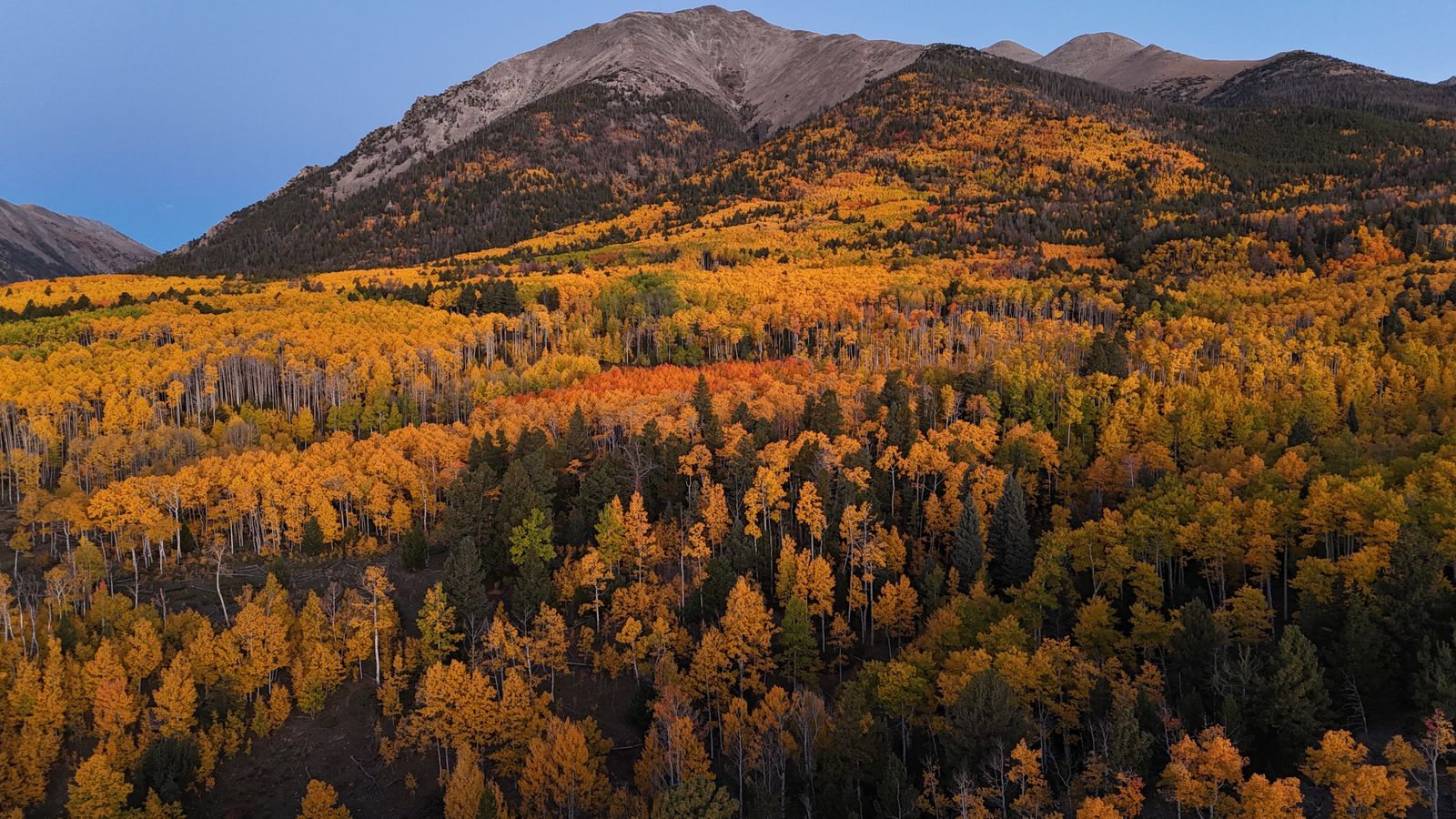
In a corner of Utah’s Fishlake National Forest, a single quaking aspen has been quietly cloning itself since roughly the end of the last Ice Age. Its name is Pando — Latin for “I spread” — and it covers 106 acres, weighs around 6,000 tonnes, and pushes up tens of thousands of genetically identical stems from one continuous root system. By dry weight, it is the largest known single organism on Earth. And on any given summer evening, mule deer are eating it to death.
The trees you can see above ground are, in a sense, a false advertisement. Each trunk looks like an individual aspen, pale bark, coin-shaped leaves clattering in the wind. Underneath, they are all one plant, connected by a subterranean web of roots that has been pushing up new shoots — called ramets — for somewhere between 9,000 and 14,000 years.
One seed, 14,000 years ago
Pando began as a single seed the size of a pinhead. That seed germinated into a male aspen — Pando is dioecious and entirely male — and instead of relying on pollen and offspring to spread, it began sending out lateral roots that pushed new stems to the surface. Every trunk you see is genetically identical to that first seedling.
Age estimates vary because you cannot core Pando like a normal tree. The mature stems currently standing are only between 110 and 130 years old, according to ecologist Paul Rogers, who has spent years studying the clone. The root system is the ancient part. Conservative estimates put it at 9,000 years. Others stretch to 14,000, which would mean Pando was already alive when the first humans in North America were painting on cave walls in what is now New Mexico.
For scale: the bristlecone pine Methuselah in California, often called the world’s oldest non-clonal tree, is estimated to be around 4,800 years old. Pando may be more than three times older.
The math of a 6,000-tonne plant
The physical numbers are almost hard to picture. 106 acres is about 80 American football fields. 6,000 tonnes is roughly the weight of 40 blue whales, or a small naval destroyer. Tens of thousands of stems, each looking like its own tree, all drawing water and sugar through a shared root network that scientists have confirmed through genetic sampling.
What makes a clonal colony a single organism, biologically? The definition rests on genetic identity and physical connection. Every stem in Pando carries the same DNA. Every stem is, at least in principle, joined to the others underground. Sever a root and the stems it feeds may keep growing for a while, but they were part of the same plant for millennia. That is a stricter test than most fungal networks meet, and Pando passes it.
Some aspen clones are capable of especially vigorous vegetative growth, which may help explain how one seedling managed to spread across a hillside the size of a small town.
Why one plant, and not just a forest
Aspens do this everywhere they grow. Across the American West, most aspen stands you walk through are clones — smaller, younger versions of what Pando is. The species evolved to spread laterally through roots because seedlings struggle in dry, competitive soils. Sending up a new stem from an existing root system is faster and cheaper than starting from a seed.
Aspens also fill a niche that supports enormous biodiversity. Aspen species are found across the northern hemisphere, from British Columbia to Karelia to Kamchatka, and the groves they form host hundreds of dependent species — songbirds, insects, understory plants, fungi. Where aspens fail, those communities collapse with them.
Pando is the extreme end of the aspen strategy. Given the right hydrology, the right soils, and a long enough run of favorable climate, one seedling can become a hillside. Then a forest. Then, over ten thousand years, something for which we do not really have a good vocabulary.
The mule deer problem
Pando is dying by attrition, and the mechanism is depressingly simple. Every spring, the root system pushes up thousands of young shoots. Every summer, mule deer and cattle eat almost all of them before they can grow above browse height.
What is left is a demographically broken forest. Mature stems are aging out — reaching the end of their natural lifespan — and dying. There is no next generation waiting to replace them. Rogers and his co-authors describe the grove as a faltering senior generation standing over an empty nursery. Photographs of Pando taken over the past several decades show a canopy thinning out, with open gaps widening where trunks have fallen and nothing has grown up to take their place.
The deer are not the original cause. Humans are. Wolves and cougars, which once kept mule deer populations in check across the Wasatch Plateau, were largely eliminated from the region a century ago. Hunting pressure on deer has been managed for recreation, not for aspen regeneration. And Fishlake, with its meadows and roads and campgrounds, is exactly the kind of edge habitat mule deer prefer.
Fencing has helped where it has been tried. Sections of Pando enclosed by tall deer fencing in the 2010s have shown vigorous regrowth — thickets of young stems reaching well above browse height. Unfenced sections next to them look almost bare of new growth. The clone can still reproduce. It just cannot do so while surrounded by hungry ungulates.
Climate, drought, and the pressure from above
The mule deer are the immediate cause of death. The longer-term pressure is climatic. Quaking aspens depend on reliable snowpack and cool, wet springs to fuel their root systems. Utah has been running short of both. Below-average snowpack and elevated wildfire risk have become increasingly common, and major fires have burned through central Utah forests in recent years.
The Cottonwood fire charred large areas of central Utah forest relatively close to Pando. Fire itself is not necessarily bad for aspens; they resprout vigorously from roots after burns, and in some ecosystems fire is what gives aspens the disturbed ground they need. But drought stress weakens the parent root system, and warm, dry summers accelerate the death of mature stems that were already at the end of their life.
A grove that has ridden out 14,000 years of climate change — the end of the Younger Dryas, the warm Holocene Optimum, the Little Ice Age — is now facing a combination of pressures its evolutionary strategy did not budget for.
What counts as a single organism, anyway
Pando is often listed as the largest and heaviest known organism on Earth, but the “oldest” claim gets more contested. In Tasmania, a shrub called King’s Lomatia has been reproducing clonally for at least 43,600 years, based on fossil leaf evidence found near the extant population. Ancient seagrass meadows and large honey fungus colonies also compete for the title of oldest or largest living organism.
Which of these is “one organism” depends on how strict you are about physical continuity. A separated fungal network probably still counts. A shrub whose original stem died 40,000 years ago but whose clones persist is trickier. Pando has the advantage of clear physical connectivity — the root system has been continuously alive, without any known break, since it started spreading. The tissue you would touch if you dug down beneath a young stem today is descended, without interruption, from that first seed.
A 20-year cloning experiment in Arabidopsis plants suggested there may be a biological wall to endless cloning — mutations accumulate, epigenetic marks drift, and eventually the copies degrade. Pando, if the higher age estimates are right, has apparently pushed past that wall for millennia. How, exactly, is one of the open questions in plant biology. The root system’s ability to selectively suppress or promote certain stems may act as a kind of quality control.
Whether plants “age” in the way animals do is itself a live scientific debate — Science Blog has looked at the strange biology of plant senescence and why organisms like Pando complicate any tidy definition.
Fences, wolves, and what saving Pando would actually take
The U.S. Forest Service, working with researchers from Utah State University’s Western Aspen Alliance and the nonprofit Friends of Pando, has been fencing sections of the clone and monitoring regeneration. Where the fences hold, young stems shoot up in dense thickets — visible proof that the root system is still capable of producing a next generation. Where fences fail or were never built, the browse line stays as flat as a mown lawn.
Fencing 106 acres is not cheap, and fences fail. Deer find gaps. Cattle push them over. A more durable fix would involve reducing mule deer populations to something closer to pre-settlement levels — which in practice means either more hunting pressure or the return of predators the region has spent a century keeping out. Both are politically fraught in a way that a slow-motion ecological collapse tends to be.
Science Blog has covered the ongoing conservation work at Pando in detail, and the pattern researchers keep returning to is that Pando is fixable — if humans are willing to change the herbivore pressure on it. It is not dying of old age, or drought alone, or any inevitability. It is dying because tens of thousands of tiny meals are more attractive to a mule deer than a stand of sagebrush.
Walking through one plant
You can visit Pando. It sits along Utah State Route 25 on the western shore of Fish Lake, about a three-and-a-half-hour drive from Salt Lake City. There is a small interpretive trail. Most visitors, standing among the pale trunks and listening to the leaves rattle, do not realize they are inside a single organism. The signage helps, but the scale defeats intuition. You cannot really see a 106-acre plant from inside it, the same way you cannot see the shape of a city from a sidewalk.
What you can see, if you look carefully in late summer, is the absence. Between the mature trunks, the ground should be crowded with young shoots — waist-high, chest-high, head-high stems racing to become the next canopy. In most of Pando, that middle generation is missing. Just old trunks, and grass, and hoofprints.
A seedling that germinated when mammoths still walked North America has been pushing up new versions of itself, year after year, for the entire history of human agriculture. It survived the warming that ended the Ice Age. It survived the Medieval droughts that toppled the Ancestral Puebloans. It is, for now, still surviving. The stems standing today will be gone in a few decades. Whether the root beneath them gets to try again depends almost entirely on what happens to the deer.