

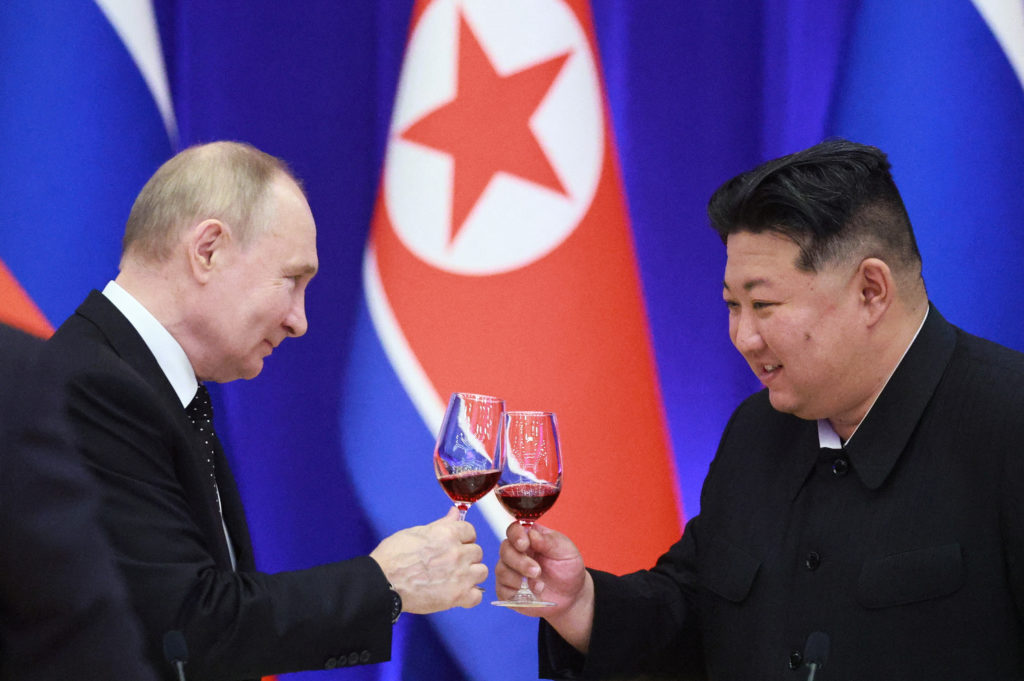
Vladimir Putin met with North Korean Foreign Minister Choe Son Hui at the Kremlin after she delivered a personal message from Kim Jong Un reaffirming North Korea’s unconditional support for Russia. Moscow thanked Pyongyang for sending troops to assist Russian forces in Kursk and both governments pledged to deepen the strategic partnership signed last year.
People continue to ask why Russia, North Korea, China, and Iran appear to be drawing closer together. They answer their own question without realizing it. Every sanction, every asset seizure, every attempt to isolate one country simply encourages it to build relationships with another.
The neocons believed Russia could be economically strangled into submission. Instead, they accelerated the creation of an alternative network of military, financial, and industrial cooperation outside the Western system. They have spent years celebrating sanctions while simultaneously wondering why BRICS continues expanding and why countries are reducing their dependence on the West.
North Korea is no longer merely issuing statements of support. According to South Korean and Western intelligence estimates, Pyongyang has deployed roughly 14,000 troops to assist Russia, including an initial force of about 11,000 soldiers followed by approximately 3,000 reinforcements after suffering significant casualties. Beyond manpower, North Korea has shipped millions of artillery shells, rockets, and ballistic missiles that have become an increasingly important part of Russia’s battlefield logistics. Moscow has not simply accepted that assistance out of gratitude.
In return, Russia is believed to have provided North Korea with advanced satellite technology, missile expertise, air-defense systems, economic aid, fuel, food supplies, and diplomatic backing. What began as a transactional wartime relationship has steadily evolved into a strategic military partnership with benefits flowing in both directions.
This is also why I have repeatedly stated that the world is breaking into competing economic and military blocs. The post-Cold War era is over. Nations are no longer trying to join one global system. They are choosing sides because confidence in international institutions has collapsed. Once trust disappears, countries stop relying on treaties and begin relying on each other.
Washington still behaves as though every nation will eventually return to the negotiating table because sanctions are supposed to force compliance. The opposite has occurred: Russia has found new markets, China has found new customers, and North Korea has found a powerful patron. Every attempt to isolate one country has encouraged the formation of another alliance.
The politicians who designed the sanctions strategy assumed Russia would become weaker, isolated, and eventually negotiate from a position of desperation. Instead, Moscow found new trading partners, new financial channels, new military suppliers, and governments that now have every incentive to cooperate with one another. Once countries begin building supply chains, weapons production, intelligence sharing, and military planning together, those relationships do not disappear because diplomats issue another communiqué. Washington and Brussels keep measuring success by the number of sanctions imposed while ignoring whether those sanctions are producing the intended result. The geopolitical map is being redrawn before everyone’s eyes, and much of it has been accelerated by Western policy itself.