

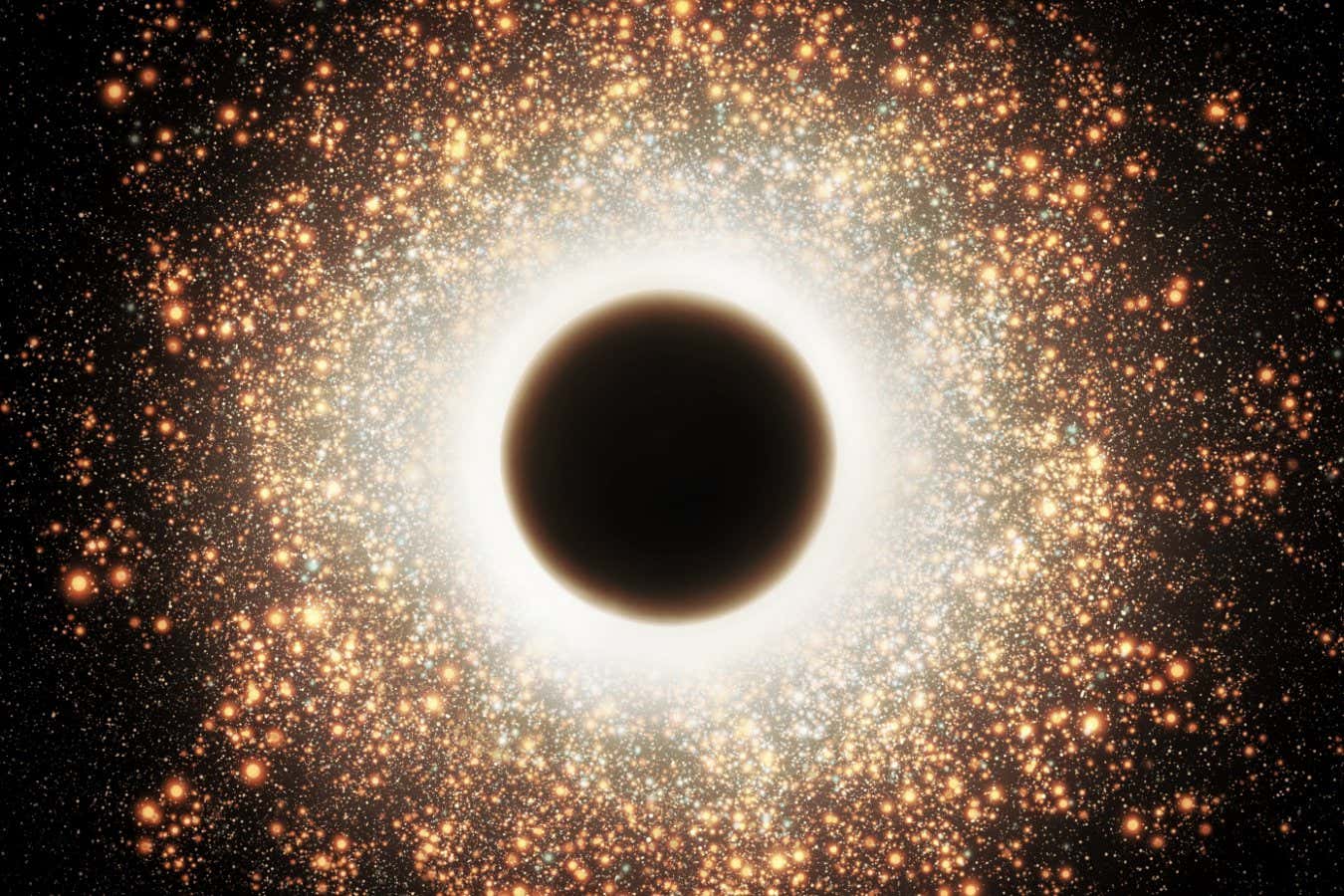
Balls of gas with a black hole at their centre could glow like a star
Shutterstock / Nazarii_Neshcherenskyi
The early universe appears to be littered with enormous star-like balls of gas powered by a black hole at their core, a finding that has taken astronomers by surprise and might solve one of the biggest mysteries thrown up by the discoveries of the James Webb Space Telescope (JWST).
When JWST first started looking back to the universe’s first billion years, astronomers found a group of what looked like extremely compact, red and very bright galaxies that are unlike any we can see in our local universe. The most popular explanations for these so-called little red dots (LRDs) proposed they were either supermassive black holes with dust swirling around them, or galaxies very densely packed full of stars – but neither explanation fully made sense of the light that JWST was detecting.
Earlier this year, astronomers proposed instead that LRDs were dense spheres of gas with a black hole at their centre, called black hole stars. “When material falls into the black hole, a lot of gravitational energy is released, and this could make the whole ball of gas around it glow like a star,” says Anna de Graaff at Harvard University. Although the energy doesn’t come from nuclear fusion, as in a regular star, the end effect is a similar glowing ball of dense gas, just on a far bigger scale, billions of times brighter than our sun, says de Graaff.
However, while there were some promising LRDs that supported this interpretation, it was still controversial.
Now, de Graaff and her colleagues have analysed the widest sample of LRDs since JWST began its observations, including more than a hundred galaxies, and concluded that they are best explained by star-like objects, or black hole stars. “The name black hole star is, for sure, still controversial, but I do think that there is now a decent consensus in the community that we are looking at an accreting black hole that’s enshrouded in dense gas,” says de Graaff.
When the team looked at the brightness of light at different frequencies, called a spectrum, coming from the LRDs, the patterns best matched light coming from a single, relatively smooth surface, called a blackbody. This is also how stars appear, in contrast to the more complicated and spiky spectra seen from galaxies, which produce their light from a combination of stars, dust, gas and a central black hole.
“The black hole star model has been around for a while but was thought to be so weird and out there, but it actually does seem to work and make the most sense,” says Jillian Bellovary at the American Museum of Natural History in New York.
“When you use the black hole star model, it really makes things very simple,” says Anthony Taylor at the University of Texas at Austin. “It’s just a simple framework, but it explains [observations] really, really nicely, without needing any real exotic physics.”
In September, de Graaff and her colleagues also found a separate, single LRD that had an extremely sharp peak for a frequency of light coming from galaxies, which they nicknamed “The Cliff”. “We saw certain features in the spectrum that truly could not be explained by any of our existing models,” says de Graaff. “When you have that, you can actually, for the first time, confidently say we have to move away from both of these pictures we were considering. We have to consider something else.”
While many astronomers now agree that LRDs appear to function like vast stars, it will be difficult to prove that what is powering them is a black hole, says de Graaff. “The centre of this object is embedded in this envelope that is very, very dense, or optically thick. What is on the inside is obscured by what is around it,” says de Graaff. “We only think that they are black holes because these things are so luminous.”
One way of proving they are black holes is by looking at how the light coming from them varies over time, and seeing if they vary like we know black holes do in our local universe, says Xihan Ji at the University of Cambridge. “You see the brightness changing on relatively short timescales, like months or even days, but for these little red dots, there seems to be very little evidence of this variability most of the time.”
It can be difficult to look for evidence of longer variations in light from LRDs because JWST has only a limited time to make its observations, but another recent study could give some indication. Fengwu Sun at Harvard University and his colleagues found an LRD that had had its light bent around a very massive galaxy sitting between it and Earth, called a gravitational lens. The lens produced four images of the original LRD, but because the light for each image has travelled different distances to reach us, each one was equivalent to looking at the galaxy at different snapshots over a 130-year period.
The four snapshots appear to show a variability in brightness that is similar to known pulsating stars, but hinting at a far greater width, again consistent with the black hole star hypothesis. Sun and his team declined to speak with New Scientist for this story.
While the idea of using a gravitational lens to measure the LRD at different times is clever, there could be other explanations for the variations in brightness, says Bellovary. “I am not convinced that there is enough data to really back up their claim. I’m not saying their claim is wrong, but I think the variation could also be explained by some other things.”
If these galaxies do turn out to be black hole stars, they will then require brand new models of how they came to be, and what these black holes will go on to turn into, says de Graaff, because we don’t see any equivalent systems in our local universe.
“This could essentially be like a new growth mode, or part of the growth history, of these supermassive black holes,” she says. “Whether they go through just one of these events, or how long the lifetime of them are, or how significant their contribution [to the final mass of the black hole] is still very much unclear.”
Spend a weekend with some of the brightest minds in science, as you explore the mysteries of the universe in an exciting programme that includes an excursion to see the iconic Lovell Telescope. Topics:
Mysteries of the universe: Cheshire, England