

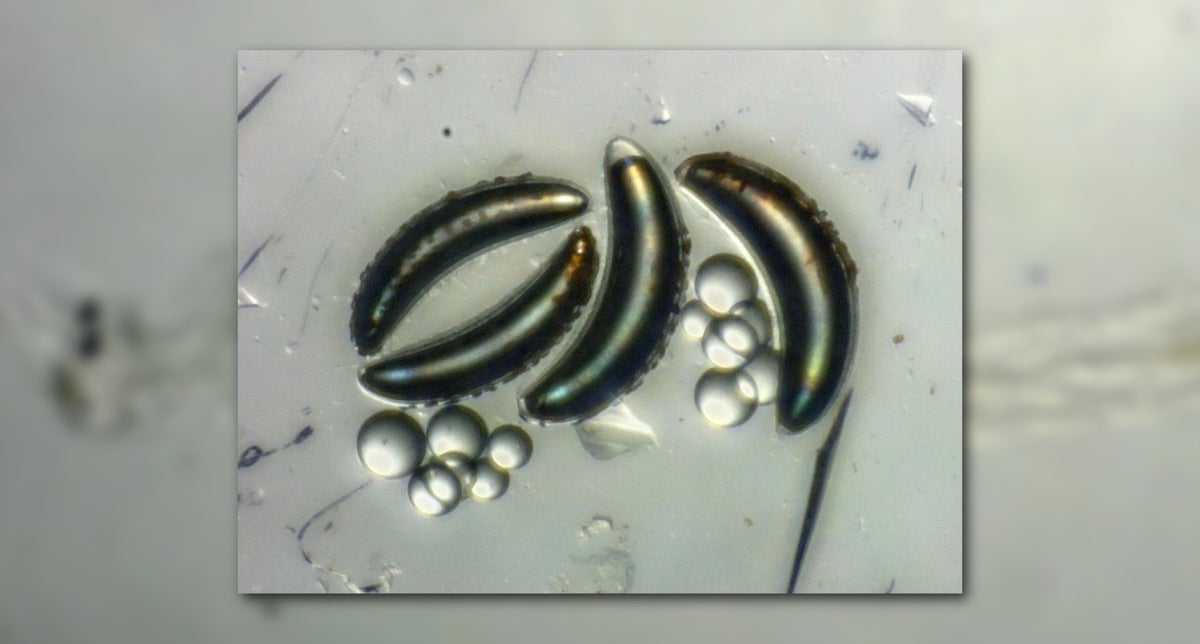
Insects are everywhere: from fruit flies to ants to bees to cockroaches, they are seemingly inescapable. But there is one place on Earth where insects are nowhere to be found: the ocean. Incredibly, no one knows why that is—but a new study offers some clues.
The paper eliminates a popular theory as to why insects can’t live in oceans—namely that their respiratory systems would implode under deep-sea pressure. Researchers found that the larvae of the lake fly Chaoborus edulis can dive some 250 meters below the surface of Lake Malawi to avoid predatory fish. The feat is far “beyond what we thought they were capable of,” says Philip Matthews, a co-author on the paper and an associate professor of zoology at the University of British Columbia.
Matthews’s team used a sonar system to determine the insects’ location in the lake’s waters. The researchers found that the larvae stay near the surface at night and dive to depths of up to 258 meters during the day to avoid fish.
On supporting science journalism
If you’re enjoying this article, consider supporting our award-winning journalism by subscribing. By purchasing a subscription you are helping to ensure the future of impactful stories about the discoveries and ideas shaping our world today.
After collecting data about the lake flies’ routine, the researchers brought some of the larvae to their lab, where they found that resilin, the protein that makes up the insects’ respiratory organ, contracts and expands in response to pressure. Unlike resilin in other insects, for which the protein typically acts as a passive energy storage system or exoskeleton protection, the resilin in these lake flies plays an active role in ensuring their air sacs don’t implode at depth.
This species of insect larvae dives deep underwater to avoid predatory fish during the day, then resurfaces to feed at night.
University of British Columbia
The paper is “beautiful,” says Natasha Mhatre, an associate professor of biology at the University of Western Ontario.
“It’s talking about biochemistry and how that biochemistry affects mechanics of the swim bladder and how, then, the mechanics of the swim bladder affect the ecology,” she says. “Connecting all of these different levels is what’s so sweet about this paper.”
Unfortunately, the study still leaves researchers wondering why no insects live in the ocean more permanently.
“This idea that it was going to be an insurmountable barrier for an insect to take the respiratory system to depth—we’ve now shown that that is not the case,” Matthews says. “So that kind of leaves this question open as to what’s keeping them out of the oceanic environment.”
It’s Time to Stand Up for Science
If you enjoyed this article, I’d like to ask for your support. Scientific American has served as an advocate for science and industry for 180 years, and right now may be the most critical moment in that two-century history.
I’ve been a Scientific American subscriber since I was 12 years old, and it helped shape the way I look at the world. SciAm always educates and delights me, and inspires a sense of awe for our vast, beautiful universe. I hope it does that for you, too.
If you subscribe to Scientific American, you help ensure that our coverage is centered on meaningful research and discovery; that we have the resources to report on the decisions that threaten labs across the U.S.; and that we support both budding and working scientists at a time when the value of science itself too often goes unrecognized.
In return, you get essential news, captivating podcasts, brilliant infographics, can’t-miss newsletters, must-watch videos, challenging games, and the science world’s best writing and reporting. You can even gift someone a subscription.
There has never been a more important time for us to stand up and show why science matters. I hope you’ll support us in that mission.