
Close Menu
    Trending
    • Astros star Carlos Correa suffers ‘serious’ injury
    • The Pentagon wants lasers. Can anyone build them fast enough?
    • Tiny frozen world unexpectedly appears to have an atmosphere
    • Indiana’s Immigration Crackdown | Armstrong Economics
    • Simon Cowell Reveals Struggle After Liam Payne Death
    • Evacuations ‘ongoing’ from hantavirus-hit cruise ship
    • Colombia tourist jewel plagued by violence | In Pictures News
    • Russini may still have an ace up her sleeve in Vrabel saga
    Benjamin Franklin Institute
    Wednesday, May 6
    • Home
    • Politics
    • Business
    • Science
    • Technology
    • Arts & Entertainment
    • International
    Benjamin Franklin Institute
    Home»Science»Tiny frozen world unexpectedly appears to have an atmosphere
    Science

    Tiny frozen world unexpectedly appears to have an atmosphere

    Team_Benjamin Franklin InstituteBy Team_Benjamin Franklin InstituteMay 6, 2026No Comments3 Mins Read
    Share Facebook Twitter Pinterest Copy Link LinkedIn Tumblr Email VKontakte Telegram
    Share
    Facebook Twitter Pinterest Email Copy Link


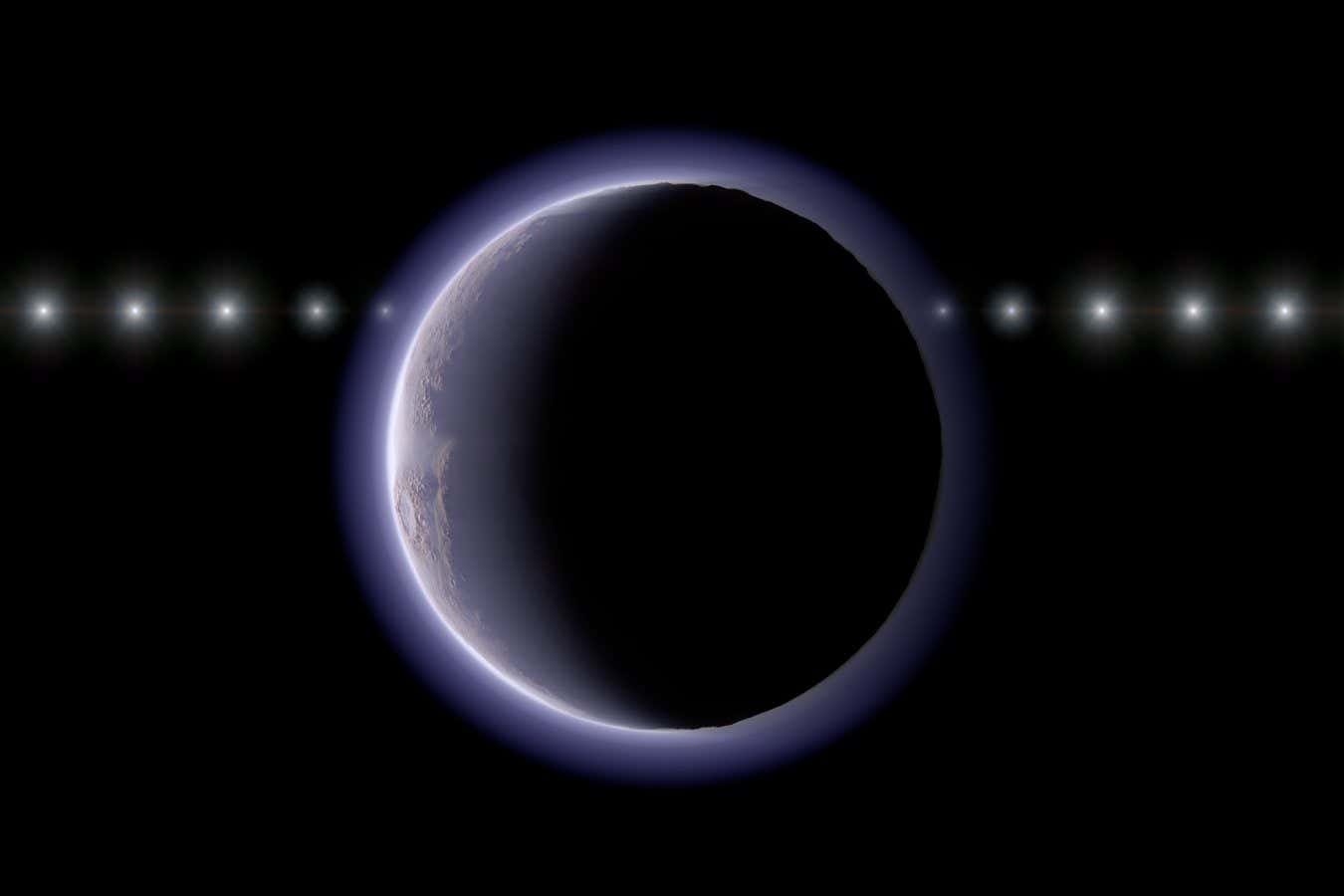
    Artist’s impression of the trans-Neptunian object (612533) 2002 XV93 blocking the light from a distant star

    NAOJ/Ko Arimatsu

    A small icy body as far away as Pluto has stunned scientists with the revelation that it has an atmosphere.

    The object, located in the Kuiper Belt of distant frozen bodies at the edge of the solar system, is formally named (612533) 2002 XV93, after the date of its discovery nearly a quarter of a century ago. It has a diameter of less than 500 kilometres.

    The object also belongs to a class of objects known as plutinos because they are in the same stable orbit as Pluto, completing three revolutions around the sun for every two made by Neptune.

    On 10 January 2024, 2002 XV93 passed in front of a distant star, causing what is called an occultation. Ko Arimatsu at Kyoto University and his colleagues observed this event from three locations in Japan.

    If the body had no atmosphere, the star’s light would have disappeared and reappeared almost instantaneously when it went behind 2002 XV93.

    But instead, the team saw the star gradually fade and recover over about 1.5 seconds near the edge of the shadow.

    “These gradual changes are best explained if the star’s light was bent by a very thin atmosphere around 2002 XV93,” says Arimatsu.

    The team estimates a surface pressure of about 100 to 200 nanobars, roughly 5 million to 10 million times thinner than Earth’s atmosphere and about 50 to 100 times thinner than Pluto’s tenuous atmosphere.

    “You could not breathe it, feel wind from it, or see anything like Earth’s sky,” says Arimatsu. “But it is not negligible scientifically because even such a thin atmosphere can measurably bend starlight, and it tells us that volatile gases are present or being supplied around a very small icy body.”

    The team couldn’t determine the composition of the atmosphere directly from the data. Arimatsu suggests methane, nitrogen and carbon monoxide are the most plausible candidates because they are among the few substances volatile enough to become gases at the very low temperatures of the outer solar system.

    Another mystery is what has caused the atmosphere to form, with possibilities including volcanic activity, outgassing from the interior of 2002 XV93 or even a cosmic collision.

    “This discovery challenges our conventional view of small worlds in the outer solar system,” says Arimatsu. “Until now, clearly detectable atmospheres in the solar system were essentially associated with planets, dwarf planets and some large satellites. 2002 XV93 appears to be one of the smallest solar system bodies yet with a clearly detected atmosphere.”

    “There is an atmosphere, and we don’t understand why,” says Ben Montet at the University of New South Wales in Sydney, Australia.

    “If you’re standing on the surface of this object, you’re not going to see a sky like [what] we have. But it certainly challenges the assumption that even a thin, transient atmosphere can’t exist on a body this small.”

    Jodrell Bank with Lovell telescope

    Mysteries of the universe: Cheshire, England

    Spend a weekend with some of the brightest minds in science, as you explore the mysteries of the universe in an exciting programme that includes an excursion to see the iconic Lovell Telescope.

    Topics:


    Source link

    Share. Facebook Twitter Pinterest LinkedIn Tumblr Email Telegram Copy Link

    Related Posts

    Science

    A lost ancient script reveals how writing as we know it really began

    May 6, 2026
    Science

    Extinct relative of koalas discovered in Western Australia

    May 6, 2026
    Science

    Hantavirus: Where has the deadly cruise ship outbreak come from?

    May 6, 2026
    Science

    Mythos: Backlash builds over NHS plan to hide source code from AI hacking risk

    May 5, 2026
    Science

    The 50-year quest to create a quantum spin liquid may finally be over

    May 5, 2026
    Science

    Woman in cancer remission without treatment in highly unusual case

    May 5, 2026
    Editors Picks

    Pete Davidson’s Relationship Tested After Baby Arrival

    May 1, 2026

    Jennifer Garner Breaks Silence On Plastic Surgery Rumors

    February 27, 2026

    US sanctions Mexican banks, alleging connections to cartel money laundering | Crime News

    June 26, 2025

    Market Talk – February 11, 2026

    February 11, 2026

    Iran rejects UN rights resolution condemning protest killings | Protests News

    January 24, 2026
    About Us
    About Us

    Welcome to Benjamin Franklin Institute, your premier destination for insightful, engaging, and diverse Political News and Opinions.

    The Benjamin Franklin Institute supports free speech, the U.S. Constitution and political candidates and organizations that promote and protect both of these important features of the American Experiment.

    We are passionate about delivering high-quality, accurate, and engaging content that resonates with our readers. Sign up for our text alerts and email newsletter to stay informed.

    Latest Posts

    Astros star Carlos Correa suffers ‘serious’ injury

    May 6, 2026

    The Pentagon wants lasers. Can anyone build them fast enough?

    May 6, 2026

    Tiny frozen world unexpectedly appears to have an atmosphere

    May 6, 2026

    Subscribe for Updates

    Stay informed by signing up for our free news alerts.

    Paid for by the Benjamin Franklin Institute. Not authorized by any candidate or candidate’s committee.
    • Privacy Policy
    • About us
    • Contact us

    Type above and press Enter to search. Press Esc to cancel.