
Close Menu
    Trending
    • Inside The Drunken Night That Sparked Row Among Spice Girls
    • US Senate candidate’s implosion forces Democratic reckoning
    • Is Syria stable enough to engage with the world? | Syria’s War News
    • Must-draft players in new Yahoo College Fantasy Football leagues
    • Here’s What It Really Takes to Support Other Entrepreneurs
    • Resuscitated human retinas respond to light 10 hours after death
    • Map: 3.5-Magnitude Earthquake Shakes Central California
    • Ukraine & Zelensky’s Ultimate Corruption
    Benjamin Franklin Institute
    Thursday, July 9
    • Home
    • Politics
    • Business
    • Science
    • Technology
    • Arts & Entertainment
    • International
    Benjamin Franklin Institute
    Home»Science»The mystery of nuclear ‘magic numbers’ has finally been resolved
    Science

    The mystery of nuclear ‘magic numbers’ has finally been resolved

    Team_Benjamin Franklin InstituteBy Team_Benjamin Franklin InstituteFebruary 16, 2026No Comments3 Mins Read
    Share Facebook Twitter Pinterest Copy Link LinkedIn Tumblr Email VKontakte Telegram
    Share
    Facebook Twitter Pinterest Email Copy Link


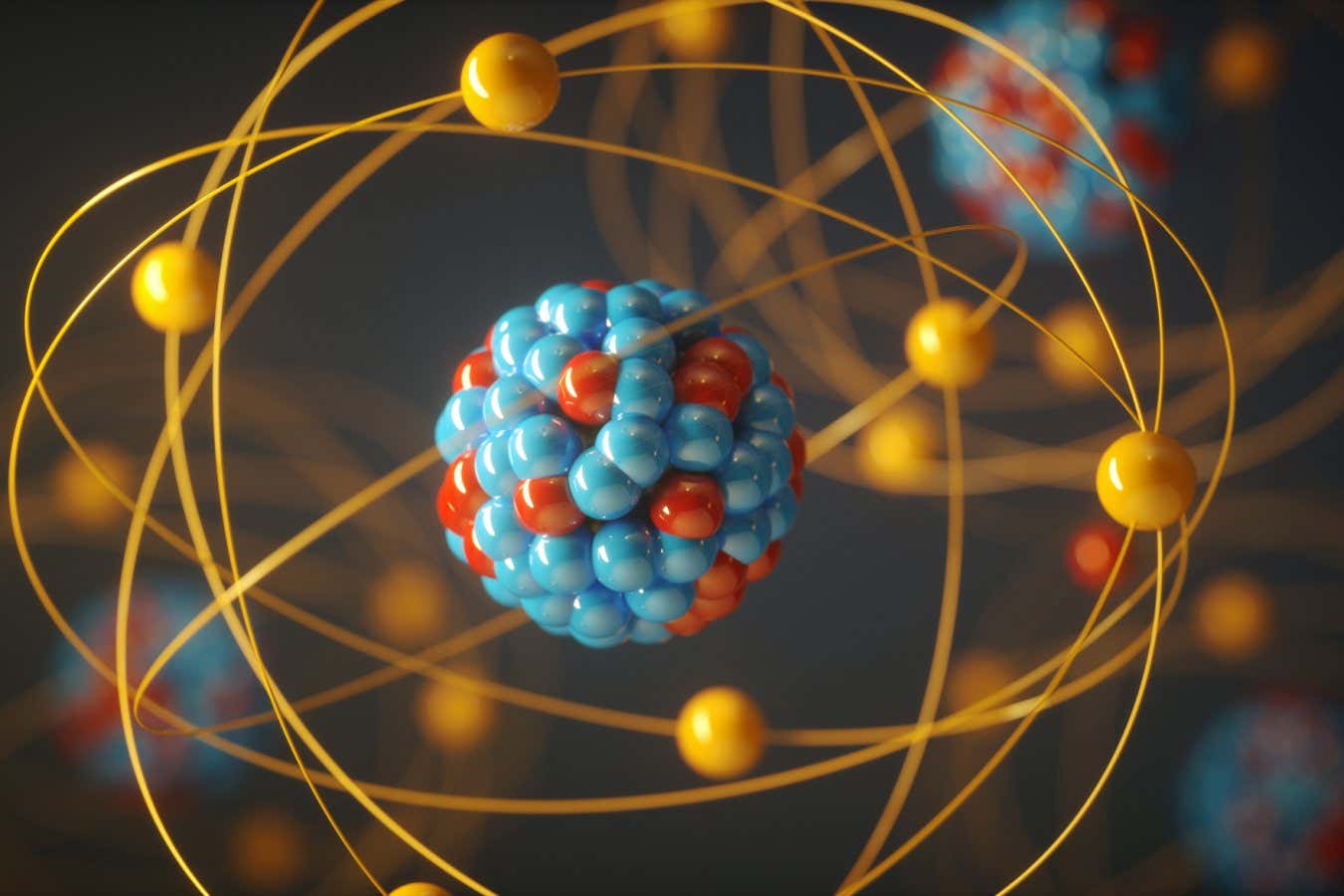
    Some atoms seem to be particularly stable because of their numbers of protons and neutrons

    Shutterstock/ktsdesign

    A special set of numbers has formed the backbone of nuclear physics research for decades, and now we finally know how it arises from the quantum mix of nuclear particles and forces.

    Nearly 80 years ago, physicist Maria Goeppert Mayer showed that when the nucleus of an atom contains certain numbers of protons and neutrons, such as 50 or 82, it becomes exceptionally stable. In the years since, researchers amassed evidence of more such “magic numbers”, which are found in the most stable, and therefore most abundant, elements in our universe.

    Goeppert Mayer and her contemporaries explained these numbers by proposing that protons and neutrons occupy discrete energy levels, or shells. This model, which is still used to interpret many nuclear physics experiments, treats each particle in the nucleus as independent, but our best quantum theories assert that particles within nuclei actually interact strongly.

    Jiangming Yao at Sun Yat-sen University in China and his colleagues have now resolved this contradiction and, in the process, elucidated how magic numbers emerge from these interactions.

    Yao says the shell model relies on input from experiments and doesn’t encode details of interactions between each particle. Instead, he and his team started their calculations from first principles, which means they mathematically described how particles interact with each other, how they stick together and how much energy is needed to move them apart in more detail.

    The two descriptions are analogous to images taken at low and high resolution, respectively, says Yao. “Before, people directly modelled the system at low resolution, or they tried to understand nuclear structure at high resolution. We used modern methods to build the bridge between these descriptions.”

    He and his colleagues started with the high-resolution description, gradually made it blurrier in each step of the calculation and tracked how the structure the particles formed changed.

    As they moved across their mathematical bridge, the researchers saw the symmetry of the particle’s quantum states change – drawing a graph based on the equations for these states would produce shapes with different symmetries at different resolutions. This change resulted in a nuclear structure that was at its most stable when particles grouped themselves in magic numbers.

    Jean-Paul Ebran at the French Alternative Energies and Atomic Energy Commission says this work offers a theoretical probe – a mathematical microscope of sorts – that mirrors how experiments work. “Nature looks different depending on the resolution at which you observe. This [study] really maps onto what we do experimentally.”

    The change in symmetry that the researchers identified is related to effects described by Albert Einstein’s theory of special relativity, thus painting an even fuller picture of how magic numbers marry together different facets of nuclear theory, says Ebran.

    So far, the researchers have tested their theoretical work on a type of tin that is doubly magic because its nuclei each contain 50 protons and 82 neutrons, as well as on several additional nuclei. Going forward, they want to extend their analysis to heavier atomic nuclei, which are typically unstable, and study processes by which heavy nuclei are created in exploding stars or merging neutron stars, says Yao.

    Topics:


    Source link

    Share. Facebook Twitter Pinterest LinkedIn Tumblr Email Telegram Copy Link

    Related Posts

    Science

    Resuscitated human retinas respond to light 10 hours after death

    July 9, 2026
    Science

    A worm that lived half a billion years ago preferred turning right

    July 9, 2026
    Science

    The 4 best science-fiction shows of 2026 so far

    July 9, 2026
    Science

    A surprisingly detailed look at the physics of a lugworm’s poop

    July 9, 2026
    Science

    The allergy culprit histamine also boosts our memory

    July 9, 2026
    Science

    Does time come from the entire universe running computations?

    July 9, 2026
    Editors Picks

    New Hugh Jackman Photo Triggers Fresh Fan Backlash

    June 12, 2026

    Supreme Leader says enriched uranium must stay in Iran, Iranian sources say

    May 21, 2026

    The hidden power of epigenetics: Best ideas of the century

    January 28, 2026

    Benin’s opposition loses all parliamentary seats, provisional results show | Elections News

    January 18, 2026

    Former referee sounds off on controversial Folarin Balogun red card

    July 3, 2026
    About Us
    About Us

    Welcome to Benjamin Franklin Institute, your premier destination for insightful, engaging, and diverse Political News and Opinions.

    The Benjamin Franklin Institute supports free speech, the U.S. Constitution and political candidates and organizations that promote and protect both of these important features of the American Experiment.

    We are passionate about delivering high-quality, accurate, and engaging content that resonates with our readers. Sign up for our text alerts and email newsletter to stay informed.

    Latest Posts

    Inside The Drunken Night That Sparked Row Among Spice Girls

    July 9, 2026

    US Senate candidate’s implosion forces Democratic reckoning

    July 9, 2026

    Is Syria stable enough to engage with the world? | Syria’s War News

    July 9, 2026

    Subscribe for Updates

    Stay informed by signing up for our free news alerts.

    Paid for by the Benjamin Franklin Institute. Not authorized by any candidate or candidate’s committee.
    • Privacy Policy
    • About us
    • Contact us

    Type above and press Enter to search. Press Esc to cancel.