

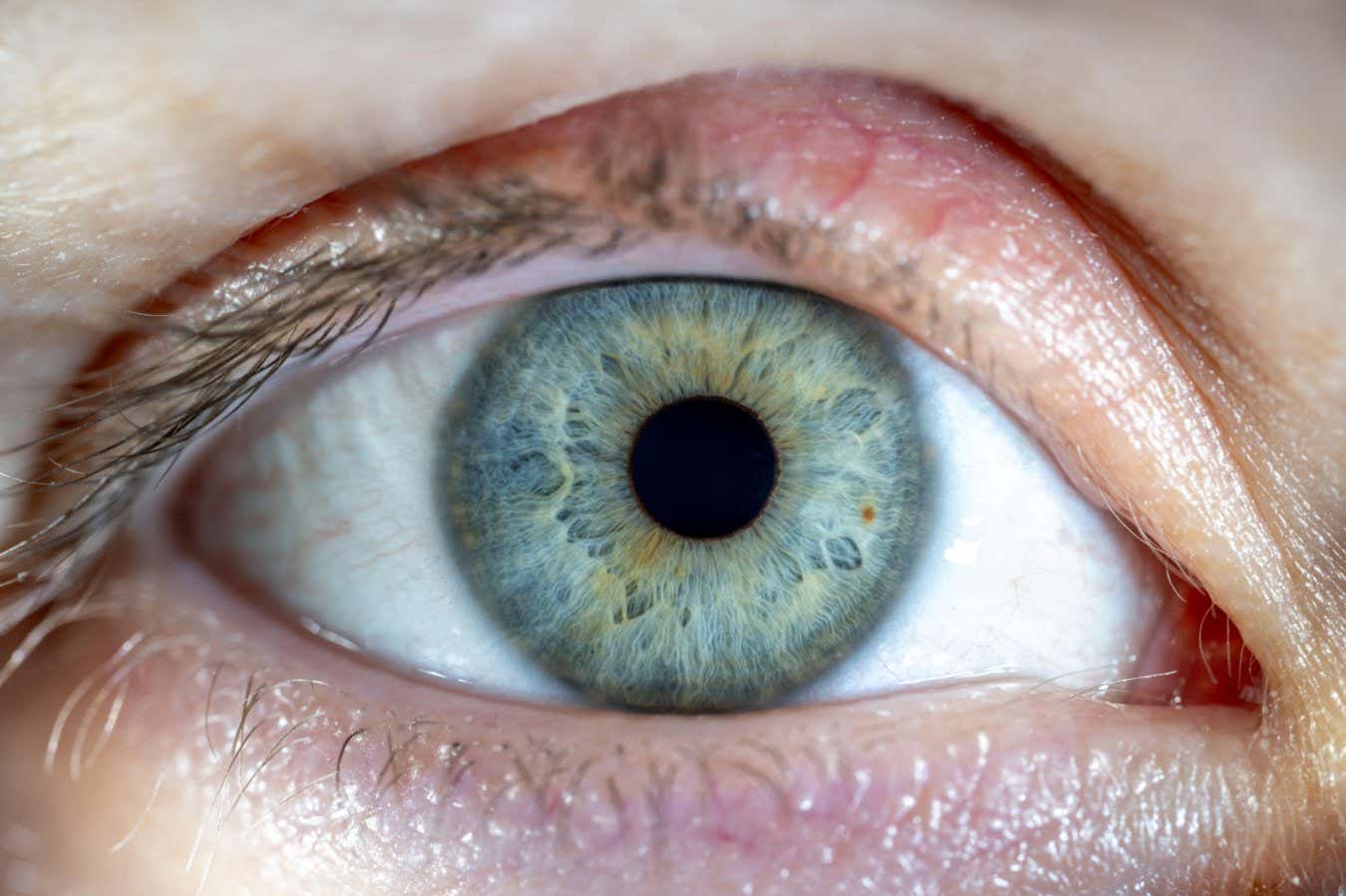
Keeping the retina working while out of the body is a step towards effective transplants
Michael Lutz/Alamy
Human eyes have been kept active outside the body for up to 10 hours after death, double the length of time that had previously been achieved. Supplying donor eyes with blood and oxygen meant they continued to respond to light, while also preserving their structure and overall health for 24 hours.
“This work undoubtedly represents an important step towards the possibility of whole-eye transplantation,” says Thomas Johnson at Johns Hopkins University in Baltimore, Maryland, who wasn’t involved in the research. “Maintaining light responses outside of the body is a tremendous feat.”
More than a million people in the UK are blind or partially sighted because of an irreversible eye condition, such as age-related macular degeneration, which affects the retina, the light-sensing tissue at the back of the eye.
Some advances have been made. For instance, corneal transplants, which replace the clear “window” in front of the eye with donor tissue, can improve vision in people with damaged corneas. But treating the retina is more challenging as it is connected to the central nervous system.
Although a partial face and whole-eye transplant was performed in 2023, it didn’t restore the recipient’s sight. This is a major challenge, in part because the retina is extremely sensitive to degeneration induced by oxygen loss, known as ischemia. “Even a brief period of ischemic time is likely to cause irreversible degeneration of light-sensitive neurons and circuits,” says Johnson.
Eimear Byrne at the Barcelona Institute of Science and Technology in Spain and her colleagues wondered whether they could reduce this damage by maintaining a donor eye under the same conditions as those experienced inside the body.
To do so, they created a system that involved inserting a flexible tube into the ophthalmic artery, which supplies blood to the eye and surrounding structures. They then perfused the donated eye with an oxygenated solution using a custom-built device they call the Eye-in-Care-Box, which uses sensors to automatically regulate pressure and flow.
To test the technique, the researchers took both eyes from six donors, perfusing one and not the other each time. The perfusion system preserved the structure of the retina and maintained the health of surrounding cells for up to 24 hours, while the non-perfused eyes degraded quickly after removal.
They then perfused another 36 donor eyeballs and found that 15 of their retinas produced electrical responses to light, similar to those measured in living people. The responses lasted for up to 10 hours after death, double the 5-hour period other scientists achieved in 2022. However, it isn’t clear why the remaining 21 eyeballs Byrne’s team perfused didn’t have this response.
Another major challenge remains before doctors can restore vision via a transplanted eye: regenerating fibres in the severed optic nerve so it can connect to visual centres in the brain. “Without this, a donor eye will have no way of communicating visual sensation to the recipient’s brain,” says Johnson.
The new work doesn’t solve this, but, by keeping the eye metabolically healthy after death, it may make future vision-restoration strategies more feasible, ensuring donated eyes are less damaged by ischemia.
Several groups are exploring how we might encourage optic-nerve regrowth. “It seems to me that now is the time to begin putting these promising interventions together in the whole-eye-transplantation context,” says Johnson.
The Eye-in-Care-Box could also be valuable for testing vision-related therapies in human eyes, rather than in other animals, according to Byrne’s team. “I certainly think there is potential for this technology to be used to develop new in-vitro models and experimental paradigms for testing drugs and other therapies, as well as understanding biology and pathology,” says Johnson. “This would have the benefit of the results being more directly applicable to human disease and biology.”
Topics: