
Close Menu
    Trending
    • Taylor Frankie Paul Addresses MomTok Drama
    • Oil climbs to one-month high as US, Iran step up attacks in Strait of Hormuz
    • Indonesia’s jailing of Gojek founder raises fears for investor confidence | Corruption News
    • Five ACC storylines heading into conference’s media days
    • Wall Street Firm Pays Gen Z Interns $34,400 a Month
    • We finally know the name of a Maya mathematician
    • Food tracking: Does using an app make you healthier?
    • Market Talk – July 13, 2026
    Benjamin Franklin Institute
    Tuesday, July 14
    • Home
    • Politics
    • Business
    • Science
    • Technology
    • Arts & Entertainment
    • International
    Benjamin Franklin Institute
    Home»Science»Former Soviet scientific megastructures captured in striking photos
    Science

    Former Soviet scientific megastructures captured in striking photos

    Team_Benjamin Franklin InstituteBy Team_Benjamin Franklin InstituteMay 10, 2026No Comments3 Mins Read
    Share Facebook Twitter Pinterest Copy Link LinkedIn Tumblr Email VKontakte Telegram
    Share
    Facebook Twitter Pinterest Email Copy Link


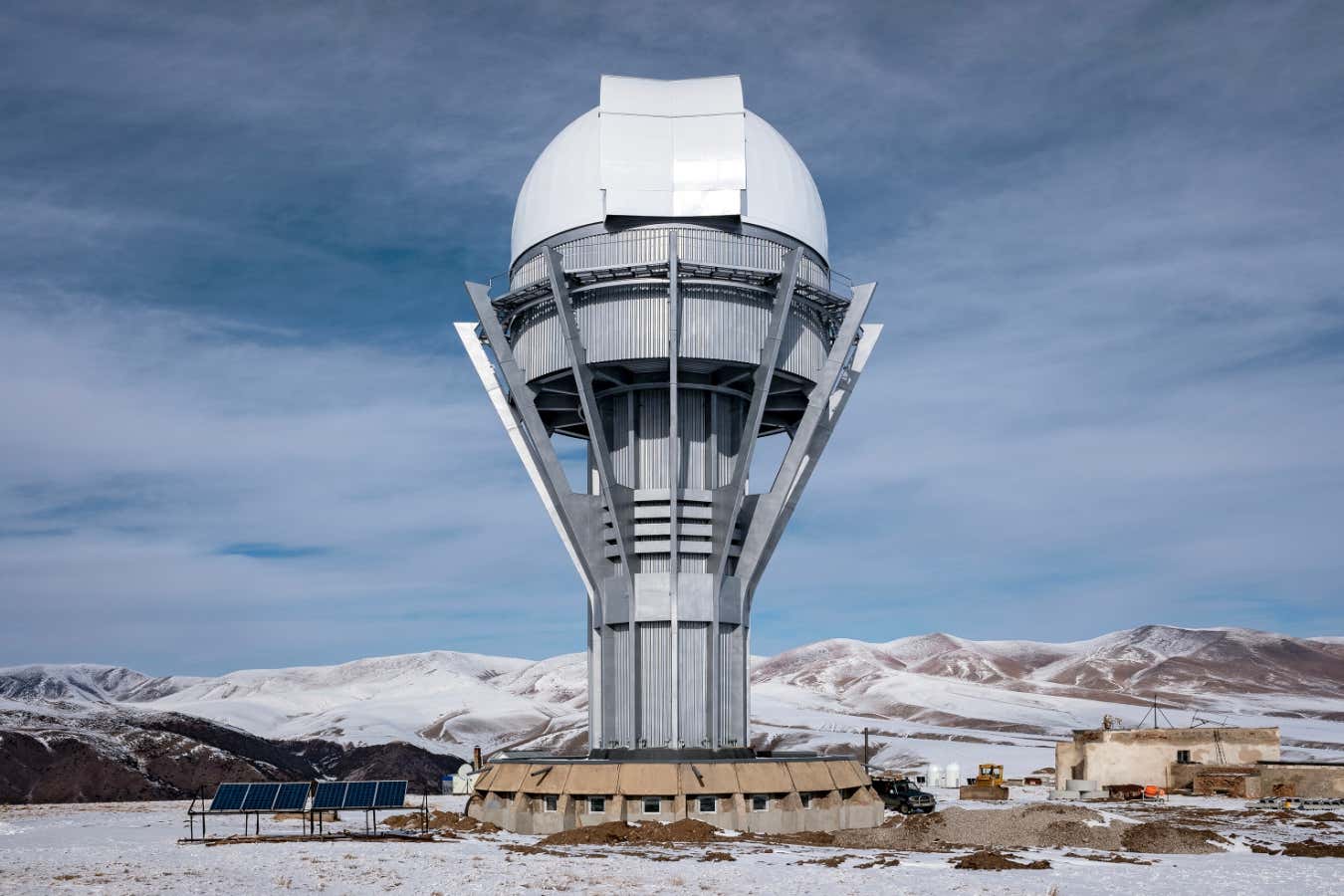
    The 45-metre-high tower housing the AZT-20 telescope at the Assy-Turgen Observatory in Kazakhstan

    Soviet Scientific Institutes, by Eric Lusito, FUEL Publishing, 2026

    These colourful photographs capture the remains of what was once a constellation of Soviet scientific megaprojects, all intentionally designed by the state to replace religious objects of worship.

    Photographer Eric Lusito gained access to many of these Soviet sites for his new book, Soviet Scientific Institutes. Starting in Ukraine, Lusito spent four years travelling across the former Soviet Union, liaising with scientists and visiting many locations that had remained shuttered since the fall of the Soviet Union.

    The first three sites Lusito visited were in Ukraine, in late 2021, before the start of the Russian invasion, and reminded Lusito of comic books from his childhood, such as Edgar P. Jacobs’s Blake and Mortimer and Hergé’s The Adventures of Tintin. “I found these scientific places very exciting and wanted to see more,” says Lusito. “I was drawn to their mysterious beauty, their history and to the way they had evolved over time.”

    While many of the sites were in disrepair, some were beautifully preserved and frozen in time, such as the control room for the Orgov Radio-Optical Telescope in Armenia (below), which was designed by Soviet scientist Paris Herouni in the 1970s. The beautiful design of rooms like these were no accident; speaking to Herouni’s niece, Lusito learnt that Herouni had to battle against Moscow’s scientific administrators to get it built.

    New Scientist. Science news and long reads from expert journalists, covering developments in science, technology, health and the environment on the website and the magazine.

    The optical control panel for the Orgov Radio-Optical Telescope in Armenia

    Eric Lusito

    At their peak, thousands of scientists poured through the hallways and control rooms of these scientific institutions, each of them recording their clocking in on machines like the colourful attendance board in the Institute of Radiophysics and Electronics at the National Academy of Sciences of Ukraine (below).

    New Scientist. Science news and long reads from expert journalists, covering developments in science, technology, health and the environment on the website and the magazine.

    The original Soviet-era staff attendance board in the Institute of Radiophysics and Electronics at the National Academy of Sciences of Ukraine

    Eric Lusito

    Some of these were doing important practical research, such as in the high-voltage hall of the building previously known as the Electrotechnical Institute in Kharkiv, Ukraine (below), where scientists produced lightning-like bolts of energy, in order to learn how to protect the country’s first unified grid system. A Soviet-era mural, of a hand grasping a lightning bolt, can be seen on the rear wall.

    New Scientist. Science news and long reads from expert journalists, covering developments in science, technology, health and the environment on the website and the magazine.

    The high-voltage hall at the Electrotechnical Institute in Kharkiv, Ukraine

    Eric Lusito

    Others, however, were doing purely fundamental science, such as in the MAKET-ANI experiment in Armenia’s Aragats Cosmic Ray Research Station (below), which measured high-energy particles that fall through the sky and settle on the high-altitude snow-capped peaks of Mount Aragats.

    New Scientist. Science news and long reads from expert journalists, covering developments in science, technology, health and the environment on the website and the magazine.

    The MAKET-ANI, an experiment at Armenia’s Aragats Cosmic Ray Research Station

    Eric Lusito

    Many of the scientific sites that Lusito visited in Ukraine had to suspend their scientific operations after the outbreak of Russia’s war in Ukraine, like the Institute of Ionosphere in Kharkiv, which houses several parabolic detectors, including a 100-metre antenna (below).

    New Scientist. Science news and long reads from expert journalists, covering developments in science, technology, health and the environment on the website and the magazine.

    The 100-metre parabolic antenna at the Institute of Ionosphere in Kharkiv, Ukraine

    Eric Lusito

    Much of what Lusito saw were derelict or decommissioned, but there were some green shoots. At the Assy-Turgen Observatory in Kazakhstan, Lusito photographed the 45-metre high pavilion housing the AZT-20 telescope (main image), which was originally started in the 1980s but ceased construction after the collapse of the Soviet Union. The project resumed in the 2010s and was finished in 2017, becoming Kazakhstan’s largest telescope and one of the largest in the post-Soviet region.

    Topics:


    Source link

    Share. Facebook Twitter Pinterest LinkedIn Tumblr Email Telegram Copy Link

    Related Posts

    Science

    We finally know the name of a Maya mathematician

    July 13, 2026
    Science

    Scientists spot sugar in interstellar space for the first time ever

    July 13, 2026
    Science

    Mathematicians still don’t know the fastest way to multiply numbers

    July 13, 2026
    Science

    RFK, Jr. is turning his attention to the U.S. Preventive Services Taskforce

    July 13, 2026
    Science

    Can we geoengineer ourselves out of an El Niño year?

    July 13, 2026
    Science

    Scientists get clearest view yet of a spreading seafloor

    July 13, 2026
    Editors Picks

    The Dark Side Of Humanity?

    February 1, 2026

    Crystal-based cooling could make fridges more sustainable

    January 3, 2025

    No. 18 North Carolina shows it still has life with win over No. 24 Louisville

    February 24, 2026

    European states to send planes to evacuate citizens from hantavirus-hit cruise ship

    May 9, 2026

    David Attenborough is one of a kind, for better or worse

    May 17, 2026
    About Us
    About Us

    Welcome to Benjamin Franklin Institute, your premier destination for insightful, engaging, and diverse Political News and Opinions.

    The Benjamin Franklin Institute supports free speech, the U.S. Constitution and political candidates and organizations that promote and protect both of these important features of the American Experiment.

    We are passionate about delivering high-quality, accurate, and engaging content that resonates with our readers. Sign up for our text alerts and email newsletter to stay informed.

    Latest Posts

    Taylor Frankie Paul Addresses MomTok Drama

    July 14, 2026

    Oil climbs to one-month high as US, Iran step up attacks in Strait of Hormuz

    July 14, 2026

    Indonesia’s jailing of Gojek founder raises fears for investor confidence | Corruption News

    July 14, 2026

    Subscribe for Updates

    Stay informed by signing up for our free news alerts.

    Paid for by the Benjamin Franklin Institute. Not authorized by any candidate or candidate’s committee.
    • Privacy Policy
    • About us
    • Contact us

    Type above and press Enter to search. Press Esc to cancel.