

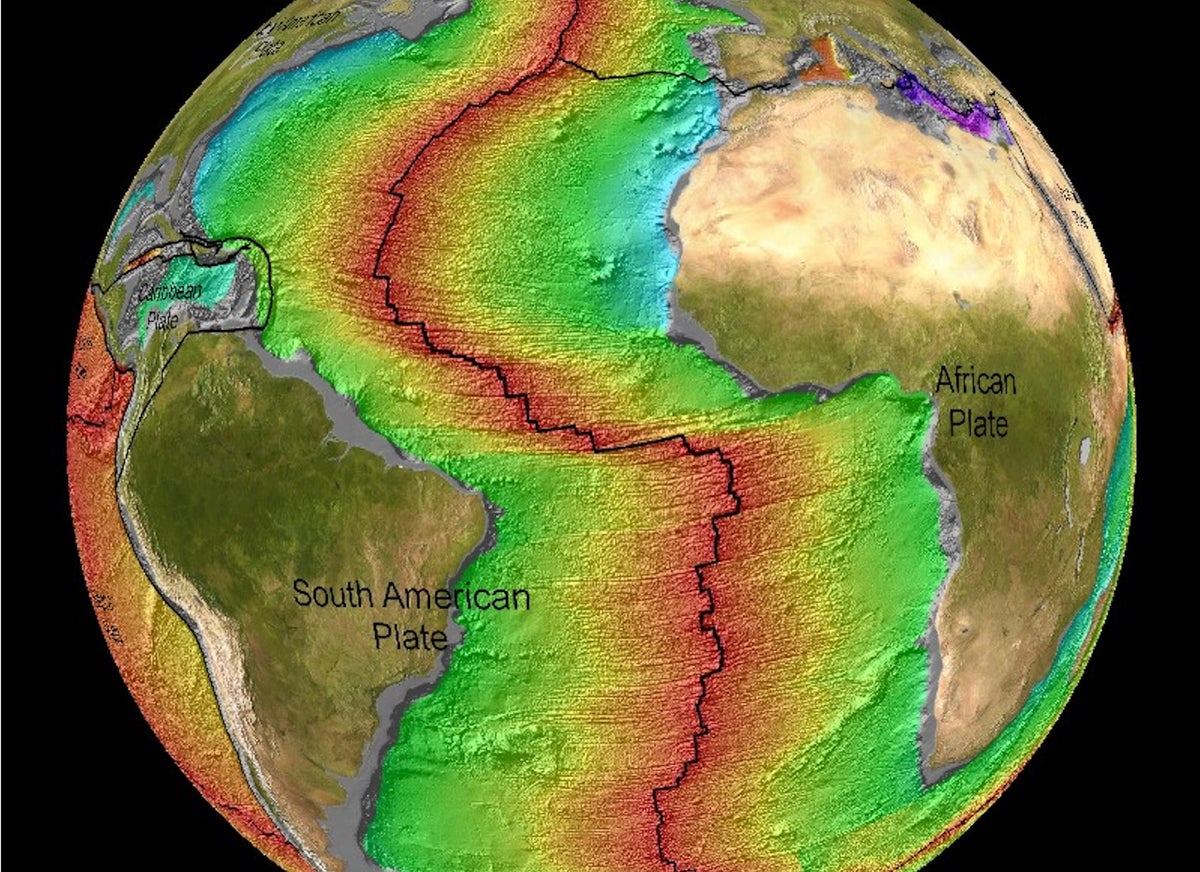
Kilometers below the ocean’s surface, Earth’s seafloors are on the move. Across a massive network of underwater mountain chains known as mid-ocean ridges, tectonic plates slowly pull apart, belching molten rock at the spreading seams. As this lava cools, it forms new oceanic crust—literally the world’s largest game of The Floor Is Lava.
We know how this new ocean crust is built over millions of years, but we’ve rarely caught one of the brief episodes that actually does the work.
Now, in one of the clearest observations ever made, scientists have watched one of those moments unfold in real time and with unprecedented detail in an active seafloor spreading event in the Indian Ocean. Their findings were reported in a new study published Wednesday in Nature.
On supporting science journalism
If you’re enjoying this article, consider supporting our award-winning journalism by subscribing. By purchasing a subscription you are helping to ensure the future of impactful stories about the discoveries and ideas shaping our world today.
“We generally don’t get the chance to be there at the right time and the right place to see these things,” says Hannah F. Mark, an assistant research professor at the Lamont-Doherty Earth Observatory of Columbia University, who was not involved in the study.
The feat required a small armada of instruments—acoustic transponders, pressure gauges, hydrophones (underwater seismic microphones) and geodetic beacons—deployed across a tectonically active stretch of a mid-ocean ridge.
After installing the instruments, the team simply had to wait. But they didn’t have to wait long.
Less than two months later a swarm of earthquakes ripped along the ridge. The seafloor dropped about four meters (13 feet), the plates pulled apart by more than one meter (three feet), and up to 160 million cubic meters of lava—the volume of more than 60 Great Pyramids of Giza—erupted onto the seabed. “We were expecting to measure a few centimeters of horizontal displacement and maybe a few centimeters of vertical displacement,” says lead author Jean-Yves Royer of the Laboratory of Planetology and Geodynamics of Nantes in France. In a single event, the ridge accommodated nearly 40 years’ worth of plate motion. It’s an important distinction: though the plates separate at about the speed fingernails grow, that growth isn’t smooth. Instead decades of motion can be released in sudden bursts of earthquakes and volcanic activity.
Besides the remarkable feat of even capturing the event, the research also sheds light on a longstanding question about how the seafloor spreads.
Scientists have long suspected that many faults at mid-ocean ridges don’t move entirely through earthquakes. Instead much of the motion occurs through aseismic slip—a slow, silent release of strain that produces little or no seismic shaking. Whether that quiet slipping is directly triggered by the movement of magma, however, has remained an open question.
This event suggests it is.
By comparing the measured movement of the faults with the motion inferred from the earthquakes, the researchers found a striking mismatch. The fault shifted by roughly two meters, but the earthquakes accounted for only 10 to 20 centimeters of that motion. The rest happened silently, after the rocks had already fractured. “That was a surprise,” Royer says.
“It’s not just that there is aseismic slip,” Mark says. “It’s that it happens at the same time as—and probably is causally linked to—the magma.”
If that interpretation is correct, it could explain why faults along mid-ocean ridges produce fewer earthquakes than scientists would otherwise expect. Some of the plates’ motion, it seems, happens too quietly for us to notice—unless someone has the foresight to leave an array of instruments on the seafloor and the good fortune to have Earth put on a show.
It’s Time to Stand Up for Science
If you enjoyed this article, I’d like to ask for your support. Scientific American has served as an advocate for science and industry for 180 years, and right now may be the most critical moment in that two-century history.
I’ve been a Scientific American subscriber since I was 12 years old, and it helped shape the way I look at the world. SciAm always educates and delights me, and inspires a sense of awe for our vast, beautiful universe. I hope it does that for you, too.
If you subscribe to Scientific American, you help ensure that our coverage is centered on meaningful research and discovery; that we have the resources to report on the decisions that threaten labs across the U.S.; and that we support both budding and working scientists at a time when the value of science itself too often goes unrecognized.
In return, you get essential news, captivating podcasts, brilliant infographics, can’t-miss newsletters, must-watch videos, challenging games, and the science world’s best writing and reporting. You can even gift someone a subscription.
There has never been a more important time for us to stand up and show why science matters. I hope you’ll support us in that mission.