

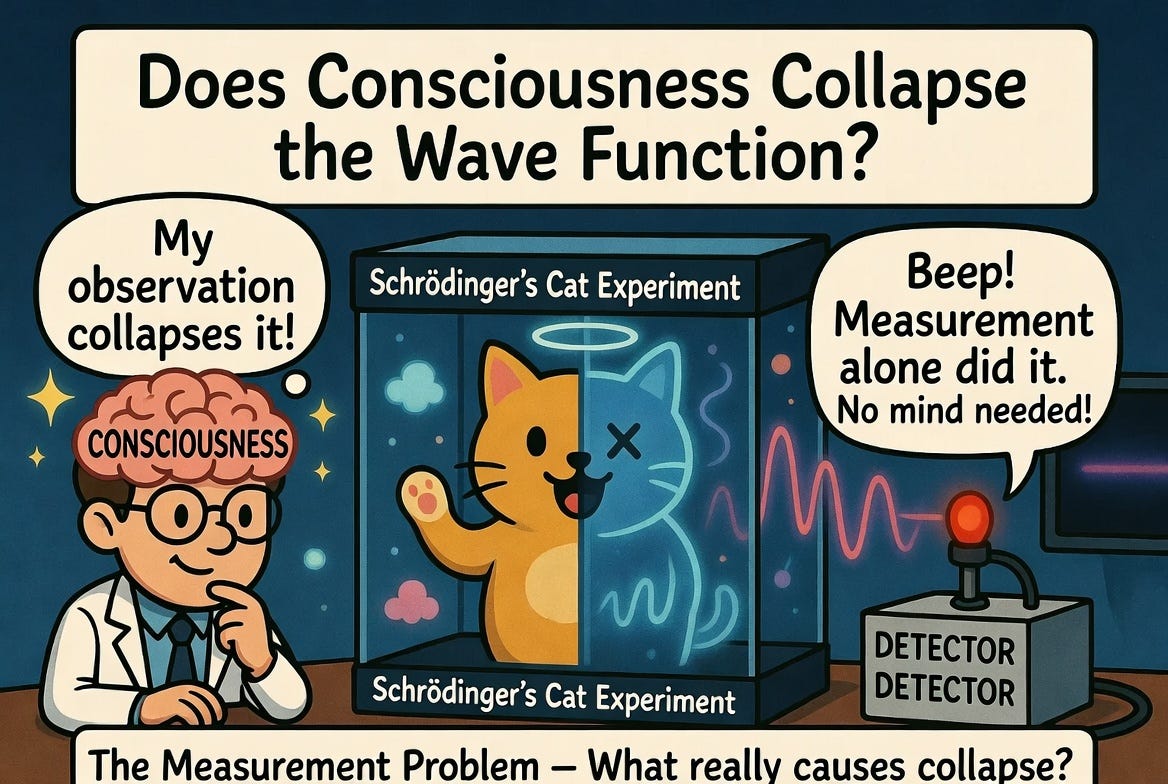
This is a big and important question that frames our understanding of QM. But beyond this there are implications for our view of physics and ontology = the nature of reality. An answer in the affirmative would imply that consciousness is a fundamental, irreducible element of reality. Consciousness does not depend on matter. It becomes natural to consider survival of individual awareness after death. The universal intuition that we have free will has a basis in our scientific paradigm. An answer in the negative emphasizes that reductionist physics is a self-consistent, closed system, and consciousness an illusion of sorts, a side-show that physicists can safely ignore.
In the 1925 formulation of quantum mechanics (QM) (still the basis of modern atomic physics), the primary reality is not particles but configurations of particles. The wave function (WF) is related to the probability of any measurement of that configuration producing a given result. The Schrödinger Equation (SE) is the primary equation of motion; it is to QM what F=ma is to Newtonian mechanics. The SE tells how the WF changes from moment to moment, and it predicts the outcome of measurements. But there is a rule that is as much a part of QM as the SE. The rule says that at the moment of a measurement, the SE resets — not from where it was just before the measurement, but from an artificial-looking WF in which all the probability is concentrated at one point, that point being the result of the measurement. The probability function is replaced by a statement of certainty, the measurement outcome is now known, so its probability is exactly one. This is usually called “collapse of the wave function”.
From the beginning, physicists noted that this was really strange. In practice, the two principles work very well together.
(1) Start with a WF that represents the result of your measurement
(2) Use the SE to calculate how the WF changes until the next measurement.
In practice, this pair of rules predicts the results of the next measurement based on what you found during the previous measurement. But the theory is highly unsatisfying. It seems that there is no such thing as an objective world, but rather a world that is constantly being redefined by what you choose to measure. The fundamental question that has divided physicists is, What is a measurement? If a measurement is part of physics, why is it an exception to the SE? And if it is not part of physics, what is there that is outside of physics, and shouldn’t we include whatever that is as part of what we call “physics”?
Among today’s physicists there are three types of answers to this question:
- A “measurement” is performed by a large system that obeys Newton’s physics, not Quantum physics. The WF loses its coherence when it interacts with this larger system, and for all practical purposes it is behaving like a Newtonian system in that moment.
- In contrast to #1, the world really is quantum through-and-through, including the measuring apparatus. The wave function never collapses to a point. Rather there is a separate universe for each possible result of the measurement, and we humans find ourselves always in one of the most probable universes as the universe splits and splits again in each moment.
- There is something “outside physics” that is responsible for the collapse of the wave function, and that something is the mind of the person (or cat) who performs the measurement. It is a living consciousness that collapses the wave function, and what we call a “measurement” is an interaction between mind and matter.
The present essay is concerned with perspective #3, and I propose a way of testing #3 as a working hypothesis.
Most physicists today are divided between perspectives #1 and #2. The third is either tainted or supported (depending on your attitude) by association with Hindu or Daoist traditional philosophies. But some of the greatest physicists of the 20th century expressed support for #3, including Max Planck, Erwin Schrödinger himself, Eugene Wigner, John von Neumann, James Jeans, David Bohm, and Wolfgang Pauli.
“I regard consciousness as fundamental. I regard matter as derivative from consciousness. We cannot get behind consciousness. Everything that we talk about, everything that we regard as existing, postulates consciousness.”
— Planck“The Universe begins to look more like a great thought than like a great machine.”
— Jeans“Consciousness cannot be accounted for in physical terms. For consciousness is absolutely fundamental…The total number of minds in the universe is one. In fact, consciousness is a singular noun of which the plural is unknown.”
— Schrödinger
Schrödinger also illustrated the absurdity of mechanical wave function collapse with his famous cat example. Wigner was more explicit, demonstrating that contradictions arise if we attempt to apply the laws of physics to the human making a measurement.
Pauli and Bohm were outspoken mystics. Von Neumann wrote an influential QM text based on perspective #3.
The reason that most scientists today dismiss these intellectual giants is that they subscribe to a reductionist paradigm, in which physics is a closed system and consciousness is an epiphenomenon with no ability to affect anything that is physically real (no free will). The universe is mechanical, and is best understood as the interaction among many (many!) moving parts, all based on fixed laws. This paradigm frames the vast majority of scientific studies and scientific hypotheses over the last 150 years, and the framework has been so productive that few are willing to subject it to question.
This is such an important question — why don’t we test it experimentally?
- Set up a quantum system
- Let it interact with a measuring apparatus where no living being ever looks at the result.
- Compare that situation to the same system and apparatus, in which someone not only looks at the result of the measurement, but takes definitive, macroscopic action in the real world based on the outcome.
- If consciousness is necessary to collapse the wave function, we should see that the wave function is collapsed in case (3) but not case (2).
I’ll explain in detail one way in which this experiment may be realized. This is a challenge and a proposal for experimentalists — I do not know how technically easy or difficult it may be in practice.
Start with the principle of complementarity — quantum variables usually come in pairs such that if you know one, you lose all information about the other. This is the case with angular momentum, which is spin. If you determine that an electron is spinning clockwise around the x axis, you lose all information about whether it is spinning clockwise or counter-clockwise around the y axis. There is broad agreement among quantum physicists on this point. Once you have said that the electron is spinning clockwise about the x axis, you have said all that can be said about the way it is spinning. You cannot say either “it is also spinning around the y axis in the clockwise direction” or “it is also spinning around the y axis in the counter-clockwise direction” or “it is not spinning around the y axis”. Any of these statements would be a contradiction of the one thing that you know, which is that “the electron spinning around the x axis in the clockwise direction”.
You have heard of “electromagnets”. When electricity flows around in a loop, the loop becomes a magnet. So you should not be surprised that the spinning electron acts like a tiny magnet. In an experiment, we might measure the electron’s spin about the x axis by putting the electron in a magnetic field that is aligned in the x direction and watching how it moves.
Suppose we do this, and the result is “clockwise in the x direction”. We can repeat the measurement with a similar apparatus downstream on the electron’s path. We will certainly find corroboration. The electron is still spinning clockwise in the x direction.
Nothing stops us from setting up a subsequent experiment where the imposed magnetic field is at right angles. Let’s imagine that we do this and we thereby determine that the electron is spinning clockwise about the y axis.
According to the strange (but well-accepted) rules of quantum mechanics, we now know for sure that the electron is spinning clockwise about y, but we have lost all information about the electron’s x spin. A third measurement of the electron in which we query the x axis spin is equally likely to come out “clockwise” or “counter-clockwise”.
Our measurement of the y spin has changed what we know about the x spin from “clockwise for sure” to “50-50 chance of clockwise or counter-clockwise”.
This is the basis for our experiment to determine whether consciousness is necessarily a part of the “measurement” process. Our hypothesis is that without consciousness, there is no measurement, so the x spin of the electron will remain clockwise, even if all the physical measuring apparatus was operational. Only when a conscious observer notes the result of the second stage (the y measurement) does the x spin become maximally uncertain, equally likely to be clockwise or counter-clockwise.
So our proposed experiment is this.
- Start with a measurement of the electron’s x spin.
- Set up a second apparatus downstream to measure the y spin.
- Either look at the dial or don’t look at the dial of the machine that records the y spin.
- Subsequently measure the x spin again.
- Prediction: If consciousness is necessary to collapse the wave function then the two cases (looking at the dial and not looking) should have statistically different results.
- If you looked at the dial, the third measurement is predicted to be equally likely clockwise or counter-clockwise about x.
- If you did not look at the dial, no y measurement actually took place, so the prediction is that the third measurement should always produce the same result as the first.
Most physicists would say, “go ahead and do this experiment if you want — I know how it will turn out.” They would say that whether you look at the dial or not (in the second measurement) can’t possibly affect the results of the third measurement. They would say that the apparatus has already done the measurement, whether or not anyone looks at the dial. Conventionally, the experiment has a low probability of success.
Let’s give it a ghost of a chance. When the experimenter looks at the dial of y axis measurement, let her take some small real-world action as a result. Counter-clockwise means I’ll have bacon and eggs for breakfast; clockwise I’ll have crunchy granola. Or counter-clockwise I’ll bicycle to work this morning, clockwise I’ll take the Metro. Any alternative pair of real-world actions would suffice to the purpose, given only that they are selected ahead of time and the experimenter commits in advance to abide by the verdict of the y axis measurement.
I think it’s worth doing. I’m betting there will be some statistical difference between the two outcomes, where there is a real-world consequence of the y-axis measurement vs the dial remains unobserved. Maybe when the dial is unobserved, the result will be 60/40 in the subsequent x-axis measurement, while the fully observed measurement will be 50/50.
My hope is that someone will pick up this challenge and actually do the experiment.