
Close Menu
    Trending
    • How Big Will Taylor Swift & Travis Kelce’s Wedding Be?
    • David hat-trick as Canada crush nine-man Qatar 6-0 to earn first World Cup finals win
    • Zimbabwe bill to scrap presidential elections sparks backlash | Politics News
    • The ‘U.S. Open champions since 1996’ quiz
    • Opinion | JD Vance: ‘I’m Not Fighting With the Pope’
    • How this street duck became Mexico’s unofficial World Cup mascot
    • Waves reflecting off Earth’s core shifted Japan after 2011 earthquake
    • Market Talk – June 18, 2026
    Benjamin Franklin Institute
    Friday, June 19
    • Home
    • Politics
    • Business
    • Science
    • Technology
    • Arts & Entertainment
    • International
    Benjamin Franklin Institute
    Home»Science»Waves reflecting off Earth’s core shifted Japan after 2011 earthquake
    Science

    Waves reflecting off Earth’s core shifted Japan after 2011 earthquake

    Team_Benjamin Franklin InstituteBy Team_Benjamin Franklin InstituteJune 19, 2026No Comments3 Mins Read
    Share Facebook Twitter Pinterest Copy Link LinkedIn Tumblr Email VKontakte Telegram
    Share
    Facebook Twitter Pinterest Email Copy Link


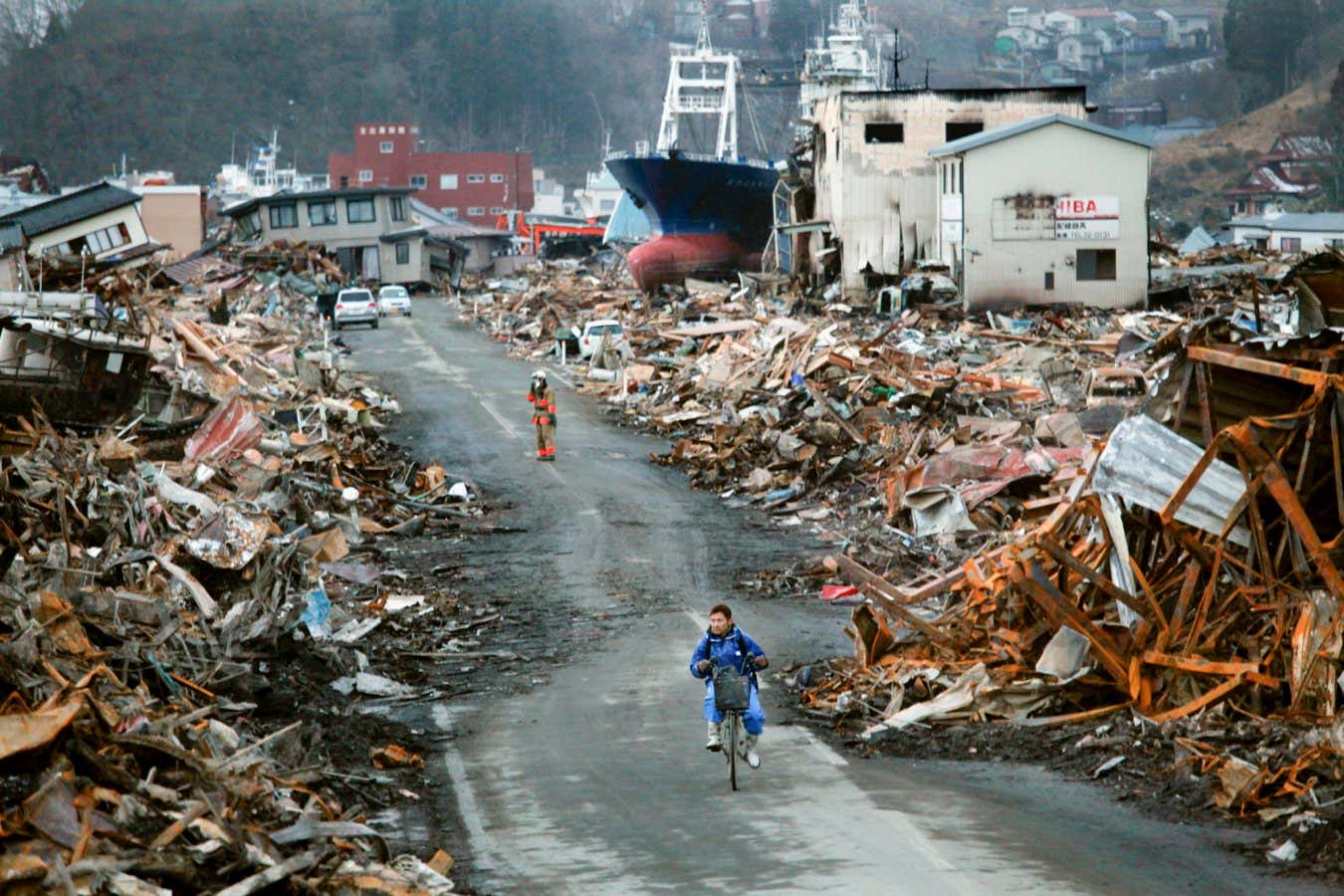
    The fishing port of Kesennuma, Japan, in the aftermath of the Tohoku earthquake in 2011

    Carolyn Cole/Los Angeles Times via Getty Images

    Around 15 minutes after the magnitude-9 Tohoku earthquake on 11 March 2011, almost the whole of Japan jumped half a centimetre to the east. This lurch resulted from an immensely powerful seismic wave that travelled 5800 kilometres to the planet’s core and then bounced back towards the surface.

    In the context of the devastation caused by the earthquake, including localised land movements of many metres and 40-metre tsunami waves that led to the meltdown of three reactors at the Fukushima Daiichi nuclear plant, 5 millimetres may seem insignificant.

    But this movement took place over a distance of 3000 kilometres, nearly seven times longer than the length of the earthquake’s main rupture line and longer than any slip ever recorded.

    What also makes the case unusual is the timing and the pattern, says Sunyoung Park at the University of Chicago. “We see a small 5-millimetre eastward step that happens nearly simultaneously and with similar size across almost all of Japan, without any ordinary earthquake at that exact time.”

    Not only was the shift immense in its north-south extent, but its width encompassed all of Japan and beyond, into the ocean.

    “It is not just a narrow ‘edge’ that moved,” says Park. “The eastward step extends at least across the whole of Japan where we have GPS stations. If we had similarly dense instruments on the seafloor, we could say more precisely how far offshore this motion extends, but on land, the shift is observed pretty much everywhere across Japan.”

    By analysing extensive GPS and seismic data recorded during the catastrophe, Park and her colleagues have figured out how such a phenomenally vast movement was triggered and why the rupture took place 15 minutes after the main quake.

    Earthquakes often generate waves that travel deep into Earth’s interior and reflect off the core, but they usually become quite weak by the time they have travelled to the planet’s centre and then back up.

    In Tohoku’s case, the main shock was so large that the original wave, though weakened, remained powerful enough on its return to the surface to cause the nationwide lurch, as four adjoining tectonic plates moved in unison.

    “We think the vigorous shaking from the original Tohoku earthquake might have already weakened the plate boundaries, making them more susceptible to be moved when the core-reflected wave came by,” says Park.

    The event demonstrates there are previously unrecognised mechanisms of destruction that can follow earthquakes, says Park. “It shows that, after a big earthquake, we might also need to be aware of potential seismic hazards due to such deep-travelling wave arrivals that can trigger more events, and over very large distances.”

    More research is now needed to understand the implications of this kind of movement for other parts of the world with similar faults, says Robin Lee at the University of Canterbury, New Zealand.

    “It shows that large earthquakes can trigger widespread, delayed fault motion minutes later, and over much larger regions than expected,” says Lee.

    Topics:


    Source link

    Share. Facebook Twitter Pinterest LinkedIn Tumblr Email Telegram Copy Link

    Related Posts

    Science

    Remarkable fossils rewrite the story of how animals conquered the land

    June 18, 2026
    Science

    Cervical cancer deaths have plummeted thanks to HPV vaccine

    June 18, 2026
    Science

    Ancient monument marked summer solstice centuries before Stonehenge

    June 18, 2026
    Science

    The bigger the lizard, the bigger the Wiki page, discovers ecologist

    June 18, 2026
    Science

    No young women have died of cervical cancer in England for years

    June 18, 2026
    Science

    Ancient monument may have been an early Stonehenge prototype

    June 18, 2026
    Editors Picks

    See the Pentagon’s new UFO image release

    May 10, 2026

    Why is Pakistan backing Bangladesh in its T20 World Cup row with India? | ICC Men’s T20 World Cup News

    January 27, 2026

    Where will there be a hosepipe ban in the South East?

    July 12, 2025

    Dollar on track for steepest annual drop for almost a decade

    December 30, 2025

    Reality TV Stars Speak Out After Terrifying Road Rage Attack In LA

    April 1, 2026
    About Us
    About Us

    Welcome to Benjamin Franklin Institute, your premier destination for insightful, engaging, and diverse Political News and Opinions.

    The Benjamin Franklin Institute supports free speech, the U.S. Constitution and political candidates and organizations that promote and protect both of these important features of the American Experiment.

    We are passionate about delivering high-quality, accurate, and engaging content that resonates with our readers. Sign up for our text alerts and email newsletter to stay informed.

    Latest Posts

    How Big Will Taylor Swift & Travis Kelce’s Wedding Be?

    June 19, 2026

    David hat-trick as Canada crush nine-man Qatar 6-0 to earn first World Cup finals win

    June 19, 2026

    Zimbabwe bill to scrap presidential elections sparks backlash | Politics News

    June 19, 2026

    Subscribe for Updates

    Stay informed by signing up for our free news alerts.

    Paid for by the Benjamin Franklin Institute. Not authorized by any candidate or candidate’s committee.
    • Privacy Policy
    • About us
    • Contact us

    Type above and press Enter to search. Press Esc to cancel.