

Feedback is New Scientist’s popular sideways look at the latest science and technology news. You can submit items you believe may amuse readers to Feedback by emailing feedback@newscientist.com
Big lizard, big page
The bigger the reptile, the longer its Wikipedia entry. So finds ecologist Ashkaan Fahimipour at Florida Atlantic University. He scraped all the Wikipedia pages about reptiles, then used this dataset to produce a graph mapping the relationship between each reptile’s body mass and the length of its page. As he explained on Bluesky: “Reptiles with longer Wikipedia pages tend to be bigger. The relationship is a power law with exponent = 0.85.”
Perhaps we shouldn’t be surprised. Conservationists will tell anyone who will listen that we are biased towards more “charismatic” animals, which is why conservation campaigns tend to feature photos of polar bears and pandas. Charismatic animals tend to be larger, as shown by a 2020 study that found people rated larger animals as more charismatic on the whole.
Still, Fahimipour’s graph is a scatterplot: there is a pretty clear upwards line, but there is also a fair bit of scatter. He explained on Bluesky that the species that stray from the line follow a pattern: “Greatest deviants tend to be venomous species, who have all that extra medical text.”
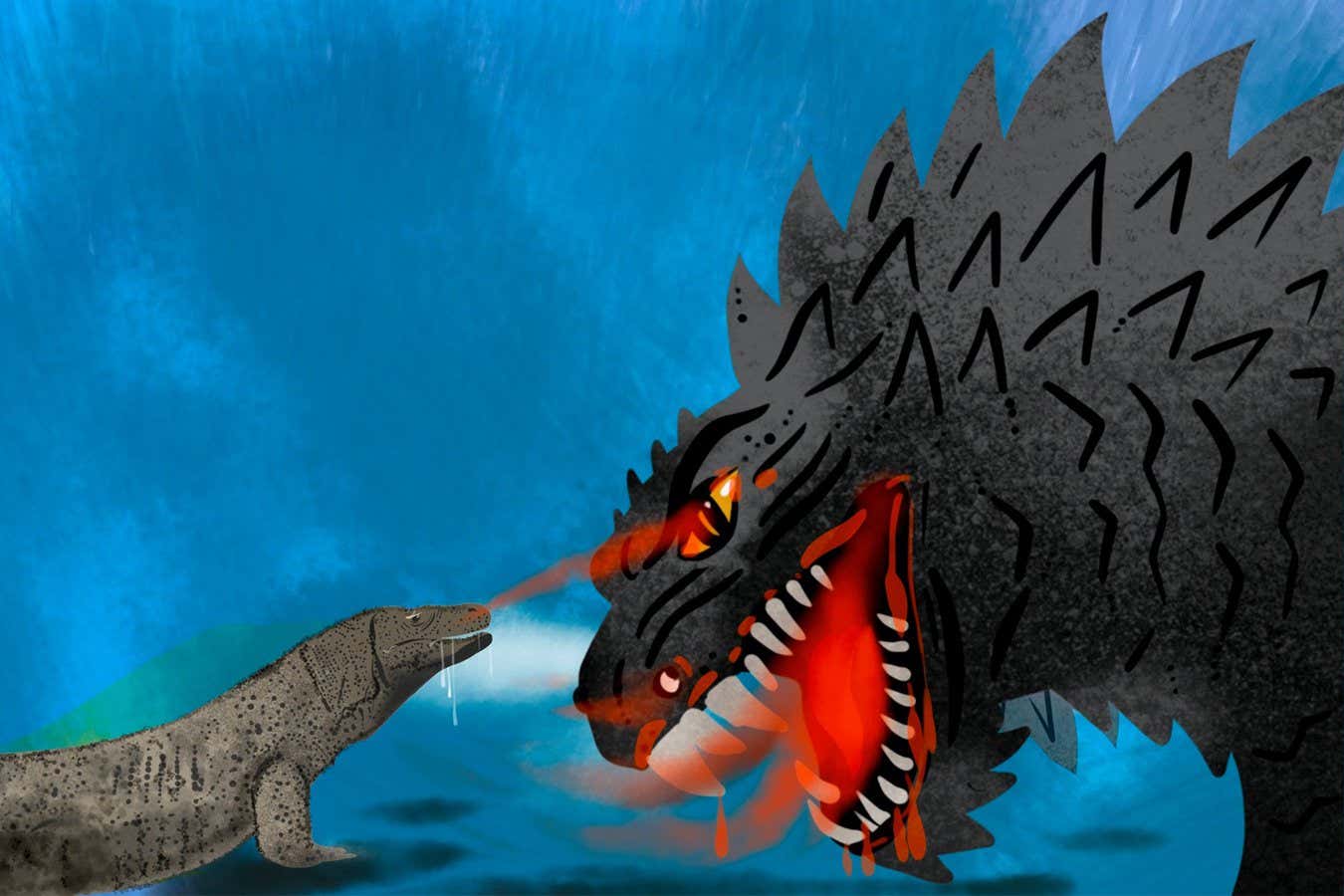
Feedback believes it should be possible to build upon this dataset by extending it into the realm of reptiles that don’t actually exist. So we consulted the Wikipedia page for noted fictional reptile Godzilla, which runs to around 7500 words (including references). Sadly, we cannot give a reliable mass for Godzilla, as his size has varied so much. Back in 2014, we reported that Godzilla had elongated from a modest 50 metres in his 1954 debut to well over 100 m, and since then the 2017 film Godzilla: Planet of the Monsters has apparently stretched him to 300 m. Estimates of his mass vary accordingly.
Nevertheless, Feedback thinks Godzilla deviates from the trend. His 7500-word Wikipedia page is shorter than the more than 8000 words (references also included) allocated to the Komodo dragon, which Fahimipour identifies as the longest page in his dataset. Regardless of how big Godzilla is, he is way larger than those piffling lizards, yet his Wiki page is not appropriately kaiju-sized.
Orwell strikes again
It has been over a year since Feedback last tackled the topic of scientific conferences and journals with wildly over-generous invitation lists. Readers with long memories may recall the story of Bruce Durie, a genealogist who found himself invited to speak or write on topics as diverse as chemistry and posthumanism.
Still, at least those invites were (presumably) real, unlike the one sent to science writer Philip Ball. He received an email begging him to submit something to a molecular biology journal – and everything about it was a red flag.
For starters, the email was addressed to “Respected Ball, P”. Assuming Philip got past that, the following text contained a lot of peculiar phrases, like “We are accepting the all types of articles”. It also claimed that “Our journal publishing across 150 specialized topics under Biology, Medicine, Engineering and General Science”, which is odd given the emailer said the journal was called “Molecular & Cellular Biology“. To confuse matters further, later in the message the journal was re-identified as “IgMin Research – A Biomed & Engineering Journal“.
Then came the pièce de résistance. The email was signed: “Sincere Regards, George Orwell, Editorial Operations Manager”. As Philip said on Bluesky: “Bit disappointed that the Editorial Operations Manager isn’t striving harder for plausibility here.”
Fortunately, Feedback hasn’t fallen for any such emails lately. We have been promised that our own research will be published in the Journal of Runways by its editor, Miranda Priestly.
Dog ate my homework
Feedback has had some hair-raising experiences with deadlines over the years, but none quite so alarming as that reported by Samantha Shannon. The author of best-selling fantasy novels like The Priory of the Orange Tree, Shannon told her Instagram followers about “the funniest excuse I’ve ever given for not hitting a deadline”. To fully enjoy this story, readers may wish to know that it all happened in 2024 and that Shannon is fine.
Her editor emailed to ask “how you’re getting on with the edits for The Dark Mirror?” To which Shannon replied: “I am waiting for an ambulance to take me to hospital because I just poisoned myself with a smoothie containing pulverised cherry stones, which I did not realise contain amygdalin, a compound that the body converts to literal cyanide. I wish I was joking.”
Feedback thinks this is an argument for us all to revisit some classic books. A is for Arsenic by Kathryn Harkup outlines the poisons used in the murder mysteries of Agatha Christie, who knew an interestingly large amount about poison, while Deborah Blum’s The Poisoner’s Handbook explains the origins of forensic toxicology. Somewhere along the way, surely one of these volumes will contain reminders about which bits of various fruits are best avoided.
In any event, the incident evidently didn’t do Shannon too much harm, because, unlike some fantasy authors we could mention, she seems to hit most of her deadlines and is on track to finish her projected seven-volume Bone Season series. Nevertheless, Feedback would like to ask her to please not go mushroom foraging unsupervised, because we would like to know what happens to Paige at the end of the story.
Got a story for Feedback?
You can send stories to Feedback by email at feedback@newscientist.com. Please include your home address. This week’s and past Feedbacks can be seen on our website.