

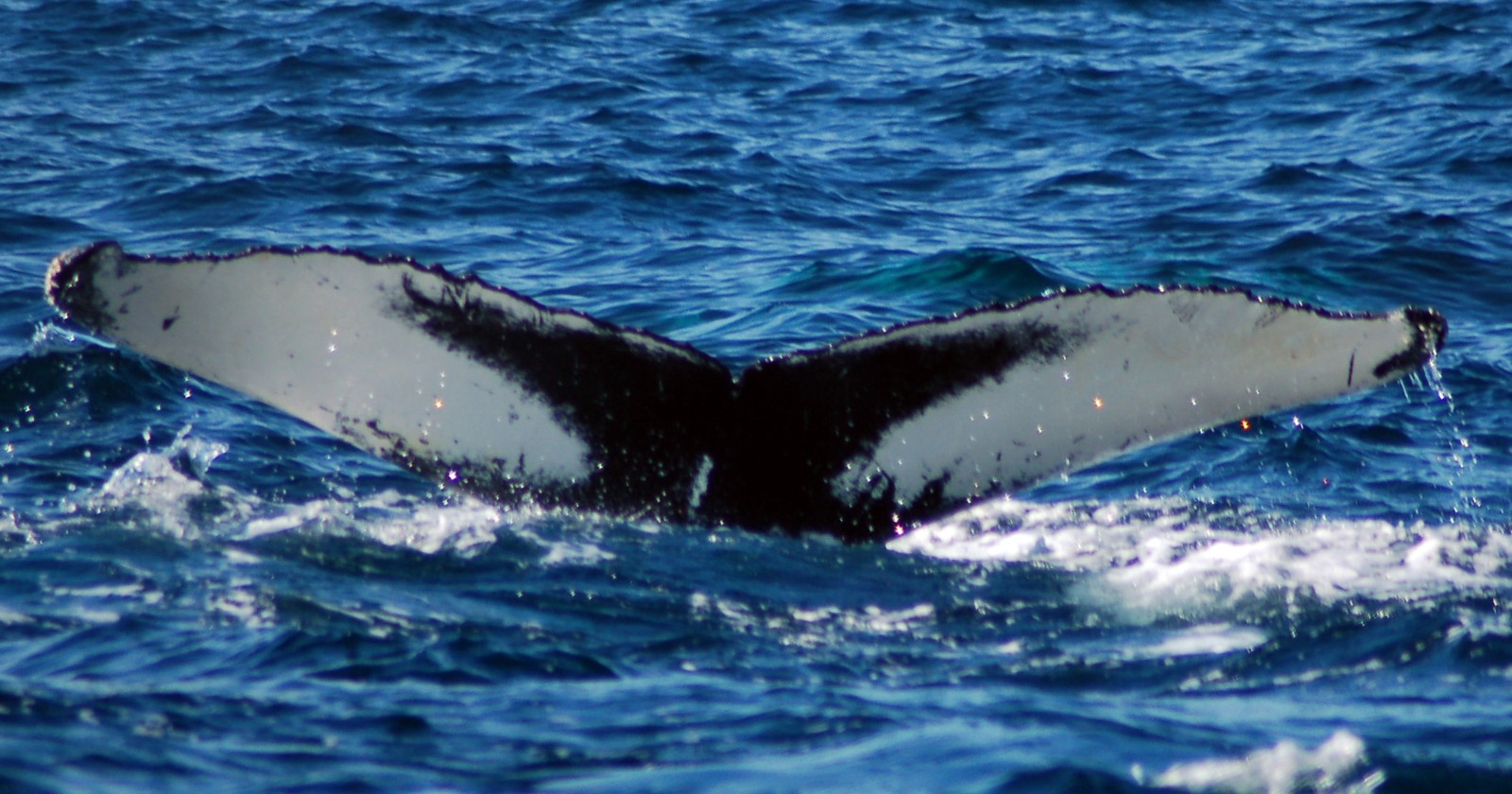
A humpback whale photographed in a rowdy group off the coast of Brazil in August 2003 was seen again in September 2025, this time alone, off eastern Australia. The two locations sit about 15,100 kilometres apart, and that gap is now the greatest distance ever recorded between two sightings of the same humpback whale.
The match is one of two described in a study published in Royal Society Open Science in May 2026, led by researchers at Griffith University working with teams in Brazil and the United States. Together the two whales are the first hard evidence that individuals move between the eastern Australian and Brazilian breeding populations in both directions, across two ocean basins that lie almost on opposite sides of the planet.
Two photographs, 22 years apart
The whales were not tracked by satellite or fitted with tags. They were identified the way humpback whales have been catalogued for decades, from the underside of their tails.
Every humpback carries a unique arrangement of shape, pigment and scarring on the ventral surface of its flukes, the two lobes of its tail. A clear photograph of that surface works like a fingerprint. The study drew on 19,283 high-quality fluke photographs collected between 1984 and 2025, taken by professional researchers and whale-watching passengers alike and pooled through Happywhale, a global citizen-science database.
An automated image-recognition system flagged possible matches across the Australian and Brazilian catalogues, and a trained researcher then confirmed each one by eye. Out of nearly 20,000 individual whales, the process turned up just two that had been photographed on both sides of the world.
Each of those two whales already carried several identification codes from different regional catalogues, a record of how many separate research groups and volunteers had logged the same animal over the years before anyone connected the two oceans. The confirmation in each case was checked independently by researchers in both regions.
The record-setter, catalogued as IBJ-1386, was first photographed on 7 August 2003 at the Abrolhos Bank off Bahia, Brazil, the country’s main humpback nursery, in a competitive group of nine adults slapping the water. Twenty-two years later, on 22 September 2025, it surfaced alone in Hervey Bay, Queensland, and lifted its tail for a camera as a whale-watching boat headed back to port.
The second whale was first seen in Hervey Bay in 2007 and again in 2013, then photographed swimming off São Paulo, Brazil, in 2019. The straight-line distance between those two breeding grounds is about 14,200 kilometres, more than a third of the way around the planet. Both gaps beat the previous record for a humpback, a 13,046-kilometre separation between Colombia and Zanzibar reported in 2024.
A distance between sightings, not a single swim
The 15,100-kilometre figure is easy to misread, and several early headlines did, calling it the longest whale migration ever recorded. It is not the length of one journey. It is the great-circle distance between two dots on a map, photographed 22 years apart.
The researchers are explicit about the difference. Photo identification captures only where a whale started and where it ended up, never the path in between. Given the years that passed between sightings, each animal would have completed many annual round trips between polar feeding grounds and tropical breeding grounds, so the true distance it swam is unknown and almost certainly far larger than the separation on the map. What the study establishes is a record for how far apart the same individual has ever been documented, not a single record-breaking trip.
The sex of both whales is also unknown. The 2003 animal was in a competitive group, a setting most often made up of males, but the team did not confirm it and warns against reading the matches as evidence of male or female wandering. With only two individuals and no genetic sexing, the paper leaves that question open.
Why a whale would cross between oceans
The most likely explanation points south, to Antarctica. Humpbacks from different Southern Hemisphere breeding populations feed in overlapping stretches of the Southern Ocean, and a whale that follows an unfamiliar group back north could, in principle, end up on an entirely new breeding ground, perhaps for the rest of its life.
That idea, the “Southern Ocean Exchange” hypothesis, was proposed in 2021 to explain earlier hints of mixing between populations. The new Australia-to-Brazil matches fit it and stretch it further, showing the connection can turn up between breeding grounds separated by the widest east-to-west gap between any populated Southern Hemisphere sites.
The authors note that a warming Southern Ocean, with shrinking sea ice and shifts in the distribution of Antarctic krill, the whales’ main prey, could make such wanderings more likely over time. They present this as a possibility to watch rather than a demonstrated cause. Two whales cannot show a trend, and the study does not claim one.
Rare enough to matter, too rare to count
Whatever drives them, these crossings are vanishingly rare. Two matches among 19,283 whales works out to about 0.01 percent of identified individuals, or roughly one every twenty years in the combined four-decade dataset. At that rate, the exchanges make no measurable difference to the size of either population.
They can still matter biologically. Even an occasional traveller can carry genes between otherwise separate stocks, helping maintain genetic diversity, and male humpbacks are known to spread new song styles across ocean basins much as musical trends move through human populations. A single whale settling in a new breeding ground could seed both a gene and a tune.
Both the Brazilian and eastern Australian populations have rebounded strongly since commercial whaling ended. The Brazilian stock has grown by an estimated 7 to 10 percent a year since the 1960s, when hunting had cut it to a few percent of its original numbers, and the eastern Australian group reached roughly 24,500 animals by 2015. A larger, recovering population produces more of these rare wanderers, which is part of why long-term photo catalogues are only now starting to catch them. Whether the crossings grow more common as the Southern Ocean keeps changing is the open question, and answering it will take the same slow accumulation of tail photographs, contributed by scientists and tourists alike, that connected these two whales in the first place.