

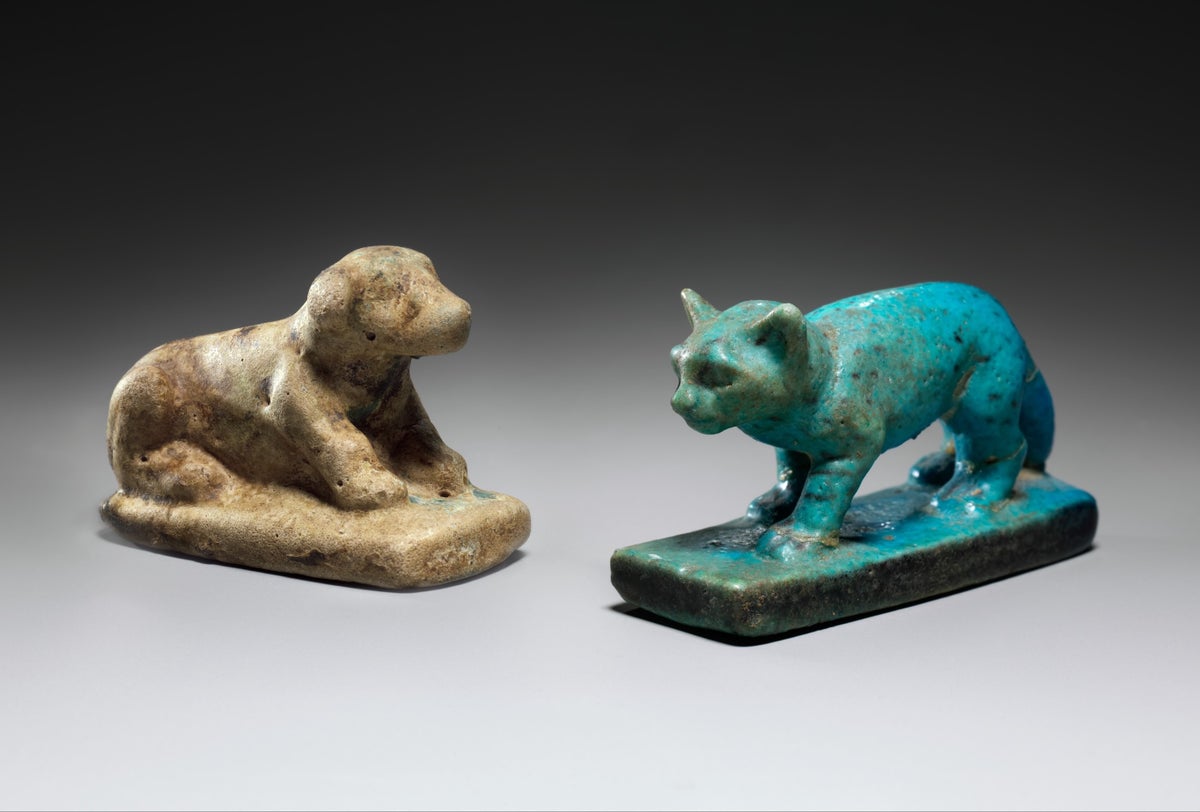
Armchair art historians, rejoice: there’s a free online daily game just for you. Called Anthropeum, the game involves guessing where and when various artifacts from New York City’s Metropolitan Museum of Art come from.
It’s deceptively simple—and outrageously fun. Players view artifacts and then place a pin on a world map to guess where it came from and choose an approximate date on a timeline. For example, last Wednesday, the game challenged me with a picture of a bronze sculpture that looked somewhat like a chariot. I selected a spot in the middle of modern-day Italy and around 500 B.C.E. on the timeline. Luckily for me, I was right.
If you’ve ever played a similar online guessing game, such as Wordle or GeoGuessr, you likely know the euphoria of combining your knowledge with a risky guess to win a resounding victory. But Anthropeum’s creator, 21-year-old college student Matthew Chu, says the game is about more than feeling smart.
On supporting science journalism
If you’re enjoying this article, consider supporting our award-winning journalism by subscribing. By purchasing a subscription you are helping to ensure the future of impactful stories about the discoveries and ideas shaping our world today.
“It’s meant to challenge us,” Chu says. “I want people to see stuff that they don’t know, so they can learn about it.”
Chu is an accounting and data science major at the University of Washington, but in his spare time he hangs out with coin and artifact collectors. He has witnessed collectors receive unidentified artifacts rescued from scrapyards around the world and then sort them for potential museum buyers by accurately identifying where and when the artifact was from.
The challenge of trying to place mysterious objects in space and time inspired Chu to create Anthropeum. The artifacts featured in the game are drawn from the Metropolitan Museum of Art’s Open Access Initiative, which offers images and data for more than 492,000 artworks in the Met’s collection.
A screengrab from Anthropeum.
Chu designed the game to present a balance of European and non-European artwork, in part, he says, because the Met’s collection overrepresents the former. “That bias would otherwise dominate the game: far more 17th-century Dutch paintings than sub-Saharan metalwork or pre-Columbian ceramics,” Chu explains on the Anthropeum website.
Using the Met’s dataset, Chu developed an algorithm to supply the game with 10 fresh artifacts’ images and data per day for the next 10 years or so. He also checks each entry to make sure the regions associated with the artifacts are accurate—the historical region information comes from two other open-source databases called historical-basemaps and OpenHistoricalMap.
Sometimes the cultures represented by a Met artifact don’t exist in the map database, and Chu must do the extra research to create a custom file for their regional area at the time they were active. He also takes the liberty of removing artifacts that are so nondescript they can’t be fairly identified with just a picture, like a rock polished into a ball.
Anthropeum doesn’t have an archive, but Chu is working on one so players can go back to try previous days’ challenges. He also hopes that he can one day add artifacts from other collections outside of the Met, but many of these are not open access for independent developers.
“A lot of my projects have been built around [open-source databases],” Chu says. “Making your project open source, someone else can build off of that and make life better for the people around you.”
Many players have provided valuable feedback that makes the game better, Chu adds. But there is “that 1 percent” of players who have been frustrated with his approach toward balancing the various origins of artworks.
“[One person said] ‘I think it’s so unfair that you have this artifact from this random island in the Pacific.’ And it’s like, no, that’s the point,” Chu says. “You see something that you don’t recognize, and you don’t know what it is and you get it completely wrong, but then you go and you learn about what culture created that. That’s part of the fun.”
It’s Time to Stand Up for Science
If you enjoyed this article, I’d like to ask for your support. Scientific American has served as an advocate for science and industry for 180 years, and right now may be the most critical moment in that two-century history.
I’ve been a Scientific American subscriber since I was 12 years old, and it helped shape the way I look at the world. SciAm always educates and delights me, and inspires a sense of awe for our vast, beautiful universe. I hope it does that for you, too.
If you subscribe to Scientific American, you help ensure that our coverage is centered on meaningful research and discovery; that we have the resources to report on the decisions that threaten labs across the U.S.; and that we support both budding and working scientists at a time when the value of science itself too often goes unrecognized.
In return, you get essential news, captivating podcasts, brilliant infographics, can’t-miss newsletters, must-watch videos, challenging games, and the science world’s best writing and reporting. You can even gift someone a subscription.
There has never been a more important time for us to stand up and show why science matters. I hope you’ll support us in that mission.