

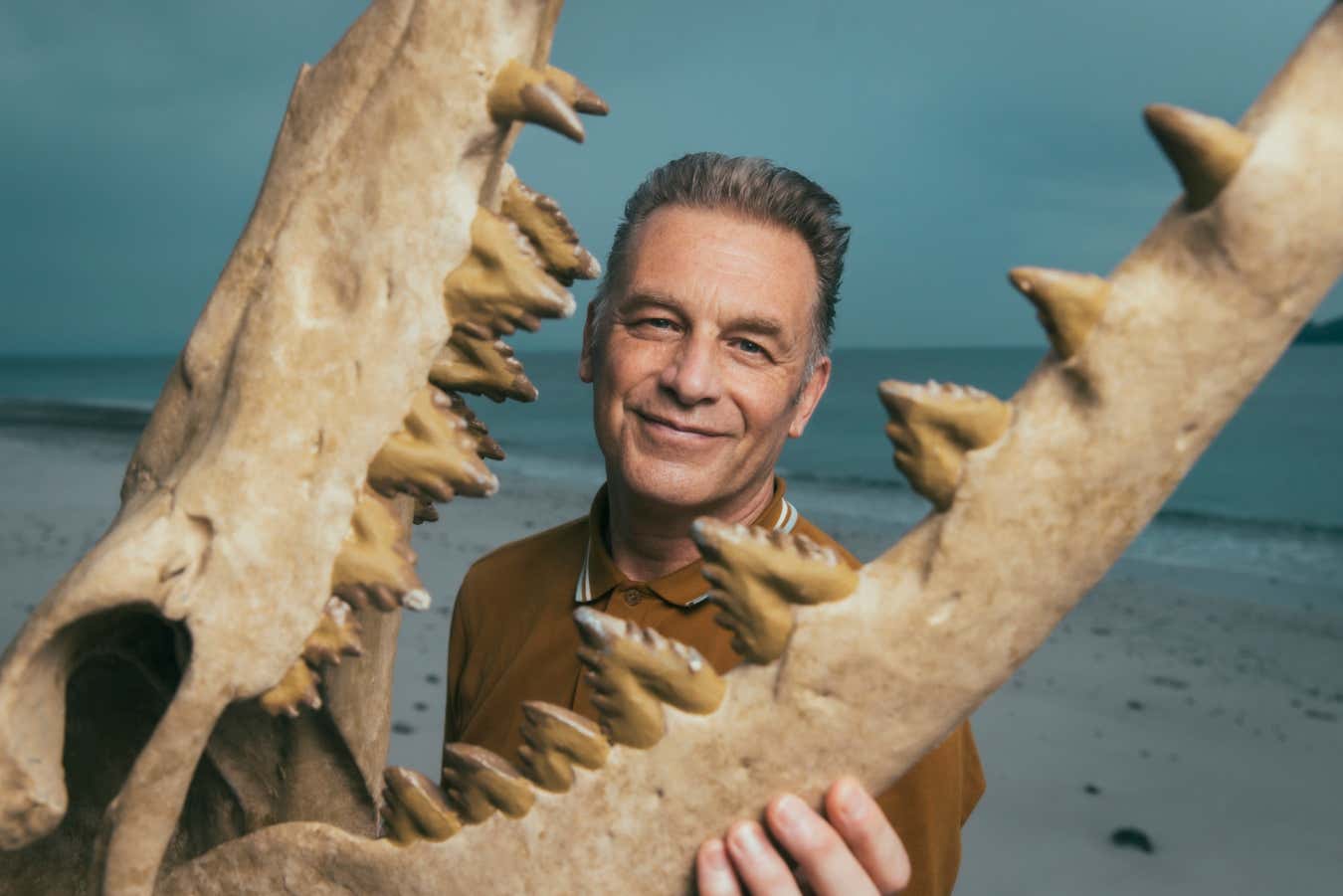
Chris Packham, in his new series Evolution, holds a replica skull of Dorudon atrox, an ancient relative of dolphins
BBC Studios/Freddie Claire
In Evolution, an ambitious new five-part programme, broadcaster and naturalist Chris Packham fleshes out the evolutionary backstories of five beloved animals. From elephants to ostriches, he takes us all the way back to the last universal common ancestor of all life on Earth and, with the help of CGI, introduces us to pivotal ancestors along the way.
He spoke to New Scientist about how he hopes that powerful new science and great CGI can help us move on from just loving nature to truly taking care of it.
Penny Sarchet: Chris, congratulations on the new show. What drew you to this project and the subject of evolution?
Chris Packham: We like a challenge, basically. We’d risen to that challenge with our previous series Earth, looking at enormous time spans and inconceivable events. To take something that big, that complex, and make it comprehensible was a challenge, and Earth was very popular. I think people were able to take a lot from it. So, evolution – again, something perceived to take a long time and to be inordinately complex – was something we thought we would rise to.
We learned some lessons with Earth. We didn’t approach evolution in the classic school-room sense, starting with the first cell and working through to the present. We chose five iconic animals to carry a narrative about the evolution of locomotion, intelligence, feeding and reproduction, etc.
That gave us the capacity to come up with some surprising stories that are accessible and engage our audience. I like the idea that we start our programmes with little things that they will be so excited by that they’ll have to pick up their mobile [phone] and text it to their mates, or tell them when they next meet them down the pub.
I thought it was very engaging, the way you went several levels deeper with each animal. For example, with bats, you look not just at how they evolved to fly at night but the whole story of why animals began to feed.
I think the fundamental things can be the most surprising for people, [but] sometimes we don’t ask those questions. We get through childhood when we should have been asking those questions – why is the sky blue, why do stars twinkle – and then we find ourselves as adults, and we kind of forget about them. But if you bring [science] back to basics and look at it in a not-childish but child-like way, it can be joyous.
Another key thing we wanted to do was identify [for] these iconic animals the key turning points. We can use CGI to rebuild some of the creatures that otherwise we would be talking about in a purely conceptual way, or we might just have a fossil model if we’re fortunate. It’s those turning points I get the most joy from – little things like gills becoming jaws, and then part of the jaw becoming the ear bones that give us the capacity to hear. You don’t normally think about that.
And bats need to eat half their own body weight every night. How are they going to do it? Well, they need their ears, and in fact, that’s part of the mechanism they’re actually eating with. I love all those things coming together.
I found it exciting to see things brought to life. When I was studying evolution, it was dusty fossils and textbook ideas. But now CGI and scientific detail have come together very well.
Science is never standing still. What we’ve done is taken the ability to tell that story in a different way, using CGI plus what we know now. We’re not saying we have all the answers. In fact, one of the trials of making this programme is that you’re working with scientists, and sometimes there are several groups, and they disagree. So, we have to either build in ambiguity, or we have to say there are two theories: this is one, this is the other. I quite enjoy not knowing, because it gives the programme and people’s imagination somewhere to go.

Chris Packham with a Baird’s Tapir in Costa Rica, in his new show Evolution
BBC Studios/Freddie Claire
What can a deeper appreciation of evolution bring to our love of wildlife?
There is a misconception that we [humans] are the be-all and end-all of evolution. We are a remarkable organism – inventive, creative, imaginative, resourceful, resilient and so on. But we’re not it, you know. Evolution continues, and will always, whatever we do. It’s not about us, it’s about life – we are not isolated; we are part of nature, we are dependent on nature.
That’s something we really do need to reinforce, because we’re doing so much harm to nature and harm to ourselves. We’re never going to look after it unless we care about it. Sir David [Attenborough] has done a sterling job over many years of engaging people with wildlife and nature and getting them to develop a deep-rooted affinity for it. No one could have done more, frankly. But now we’re in a different space – they don’t have to just love it anymore, they’ve really got to care about it. And I care about things more if I know more about them.
If you could travel back in deep time for a moment, what would you want to see?
I’m the kid who grew up with T. rex as the best animal in the world. Big, fierce and most importantly, extinct. When I was a kid, I never imagined that I would know what T. rex looked like. If you were in a classroom and you got the felt-tip [pens] out, everyone would do T. rex in a different colour, and my perception was that we would never know what colour that dinosaur was.
However, I’m 65 years old now. We’ve had basically 60 years of rapidly advancing palaeontological knowledge, and we’ve completely redefined that animal. We’ve learned more about it in the last 60 years than the last 65 million years. For me, [it] is enormously exciting to see that animal evolve through scientific discovery. But there are questions about it that we don’t know. So, if I’m trickling towards the end of my life and you offer me five minutes in a time machine, I’m [going to] the Cretaceous. I want to know what colour it was, and how it was hunting. And if it didn’t interrupt the space-time continuum, I’d throw myself in front of it to be consumed.
What a way to go!
It’d be great on the tombstone, wouldn’t it?

Chris Packham holding a rock monitor lizard in South Africa
BBC Studios/Will Edwards
I liked that you don’t just meet the five-star animals in Evolution. You also see modern relatives and analogues for important ancestors. Did you have any favourites?
The little velvet worm. I’d seen velvet worms in books, photographs and film, but I’d never met a velvet worm and they are just so unbelievably weird. When the little velvet worm came out on the log, that, for me, was amazing.
I really liked the lungfish. I’ve read about them, but I’m not sure I’d ever seen a video.
Oh, the lungfish! Really slimy, quite bitey, gulping. The limbs looked like tentacles, but they’re not, they’re articulated. It was amazing to see them; that was another really special moment. Behind the scenes, scientists turn up and tell you everything they know, and you try to get as much of that in the script that is relevant. I was talking to the lungfish man for about two hours! Should have made a separate programme…
You’re always bringing science into Springwatch. Could nature programmes in general benefit from adding science?
I started doing research at a very young age. I published stuff before I got to university. I was mentored by some really great scientists, and I love science. When they said, do you want to make Springwatch, I thought yes, but I’ve got to bring something to it.
The benefit of Springwatch is that we can bring science about species which people are very familiar with, back-garden animals, things flying around their neighbourhood. Scientists did some experiments where they offered swallows the choice between white feathers and coloured feathers to line their nest, and they found that 75 per cent of the feathers they chose were white. We see that this is because they’re broken down by particular bacteria which produce antimicrobials, which means that they have a higher hatching rate and fledging rate with more white feathers.
I’ve known swallows all of my life; our audience have known swallows. I can’t think of anything more exciting on Springwatch this year than knowing that those little birds, when they’re flying around, they’re choosing the feathers to line their nest to improve the chances of getting their chicks on the wing – it’s absolutely brilliant!
What do you hope the audience will take away from watching Evolution?
I hope they’ll be excited, I hope they’ll be surprised, I hope they’ll rethink what evolution is and what it means, and most importantly, I think that they’ll think about what the context is for this point in time. When you think of the beauty of evolution and the way that it’s worked, yes, there are processes, but there has also been an enormous amount of chance. We are so fortunate to be here at this point, on this one little blue dot floating in space with this enormous richness and diversity of life, thanks to evolution – do we really want to mess it up?
Evolution begins in the UK on 13 July on BBC Two and BBC iPlayer
Topics: