

Almost a week after rival armed groups carried out a series of coordinated attacks across Mali, the country’s military government has begun restructuring and taking measures to secure the country.
On April 25, al-Qaeda-linked group Jama’at Nusrat al-Islam wal-Muslimin (JNIM) claimed responsibility for attacks on military sites across the country, including in the capital, Bamako. JNIM said it had “captured” the city of Kidal in the north in a coordinated operation with the Azawad Liberation Front (FLA), a Tuareg-dominated rebel group with which it has previously sparred.
Recommended Stories
list of 3 itemsend of list
The series of attacks marked one of the biggest security crises the country has faced since at least 2012. JNIM controls swaths of rural territory, especially in the northern and central regions of the country, and has active cells located around the capital.
Meanwhile, armed Tuareg separatists belonging to the Liberation Front for Azawad (FLA) group, which is fighting for an independent Tuareg nation in the north, are clashing with the military and allied Russian mercenaries who have been deployed since 2021. Together, FLA and JNIM control Kidal now, but they also want to take Gao, the largest city in the north, as well as Menaka and Timbuktu, to complete the self-declared state of Azawad.
Despite having differing ideologies and, at times, fighting each other, these two groups have sometimes worked together: They operate in the same areas and draw from the same pools of fighters from aggrieved communities.
Here’s what we know about the situation on the ground now:
What has the government done since the attacks last week?
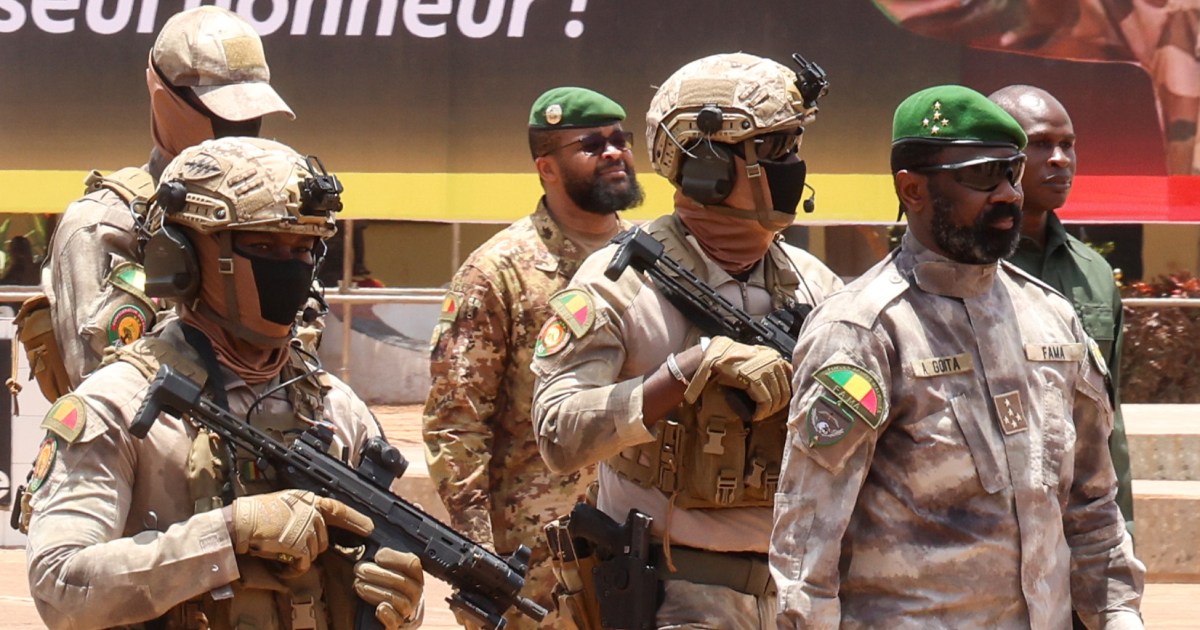
The leader of Mali’s military government, Assimi Goita, has taken on the role of defence minister following the killing of the previous minister, Sadio Camara, in last week’s attacks by rebel groups, state TV channel ORTM reported on Monday.
Camara died when a car laden with explosives driven by a suicide attacker drove into his residence, the government said.
The presidential decree appointing Goita to the role stipulated that he will also remain president while also taking on the new role.
Have civilians been affected by the attacks?
Besides the country’s defence minister, at least 23 people were killed in the fighting between armed groups and the armed forces with Russian mercenary support. The United Nations children’s agency UNICEF said civilians, including children, were among the dead and injured.
In a report published on Tuesday this week, the Office of the United Nations High Commissioner for Human Rights (OHCHR) said there have also been “gravely concerning reports of extrajudicial killings and abductions, allegedly carried out by members of the security forces following the 25 and 26 April attacks”.
“On 2 May, lawyer and politician Mountaga Tall was abducted from his house by two hooded men and taken to an unidentified location. His wife was physically assaulted as she tried to record the abduction on her mobile phone and her phone confiscated. Three relatives of the exiled politician Oumar Mariko were also reportedly abducted a day earlier. Their whereabouts remain unknown,” OHCHR said.
Malian authorities are investigating soldiers suspected of involvement in the attacks, a judicial official told the media in the country on Friday.
Reporting from Africa, Al Jazeera’s Nicolas Haque said that, since the killing of the defence minister, officers, policemen, and even lawyers are being rounded up.
“Critics have called it a witch-hunt. They’re being accused of colluding with the enemy. Authorities say last month’s attack were only possible because of ‘traitors within,’” he said.
OHCHR also noted that there have been worrying reports of hunger amid the country’s recent security crisis.
“On 3 May, the mayor of Diafarabe village, in the Mopti region, called on the authorities to act within 48 hours or people would start dying of hunger, as the village had run out of food. Diafarabe and the capital Bamako are currently under a JNIM blockade. Such blockades have unacceptable consequences for civilians and must end immediately,” the UN agency said.
“UN Human Rights Chief Volker Türk calls for an immediate end to the fighting and urges all parties to uphold international humanitarian law and international human rights law, including by ensuring protection of civilians and civilian infrastructure,” OHCHR added.
Why are Russian mercenaries fighting in Mali?
In the past, to address security crises in Mali and other West African nations, European nations, primarily France, helped the government to fight unrest for more than a decade. But in 2023, they withdrew following a breakdown in relations with Mali’s military government and the country’s growing alliance with Russia.
In December 2021, Goita had invited Russian mercenary group Wagner to support the military administration in its fight against armed groups after asking French troops to leave the country.
In June last year, Wagner said it would withdraw from Mali after more than three-and-a-half years on the ground. The paramilitary force said it had completed its mission against armed groups in the country.
But Wagner’s withdrawal from Mali did not mean the departure of Russian fighters. Russian mercenaries have remained in the country under the banner of the Africa Corps, a separate Kremlin-backed paramilitary group created after Wagner founder Yevgeny Prigozhin led a failed mutiny against the Russian military in June 2023.
Following the attacks a week ago, Mali’s army and allied Russian fighters have been locked in conflict with JNIM fighters.
On Tuesday, Al Jazeera’s Nicolas Haque reported that approximately 2,000 paramilitary fighters are currently on the ground. “Their mission: protect Mali’s military leadership,” he said.
In a statement on April 28, Russia’s Ministry of Defence also said its forces in Mali were regrouping and that they had helped thwart a coup attempt in the country.
Russian forces were conducting active reconnaissance operations to destroy rebel field camps and stood ready to repel further attacks, it added.

What has happened since the attacks?
On May 4, Al Jazeera obtained exclusive footage showing dozens of Malian soldiers being held prisoner by Tuareg separatists in northern Mali.
Al Jazeera’s Nicolas Haque reported that about 130 Malian soldiers have been taken captive in Kidal in the north, after Russian fighters fled JNIM and FLA fighters.
“Their [Russian] contract, it seems, is not to protect every Malian soldier, only those in power,” he said.
“They’ve [the soldiers] been stripped of their uniform and are being held as prisoners of war by Tuareg separatists,” he added.
In the video obtained by Al Jazeera, one man introduces himself as a paramilitary soldier, one says he’s an army officer, another says he’s a policeman. According to one soldier, wounded captives have been receiving care in hospital.
According to Haque’s report, the FLA said it respects human rights and does not target civilians. However, human rights groups have accused JNIM fighters of rape, torture and abuse.
“They [the captured soldiers] are not just prisoners of war, but perhaps bargaining chips where the chain of command is breaking and where any talk of peace now begins with their fate,” Haque reported.