

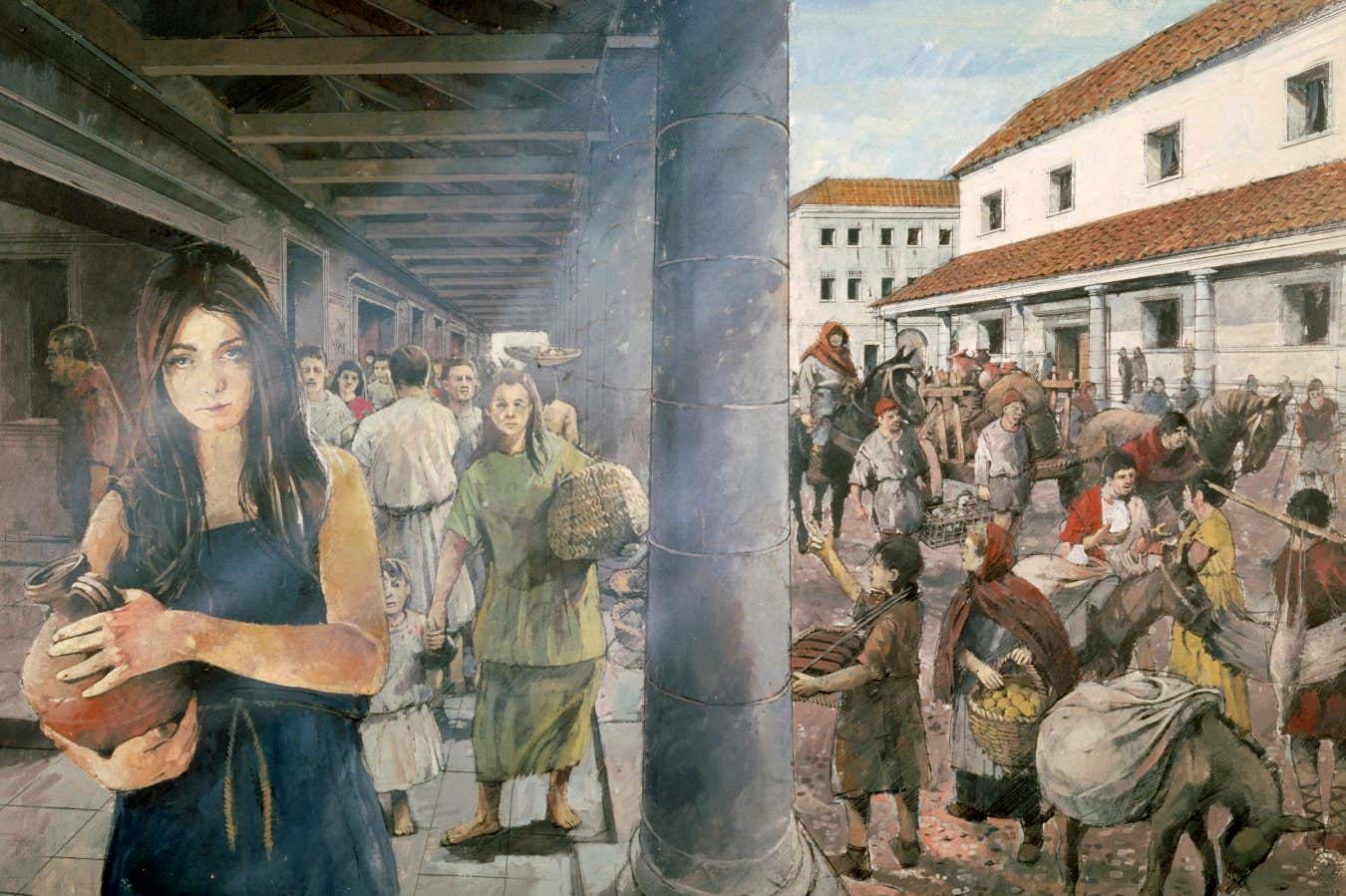
Reconstruction of the city of Wroxeter in Roman Britain
Ivan Lapper/English Heritage/Heritage Images/Getty Images
The health of populations in Britain declined under Roman occupation, particularly in more urban areas.
There is a widely held belief that the Romans brought civilisation and its many benefits to those they conquered, perhaps best exemplified in Monty Python’s Life of Brian, in which John Cleese’s character Reg asks “Apart from the sanitation, the medicine, education, wine, public order, irrigation, roads, the freshwater system and public health, what have the Romans ever done for us?”
Yet researchers have been aware for at least a decade that there was a decline in the health of the population in Iron Age Britain after the Romans conquered the territory in AD 43 – and that populations thrived after they left.
Now, Rebecca Pitt at the University of Reading, UK, has studied 646 ancient skeletons, 372 belonging to children who were less than 3.5 years old when they died, as well as 274 from adult females aged between 18 and 45 years old. These came from 24 Iron Age and Romano-British sites across south and central England, dating from four centuries before the Romans turned up until the fourth century AD, when they withdrew.
Pitt estimated the ages of the individuals from features of the pelvis in adults and from the teeth of the children. Looking at the experiences of potential mothers and infants together, she says, should give a better impression of the stressors affecting different generations under Roman occupation.
“Environmental exposures during critical periods of early development can have lasting effects on an individual’s health,” says Pitt, just as a mother’s health can influence that of a child.
Pitt examined the bones and teeth and looked for abnormalities such as lesions or fractures that could indicate tuberculosis, osteomyelitis or dental disease. She also used X-rays to look at the internal structures of bones, which can reveal changes to how the bones develop caused by malnutrition or deficiencies in vitamin C and D.
This revealed that the negative health impacts of the Roman occupation were concentrated in the two larger urban centres in the study – the Roman administrative towns of Venta Belgarum, now Winchester, and Corinium Dobunnorum or Cirencester.
Overall, 81 per cent of the urban Roman adults had bone abnormalities compared with 62 per cent of people dating from the Iron Age, but the Iron Age and rural Roman cohorts didn’t differ significantly. And just 26 per cent of Iron Age children featured such effects compared with 41 per cent or those in rural Roman settlements and 61 per cent in urban Roman sites.
“One of the things that was really apparent in the urban non-adults was rickets, which means that people weren’t getting enough access to vitamin D from sunlight,” says Pitt.
She suggests these health effects, which lasted for many generations, were down to new diseases the Romans brought with them as well as the class divides and infrastructure they introduced, resulting in limited access to resources for those lower down the social ladder and overcrowded, polluted living situations.
“My dad always jokes about The Life of Brian, but the Romans had quite a negative impact on our health, which affected quite a few generations,” says Pitt.
Martin Millett at the University of Cambridge says the finding is interesting, and that the effect might even be underestimated if the people who were being buried were those of higher status who might have been healthier, but he doesn’t think it’s necessarily an urban effect.
“These urban centres are not huge medieval towns with deep poverty and huge densities,” he says. “What we may be seeing is an increasing differentiation between the rich and the poor. The Roman Empire has an economic and a social system that means the difference between the rich and poor is getting greater through time.”
Richard Madgwick at Cardiff University, UK, also says that the legacy of the Romans didn’t benefit everyone equally. “Greater hygiene, sanitation and medical know-how was there, but the access to it? That’s a totally different matter,” he says. “The reality is that not everyone benefited and it took a little while to trickle down to the different elements of society.”
Topics: