

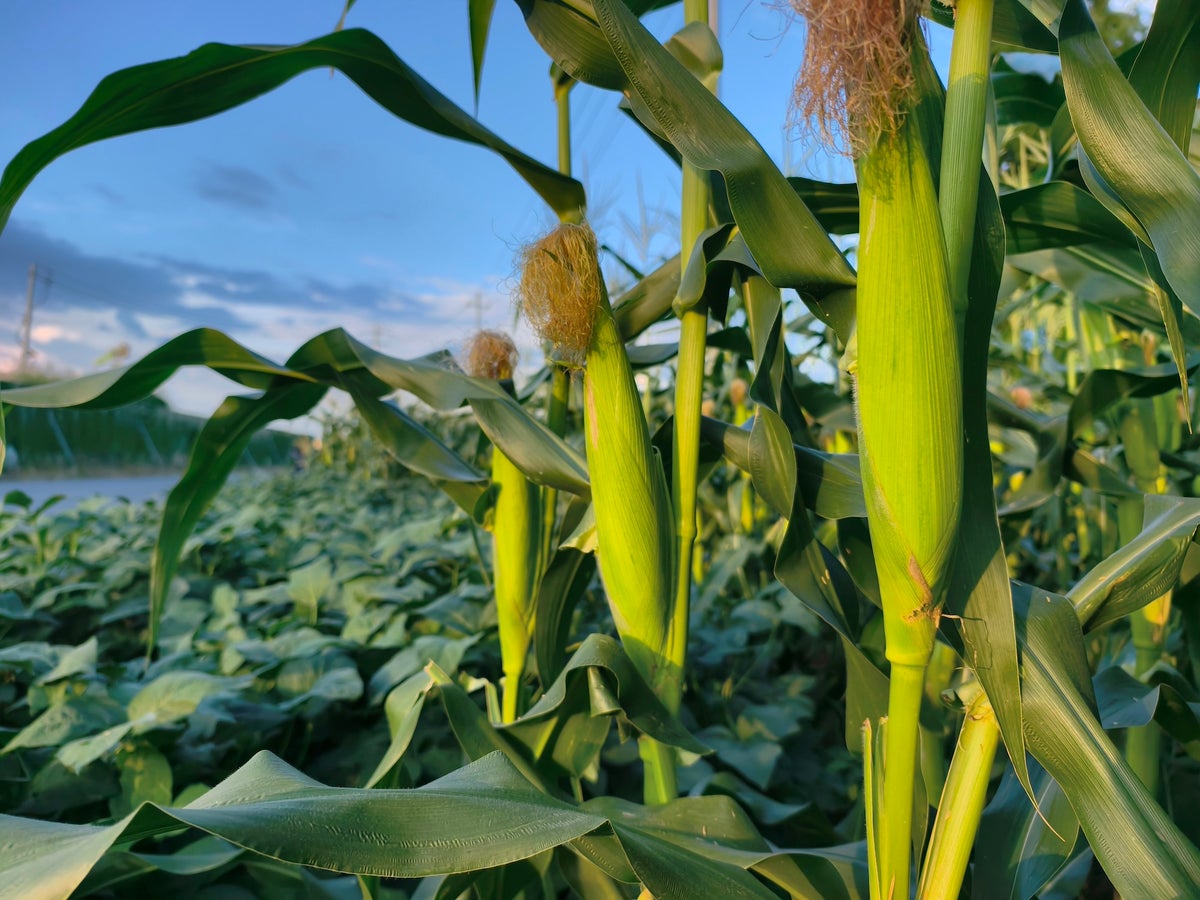
It’s boiling hot in the U.S. Midwest—which means it’s time for “corn sweat” to hit the headlines, drawing ire from millions sweltering under sky-high humidity and adding insult to heat wave injury. Cities that include Minneapolis, Des Moines and Indianapolis will wilt under heat index temperatures nearing or even exceeding 100 degrees Fahrenheit for most of the week.
The phenomenon of corn sweat has only gone mainstream within the past decade, although farmers and meteorologists based in the so-called Corn Belt—centered around Nebraska, the Dakotas, Minnesota, Iowa and Illinois—have long recognized the increased humidity that can occur over farm fields. But agricultural scientists say it’s time for the slander to stop: corn doesn’t “sweat” any more than other major crops. Rather the issue is the sheer amount of acreage that has been carefully managed to maximize yields.
Corn “sweat” isn’t really sweat; instead it is water vapor that corn releases through a phenomenon called transpiration. “This is a natural mechanism,” says Bruno Basso, an agricultural systems scientist at Michigan State University. “Plants have to transpire.”
On supporting science journalism
If you’re enjoying this article, consider supporting our award-winning journalism by subscribing. By purchasing a subscription you are helping to ensure the future of impactful stories about the discoveries and ideas shaping our world today.
Specifically, plants have to transpire because photosynthesis converts carbon dioxide and water into sugar plus oxygen and water. “This is a simple equation,” says Avat Shefooka, a crop physiologist at the University of Tennessee, Knoxville.
Under ideal conditions, the amount of water that a particular plant loses through transpiration is determined primarily by its total leaf area and the density of the small pores called stomata through which the plant takes in carbon dioxide and releases water vapor and oxygen. A larger leaf area—corn has a larger leaf area compared with those of other crop plants, such as soybeans—and more stomata mean higher water loss.
Of course, conditions in the field are often not ideal. High temperatures, low humidity, wind and sunlight all leave the local atmosphere thirstier, which pulls additional water through any plant, not just corn, like sucking on a straw, says Meetpal Kukal, an agricultural hydrologist at the University of Idaho Boise. The only way to cut off excess transpiration is to reduce the amount of water a plant can access in the soil—creating a drought, which hurts both the plant and a farmer’s yield. Farmers tend to do the opposite: irrigating crops to ensure plants have all the water they need to produce as much as possible.
That’s particularly true of corn, which covers the largest share of irrigated cropland in the U.S.—comprising a huge volume of plants with access to plenty of water for the atmosphere to suck up. Moreover, there is a lot of corn—as of the end of June, corn covered about 95 million acres of the U.S.—4 percent of the nation’s total land area. Soybeans, by contrast, cover less land, and less of that acreage is irrigated, which, at this scale, matters more than the quirks of individual plants.
Those statistics are why Kukal says corn sweat isn’t really about corn—it’s about agriculture’s scale and yield-optimization practices. “A hundred years ago, all of this was grasslands and prairies,” he says. “We were not pumping feet and feet of water on this land.” He also notes that, in recent decades, breeders have engineered corn plants to stand more upright, allowing farmers to pack plants closer together and resulting in more water vapor transpired per field.
All that water vapor becomes most problematic during a heat wave, when an area of stagnant, high-pressure air traps any water vapor released, says Amir Souri, an atmospheric scientist at NASA’s Goddard Space Flight Center. Because water vapor is a greenhouse gas, “it can act as a blanket,” raising temperatures further, he says.
That trapped heat exacerbates the fact that increased humidity makes any given temperature feel hotter to humans than a thermometer indicates. The result is sweaty humans ready to blame something, anything—even corn that’s just doing its thing.
“This is a sign of a healthy corn crop,” says Jake McNeal, an agronomist at the University of Tennessee, Knoxville, of the much maligned corn sweat. “If you want corn to sweat less, plant less corn or give it less water,” he adds—but either way, know that you’ll pay the price in corn.
It’s Time to Stand Up for Science
If you enjoyed this article, I’d like to ask for your support. Scientific American has served as an advocate for science and industry for 180 years, and right now may be the most critical moment in that two-century history.
I’ve been a Scientific American subscriber since I was 12 years old, and it helped shape the way I look at the world. SciAm always educates and delights me, and inspires a sense of awe for our vast, beautiful universe. I hope it does that for you, too.
If you subscribe to Scientific American, you help ensure that our coverage is centered on meaningful research and discovery; that we have the resources to report on the decisions that threaten labs across the U.S.; and that we support both budding and working scientists at a time when the value of science itself too often goes unrecognized.
In return, you get essential news, captivating podcasts, brilliant infographics, can’t-miss newsletters, must-watch videos, challenging games, and the science world’s best writing and reporting. You can even gift someone a subscription.
There has never been a more important time for us to stand up and show why science matters. I hope you’ll support us in that mission.