

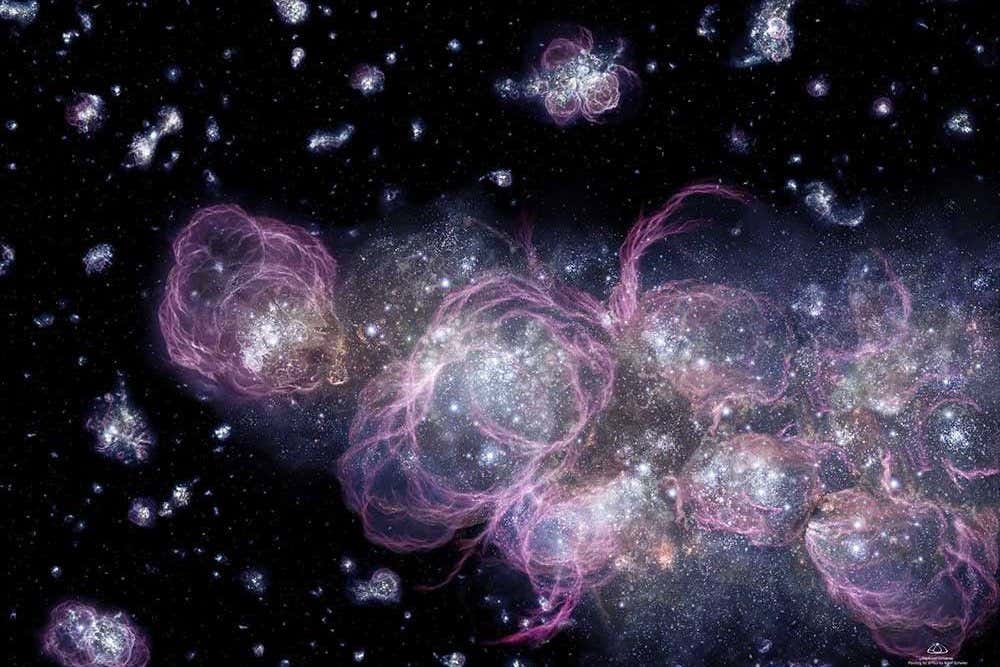
An artist’s impression of star formation in the early universe
Adolf Schaller for STScI/NASA
Astronomers have had the most compelling glimpse yet of some of the universe’s first stars. These are unlike any other stars we have seen and could help us understand crucial properties about the early universe, such as how massive the earliest stars were and how they shaped those that formed later.
It is thought that the first stars to form in our universe were made from almost entirely from hydrogen and helium, with no heavier elements. They were also enormous and blazingly hot, hundreds of times more massive and tens of thousands degrees hotter than the sun.
But because most of these so-called Population III stars lived for only a relatively short amount of time before blowing up, astronomers have yet to conclusively find a galaxy filled with them because they existed so early in the universe’s history.
Now, Roberto Maiolino at the University of Cambridge and his colleagues have found that the galaxy Hebe, a group of stars that existed just 400 million years after the big bang, has all the hallmarks of a Population III-filled galaxy.
As well as containing no observable elements heavier than hydrogen or helium, the light coming from the galaxy is concentrated around a tell-tale frequency associated with helium that has been stripped of its electrons – something only extremely hot stars, like Population IIIs, are able to do. “It seems that Population III stars is, as far as we can see, the most plausible explanation,” says Maiolino. “All other explanations are highly unsatisfactory.”
Hebe was originally spotted by Maiolino and his team in 2024 using the James Webb Space Telescope (JWST), where its spectra appeared to show an ionised helium line suggestive of Population III stars, but it was unclear whether this line was real or came from another galaxy, as well as whether there might be heavier metals in the stars.
But, after further observation with JWST, the researchers have now found a second line, associated with ionised hydrogen and coming from the same source, indicating that the helium line was, in fact, real.
“I spent a lot of time really scrutinising the data, making sure that this is a secure line detection,” says team member Hannah Übler at Ludwig Maximilians University of Munich in Germany. “Once this was clear, where we see this [ionised hydrogen] peak and otherwise no line detections, that was really amazing. It was a great moment to know, and have proof, that what we claimed a few years earlier was indeed true, that here we have helium and hydrogen, suggesting the Population III scenario.”
The results are compelling and the presence of the ionised helium line suggests we are seeing extremely hot objects, which is what we expect for a Population III star, says Daniel Whalen at the University of Portsmouth, UK, but it isn’t conclusive because we still haven’t got the level of precision needed to rule out that there aren’t heavier elements, which would make them more mature Population II stars.
A galaxy filled with as many Population III stars as Maiolino and his team predict is also difficult to explain with simulations that astronomers have made of the early universe, which find that the first stars often formed in relatively isolated and sparse clusters.
“It’s not just about the race to put a flag on Population III, saying we found it, and that’s it. Actually, we are learning already a lot,” says Maiolino. If the stars in Hebe are confirmed to be Population III stars, they could give us crucial information on the early universe, he says.
Maiolino and his team have already used the first observations of Hebe to simulate how massive the first stars may have been, and found that the majority of them are around 10 to 100 times more massive than the sun, with far fewer smaller than that.
Topics: