

Here’s what stops huge earthquakes in their tracks
When an earthquake rupturing along a fault hits a barrier, it creates a seismic signature called the “stopping phase.” Scientists have isolated this and could use it to better predict earthquake risk
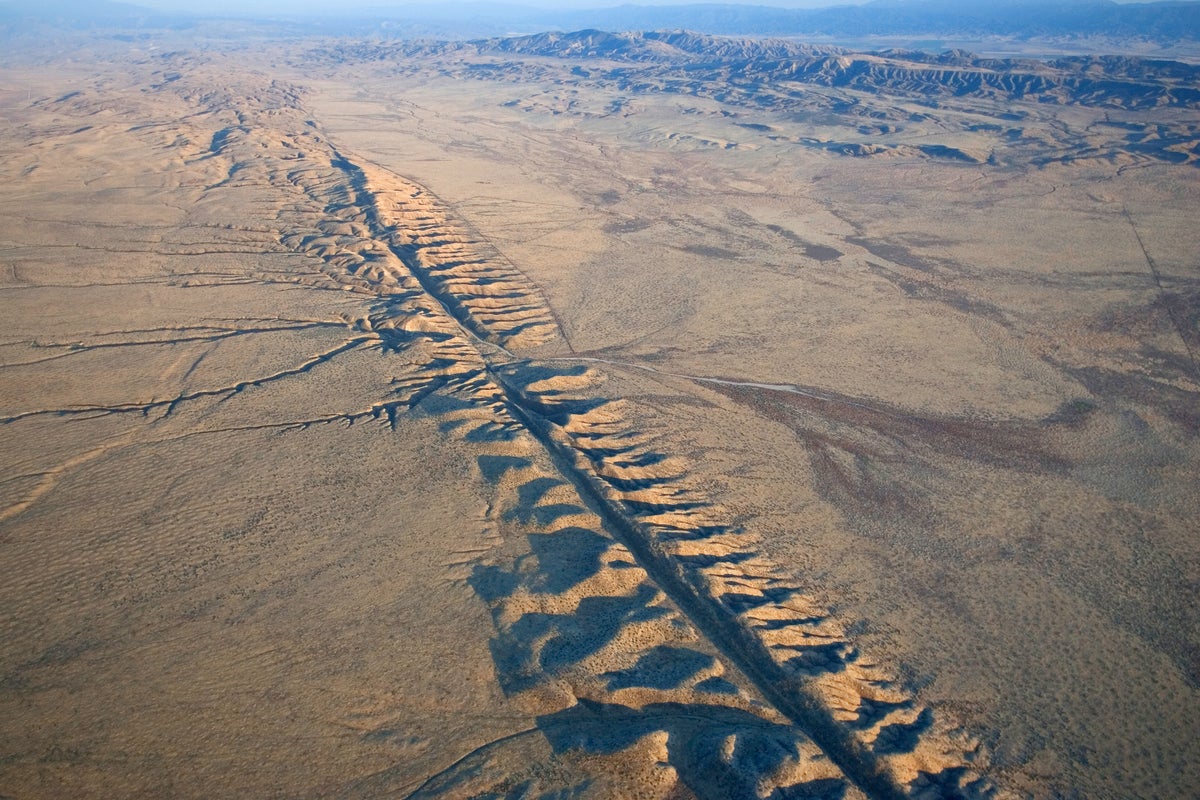
An aerial view of the San Andreas Fault crossing the Carrizo Plain in California.
Cavan Images/Peter Essick/Getty Images
On Monday residents of northeastern Japan were rattled by a massive magnitude 7.7 earthquake off the coast and warned of possible tsunamis, as well as a slim chance of a magnitude 8 or higher “megaquake” in the coming days. A new study, published Thursday in Science, investigates how such “megaquakes” evolve, what can eventually stop them and how we can predict their destructive power.
An earthquake starts deep underground when huge tectonic forces cause stress to build up along a fault line, a massive fracture in Earth’s crust where blocks of rock have shifted and moved past each other. Once this accumulated stress overcomes the friction holding the rocks together at a specific point called the hypocenter, the fault slips, and a rupture rapidly spreads along it, generating powerful seismic waves that cause the ground to shake. This process continues until the spreading rupture reaches an area of low stress and slowly loses momentum, or until it hits a physical barrier underground that makes it stop instantly, like a speeding train crashing into a concrete wall.
That process of a rupture hitting a barrier creates a signature called a stopping phase—a seismic shudder traveling the opposite direction to the main rupture. “When the rupture is going fast and encounters some barrier that suddenly makes it stop, it sends out a shock wave,” says study co-author Jesse Kearse, an Earth scientist at Victoria University of Wellington in New Zealand. A human standing above such a barrier would first feel the ground move in the same direction as the rupture and then sharply jump back the opposite direction. “It’s like you’re in a car and the brakes suddenly engage, and you snap back in your car seat,” Kearse explains.
On supporting science journalism
If you’re enjoying this article, consider supporting our award-winning journalism by subscribing. By purchasing a subscription you are helping to ensure the future of impactful stories about the discoveries and ideas shaping our world today.
But observational data showing that signature has been lacking, so Kearse and his colleague Yoshihiro Kaneko, a geophysicist at Kyoto University, hunted for it in the seismic and geodetic data registered by sensors placed close to 12 large earthquakes across the globe.
Five of the earthquakes the researchers studied had enough sensors along the fault that they could isolate the stopping phase for these quakes. The team also found that certain near-surface features, such as softer rock layers above where the stopping phase happens, can further enhance it, leading to more severe shaking of the ground at the surface.
Every barrier a rupture hits on its way works as a checkpoint. If the barrier holds, it stops the earthquake, which can end up as a minor, localized event. But if the advancing rupture has enough energy to shatter through the checkpoint, it spills over into the next fault segment, potentially cascading into a “megaquake” monster. “This demonstrates the extremely valuable role of near-field observations in understanding why earthquakes grow big or remain small,” says Yihe Huang, a geophysicist at the University of Michigan, who was not involved in the study.
Now that scientists know how to identify a stopping phase signature, the researchers say, they can pinpoint these phases in past earthquakes’ data to map out underground barriers and assess how much energy they can absorb, plus whether there are any amplifying near-surface features nearby. “This new insight can potentially transform earthquake hazard analysis,” Huang adds, by showing where an earthquake of a particular strength might be stopped and where it might be enhanced.
But there’s still a lot of research to do before the new findings help to build more accurate earthquake models. Kearse and Kaneko limited their study to strike-slip earthquakes, in which two blocks of rock slide horizontally past one another, because there are simply more data for them. Monday’s event in Japan was a thrust earthquake that made the ground move up and down—a motion that is much more likely to cause a tsunami. “The obvious continuation of this work is to make it more general,” Kearse says. “But we expect this stopping mechanism is a common feature of the earthquake process that does apply to thrust events, too. We just cannot confirm that yet.”
It’s Time to Stand Up for Science
If you enjoyed this article, I’d like to ask for your support. Scientific American has served as an advocate for science and industry for 180 years, and right now may be the most critical moment in that two-century history.
I’ve been a Scientific American subscriber since I was 12 years old, and it helped shape the way I look at the world. SciAm always educates and delights me, and inspires a sense of awe for our vast, beautiful universe. I hope it does that for you, too.
If you subscribe to Scientific American, you help ensure that our coverage is centered on meaningful research and discovery; that we have the resources to report on the decisions that threaten labs across the U.S.; and that we support both budding and working scientists at a time when the value of science itself too often goes unrecognized.
In return, you get essential news, captivating podcasts, brilliant infographics, can’t-miss newsletters, must-watch videos, challenging games, and the science world’s best writing and reporting. You can even gift someone a subscription.
There has never been a more important time for us to stand up and show why science matters. I hope you’ll support us in that mission.