

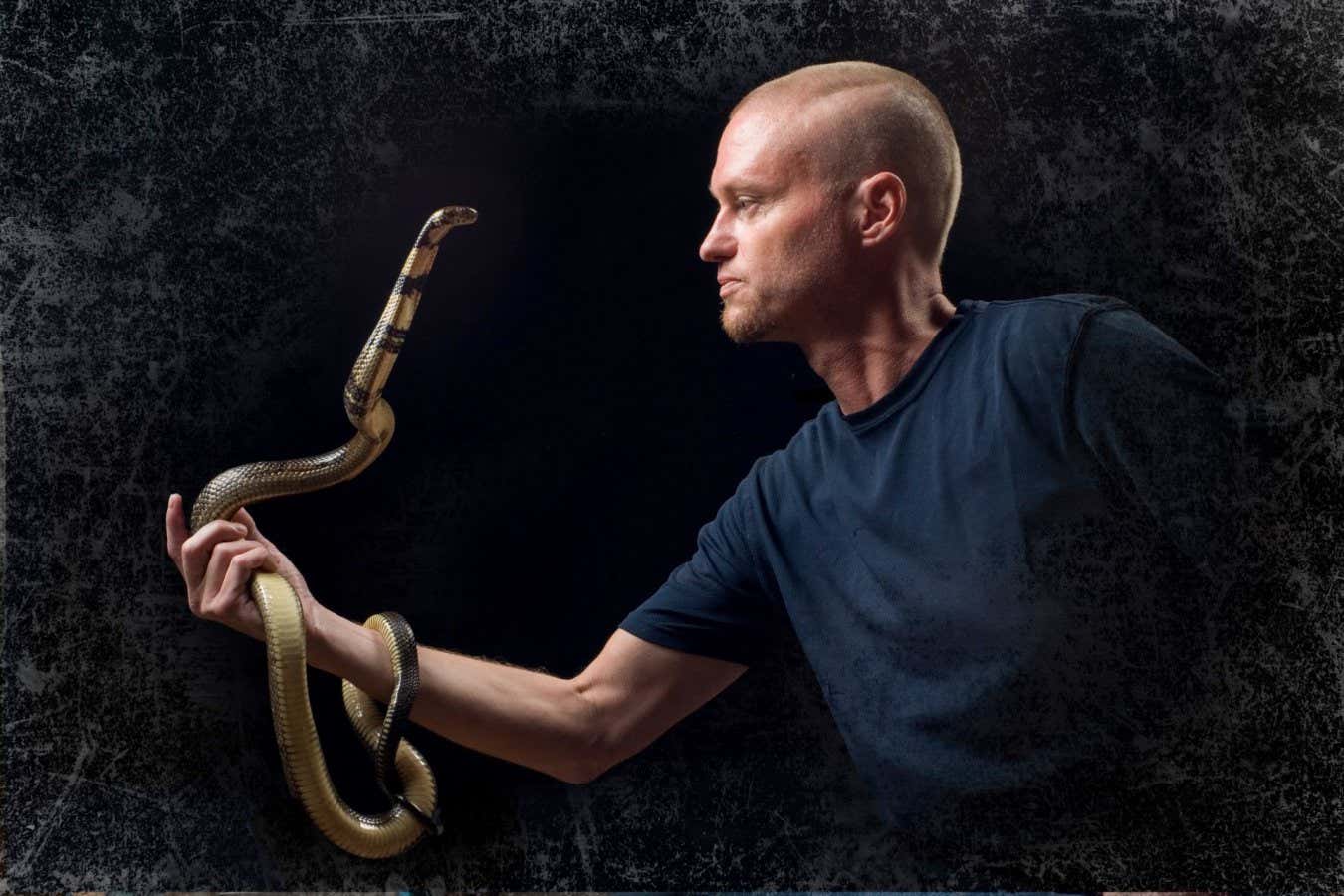
Tim Friede with a water cobra
Centivax
I know what it feels like to almost die from a snake bite. You can’t move. You can’t breathe. Your diaphragm’s frozen. But you can hear everything. So when I was in the ICU, I could hear the doctors talking about me. “Why did he do it? Was it a suicide attempt?” And I’m like: no, it wasn’t. I just screwed up.
I began injecting myself with snake venom in 2001, in an effort to develop a treatment. If you look at the numbers, 5 million people are bitten every year. There are 138,000 deaths every year and 400,000-plus amputations and other complications. Those are pretty big numbers.
There are organisations that want to help, like the Strike Out Snakebite global initiative, which is looking to raise awareness of the impact of snake-bite envenoming. And there is snake antivenom, first invented 125 years ago by Albert Calmette. But these haven’t changed much in that time, and they aren’t perfect. They’re made by injecting horses with venom, then collecting the antibodies the horses make. Using these in humans, you run the risk of anaphylactic shock because the antivenom is based off of a foreign equine protein.
I wanted to take the horse out of the picture, but I didn’t want to die. I didn’t want to lose a hand. I didn’t even want to miss work.
I had already taken a small course on extracting venom from spiders, scorpions and centipedes. That was back in 1999. So it wasn’t too difficult to extract snake venom. I began with cobra venom, injecting it at a dilution of 1 in 10,000. You don’t feel those doses too much. It’s kind of like a small bee sting. But slowly through time, I built up the concentration to lethal doses – to pure venom.
Then I was ready for live snake bites. It was nerve-wracking because I didn’t know for sure how immune I was. I didn’t know if I was going to make it or not. There’s no book on it. There’s no school that can teach you how to do it. I had to teach myself and just use my own body for the experiment.
And it was a horrible start. It was Wednesday 12 September 2001, at 11:02pm. I remember it clearly: I took a cobra bite, then waited an hour and took another cobra bite. The first one, I was fine with. But for the second one, I had no immunity because all my antibodies were bound to the venom from the first bite. At 12:00am, I dropped. Flatlined. I was in the ICU in a coma for four days. They had to give me antivenom from the local zoo. I actually had antivenom back at my house, but the ambulance crew didn’t know that.
When I got out of the hospital, I realised: I could either quit because I screwed up or I could learn from the experience and carry on. I did the latter. I have had a little over 200 bites now and I have never used antivenom again.
I got really serious about it. I started reaching out to scientists. There is a long history of self-experimentation in medicine. I have a signed personal letter from Barry Marshall, who self-medicated and won a Nobel prize. I also spoke to Peter Doherty, another Nobel winner for immunity. And I’m like: “Holy crap, these people actually take me seriously.” So that’s when I got really big into academia, studying venom.
Snake venom, even if it’s the same genus and species, can be completely different. The perfect example is the brown snake, Pseudonaja textilis, in Australia. In Queensland, to the north, its venom is different than it is in the south. And that’s the problem with antivenoms: they make it for a certain area, so it might not work in another area.
I wanted to develop broad-spectrum antibodies in my blood that could protect against all venoms. So I kept working with different snakes from all over the world. There are around 650 species of venomous snakes and I knew I wasn’t going to inject venom from all of them, because I can’t access all of them. I just tried to pick the most dangerous ones I could get: taipans – they’re the most venomous snakes in the world – cobras, kraits, coral snakes, rattlesnakes.
Taipan bites are actually pretty easy. It’s pretty much a pure neurotoxin. But vipers and pit-vipers, their venom contains necrotic components that destroy muscle. That’s completely different. The pain is huge.
I have been studied six times over 25 years now. That was the most important thing for me. I wanted to be studied because if I’m not studied, I can’t contribute to new antivenoms. The most recent is the most important. Jacob Glanville at the vaccine company Centivax contacted me because of a YouTube video I did, with a black mamba bite and a taipan bite back to back. I shipped him blood and they extracted DNA from my B-cells to clone my IgG antibodies. Then we started doing in-vivo studies with mice.
The studies were so intense, but the lab is so good. I found out – and this is pretty trippy – that we can neutralise the venom of the king cobra (Ophiophagus hannah) with my antibodies, and I’ve never used king cobra in my experiments. So that gave us hope that we can reach a broad-spectrum level, a universal antivenom.
Last year, the paper came out in Cell Press. It took almost 25 years to get to that paper. My name isn’t on the author list. I used myself as a test subject and some people in academia look down on that. We got kicked out of a lot of journals, denied publication when my name was on the author list. But I have no problem with that. I don’t want accolades.
It will still take a long, long time to get from the mice to an antivenom we can use in humans, but I have no problem waiting. I’ll wait till the day I die. But I can sleep really good at night knowing that I did everything I possibly could to make a difference.
As told to Colin Barras
Topics: