

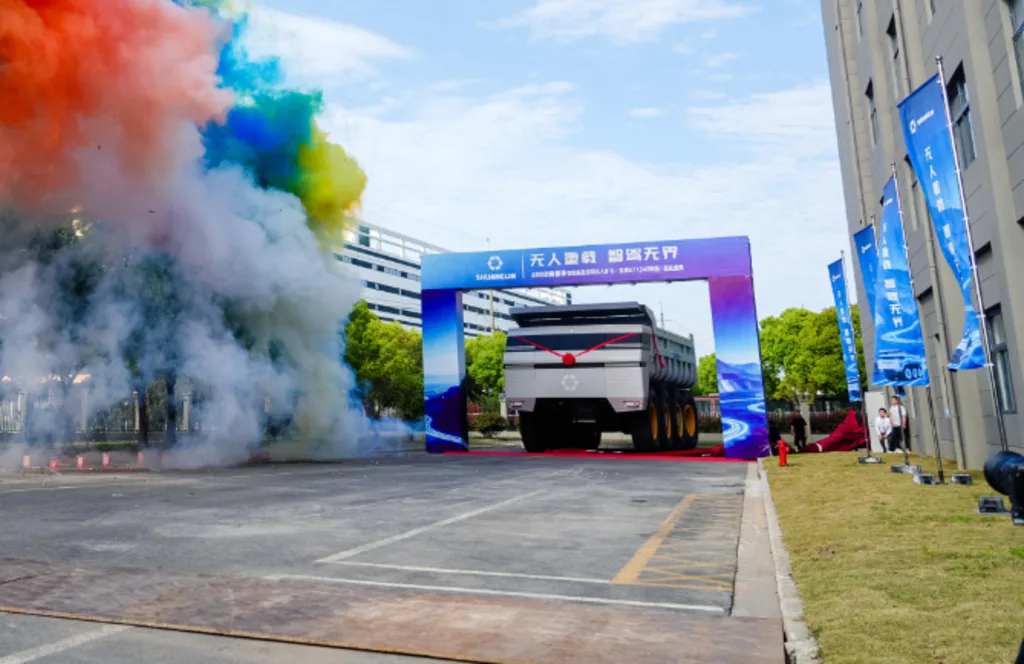
If you thought that embodied AI was all about humanoids and robotic good boys, allow me to introduce you to the Shuanglin K7. Equipped with a Level 4 driving brain that allows it to operate with no human intervention, this massive robot on four wheels can literally move on a dime, rotating 360 degrees on its own vertical axis and moving sideways like a crab, operating 24/7.
According to its developers—Shuanglin Group and Tsinghua University—this massive 17.1-foot-tall robo-truck is the first of its kind and they believe it will forever change the mining industry.
The vehicle represents a structural shift toward replacing human operators with digital systems to improve extraction logistics and workplace safety, its inventors claim. But that’s yet to be seen. The machine now needs to prove it can solve the problems in the real world.
The Shuanglin K7 measures 45.2 feet in length and 18.7 feet in width, weighing 110.2 short tons when empty. This machine’s AI brain constantly analyzes its sensors to calculate direction, speed, and routing without any human safety driver, and with, allegedly, full awareness of other vehicles and humans around it.
Provided it stays within the mapped geography of an excavation site, that is. While cars from Volvo, Mercedes, or Tesla have Level 2 autonomy—requiring the attention and hands of the drivers—the K7 can fully and safely drive autonomously through the site, recognizing all the elements typical of open pit mines.
Level 4 is not the only wonder in this steel giant. Utilizing an 8×4 drive configuration, the truck employs a distributed electronic drive-by-wire system at every wheel corner. Instead of utilizing heavy steel shafts to transfer mechanical power from an engine to the axles, this works more like a digital nervous system, sending beams of electrons to command distinct motors located at each tire.
Each motor moves independently from each other, so the vehicle—which weighs 273.4 tons when fully loaded—can drive laterally, like a crab, and turn around on its vertical axis with no maneuvering whatsoever. This means that mining sites no longer require dedicated road space just for vehicles to turn around and do their operations.
Professor Huang Jin—a professor at Tsinghua University’s school of vehicle and mobility who worked on the project—told the state-sponsored newspaper Science and Technology Daily that this extraordinary mechanical ability “can greatly improve operational flexibility and site adaptability in complex environments.”
According to its manufacturers, the machine supports a continuous 24/7 operational schedule thanks to its battery replacements, which only take 5 minutes to change. The truck also “saves” energy: While descending pit inclines, the braking system captures the physics of the falling mass much like a Formula 1 car captures its inertia when braking. In theory, according to its developers, this mechanism converts up to 85% of that kinetic energy back into stored electricity, extending the working time of the truck.
Computer models predict that all these features will yield a 35% output increase, a 90% reduction in site accidents, and a 25% drop in lifetime maintenance and tire costs compared to diesel machinery.
The many shapes of embodied AI
The Chinese government—which depends on minerals to keep its control of the global supply chain—needs this vehicle to fully automate Chinese extraction by 2030, a goal already materializing in Xinjiang and Inner Mongolia with other less capable fleets.
At the Yimin coal site in Hulunbuir, a publicly funded utility named Huaneng Group deployed 100 driverless electric haulers called “Huaneng Ruichi,” with its own artificial intelligence and 5G-Advanced communication. That deployment is just a fraction of the largest rollout of uncrewed extraction vehicles globally.
But these are only promises. The K7 currently lacks multi-year fleet data. Industry experts like Haultrax claim that without correct procedures, automated systems “may be less productive than a manned fleet” because of poor operational protocols that introduce the “potential of severe safety incidents occurring.” Haultrax identifies the wireless network as “the most critical aspect” for stability.
Other industry groups also warn about how GPS interference ceases production entirely. Physical degradation of open mining sites is equally problematic. Plus, the Saint Petersburg Mining University points out how dust and vibrations destroy electrical traction systems. These problems can all lead to fatal accidents. Last August, Reuters reported that workers at the world’s largest copper mine in Chile protested over the use of self-driving trucks after multiple accidents.
But those trucks aren’t level 4. While we will have to wait and see if any of these robots leviathans can survive the rigors of actual 24/7 work—keeping its human and humanoid colleagues safe at the same time—I have no doubt that the revolution its makers are talking about is already underway.
Whatever kinks they may encounter, they will be ironed out and the K7s will become the first of many machines designed and manufactured to further optimize China’s seemingly unstoppable manufacturing operations.
Every day, with every piece of news like this, it looks more and more clear that Beijing is pushing its plan to become the dominant superpower in the world using embodied AI. It’s not only biped and wheeled humanoids relentlessly doing the dangerous jobs that humans no longer want, but a future powered by specialized sentient AIs taking on many physical shapes and forms.