

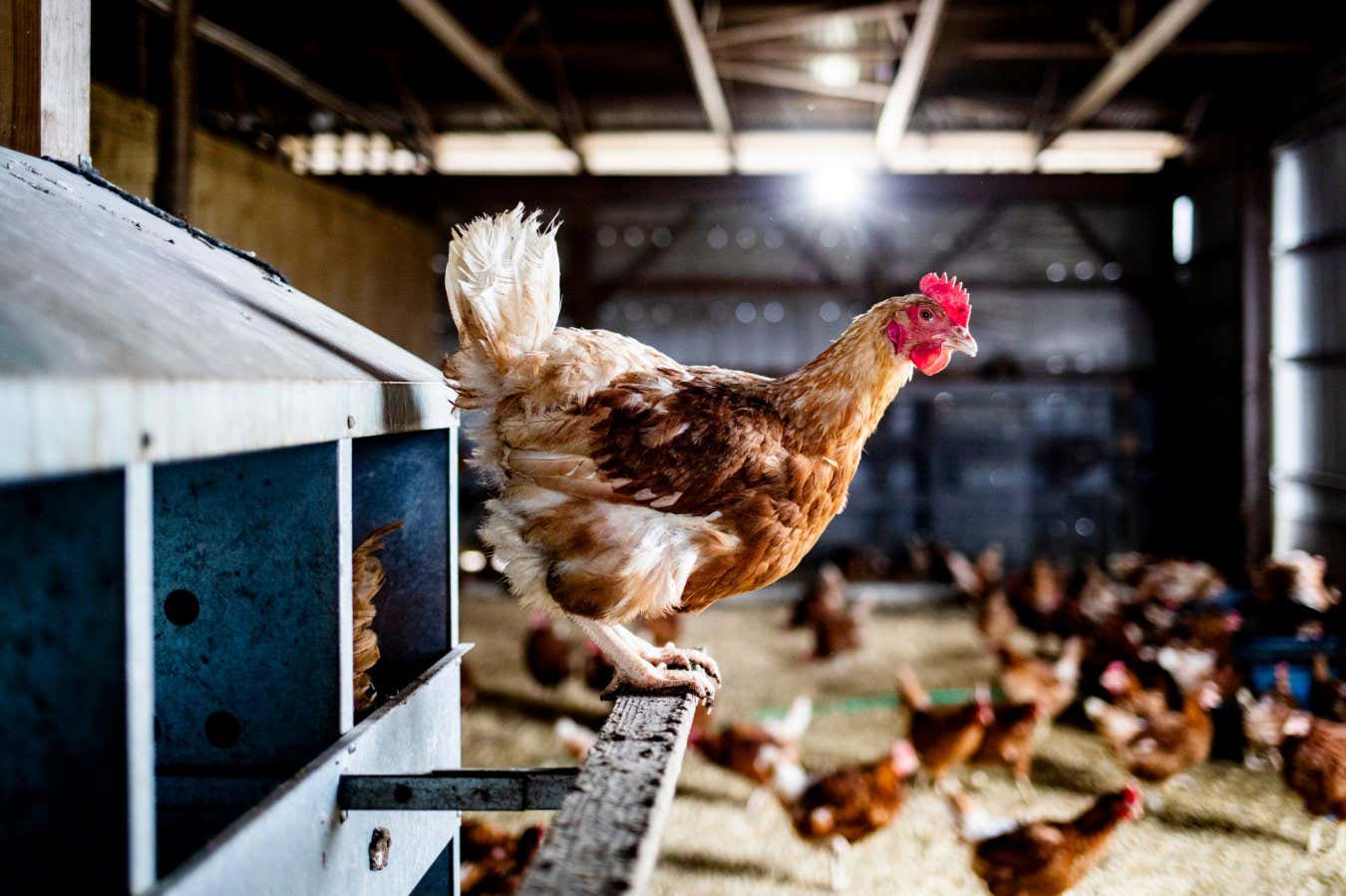
Millions of chickens have been culled due to the threat of bird flu
Emily Elconin/Bloomberg via Getty Images
The US experienced its first known bird flu deaths this year, igniting concerns that the virus could set off a pandemic in people. Nevertheless, it still reined in the outbreak enough to warrant ending its emergency response – but public health experts warn the battle is far from over.
“It is still a pandemic in [non-human] animals,” says Meghan Davis at Johns Hopkins University in Maryland. “And the virus is no less deadly now than it was before.”
The pathogen behind the vast majority of cases, a subtype of avian influenza called H5N1, first emerged in poultry in China in 1996. It then resurfaced in 2021, devastating global bird populations and spreading to several mammals, including foxes, seals and cats.
H5N1 is poorly adapted to infecting humans and isn’t known to transmit between people. But it still poses a significant threat, having killed almost half of the nearly 1000 people known to have contracted it worldwide since 2003. These fatalities probably represent severe cases, with most milder incidences going unrecorded. Nevertheless, the risk to people exists, and would be even greater if the virus were to evolve the ability to spread from person to person – a scenario that could spark a pandemic, says Davis.
That is why public health experts were alarmed when H5N1 began circulating among dairy cows in the US in March 2024, the first known instance of it infecting dairy cattle. Not only did this put the virus in close proximity to people, particularly farm workers, but it afforded it one of its best opportunities yet to adapt to spread between humans. Each time the pathogen infects a person or another mammal, it has a chance to acquire mutations necessary for human-to-human transmission, says Davis.
H5N1 has since been detected in more than 1080 herds across 19 US states, while also hounding poultry farms. Between February 2022 and mid-December, it sickened at least 1950 flocks nationwide, forcing farms to cull nearly 200 million birds.
The farm outbreaks subsequently fuelled a spike in human cases. Of the 71 people who have ever tested positive for bird flu in the US as of December 2025 all but six contracted it from infected dairy cows or poultry. As to those six cases, three contracted it from another animal source, while the origin of the remaining three incidences is a mystery, although there isn’t reason to believe they picked it up from another person.
Most of the human cases experienced mild symptoms, such as eye redness, and made a full recovery. However, a person in Louisiana with underlying health conditions died from the H5N1 virus in January – the first known death related to bird flu in the US.
Since then, the country has largely wrangled the outbreak under control. The last time someone tested positive for H5N1 was in February, says Emily Hilliard, the press secretary at the US Department of Health and Human Services. However, a man in Washington state tested positive and died due to a different, though related, bird flu strain, called H5N5, in November after being exposed to infected poultry.
“What is somewhat reassuring is that a traceback investigation from the fatal H5N5 case has not uncovered any other human cases, however, the pandemic potential for H5 viruses remains, particularly given the ability of these viruses to affect mammals, including humans, and to spread from mammal-to-mammal,” says Davis. The US Centers for Disease Control and Prevention (CDC) says it is watching the situation carefully and the risk to the public is low.
Infections of H5N1 in dairy cattle have also plummeted, with the US Department of Agriculture (USDA) reporting only two herds have tested positive between November and mid-December.
These declines ultimately led the CDC to end its emergency bird flu response in early July, says Hilliard. The response, initiated in April 2024, allowed the agency to deploy additional staff and resources towards surveillance and mitigation effort, she says.
There are a few possible explanations as to why cases declined. For one, the USDA launched its National Milk Testing Strategy in December 2024, mandating dairy farms to provide raw milk samples for H5N1 testing. “Testing is absolutely central to any control strategy,” says Davis. “If you don’t know where [H5N1] is, then mandating additional protections or enforcing quarantine of farms just can’t happen.”
In February, the USDA also announced a $1 billion strategy for curbing H5N1 on poultry farms, including increased funding for vaccine research and biosecurity measures. One of its focuses was to shore up defences against wildlife. “The overwhelming majority of [bird flu] introductions into domestic poultry and livestock have been traced to contact with infected wild birds,” says a USDA spokesperson. By mitigating H5N1 on farms, these efforts probably also reduced cases in people, given most infections occurred in dairy workers, says Davis.
However, it could also be due to seasonal fluctuations. “We have seen lulls in the summer followed by explosive cases in the fall and winter,” says Davis. “So, what you tend to find is that during migration season, which we are in at the moment, you start seeing more cases.”
Migratory birds introduce the virus to farms as they travel, which is probably why detections of H5N1 in backyard and commercial poultry flocks increased by more than 130 per cent between September and October. “What we haven’t had are a lot of human cases,” says Davis. But whether this is due to increased security measures or reduced surveillance in workers isn’t clear, she says.
“I am encouraged that we’ve seen a declining number of cases,” says Davis. “But I think there is still more that we need to do.”
Topics: