

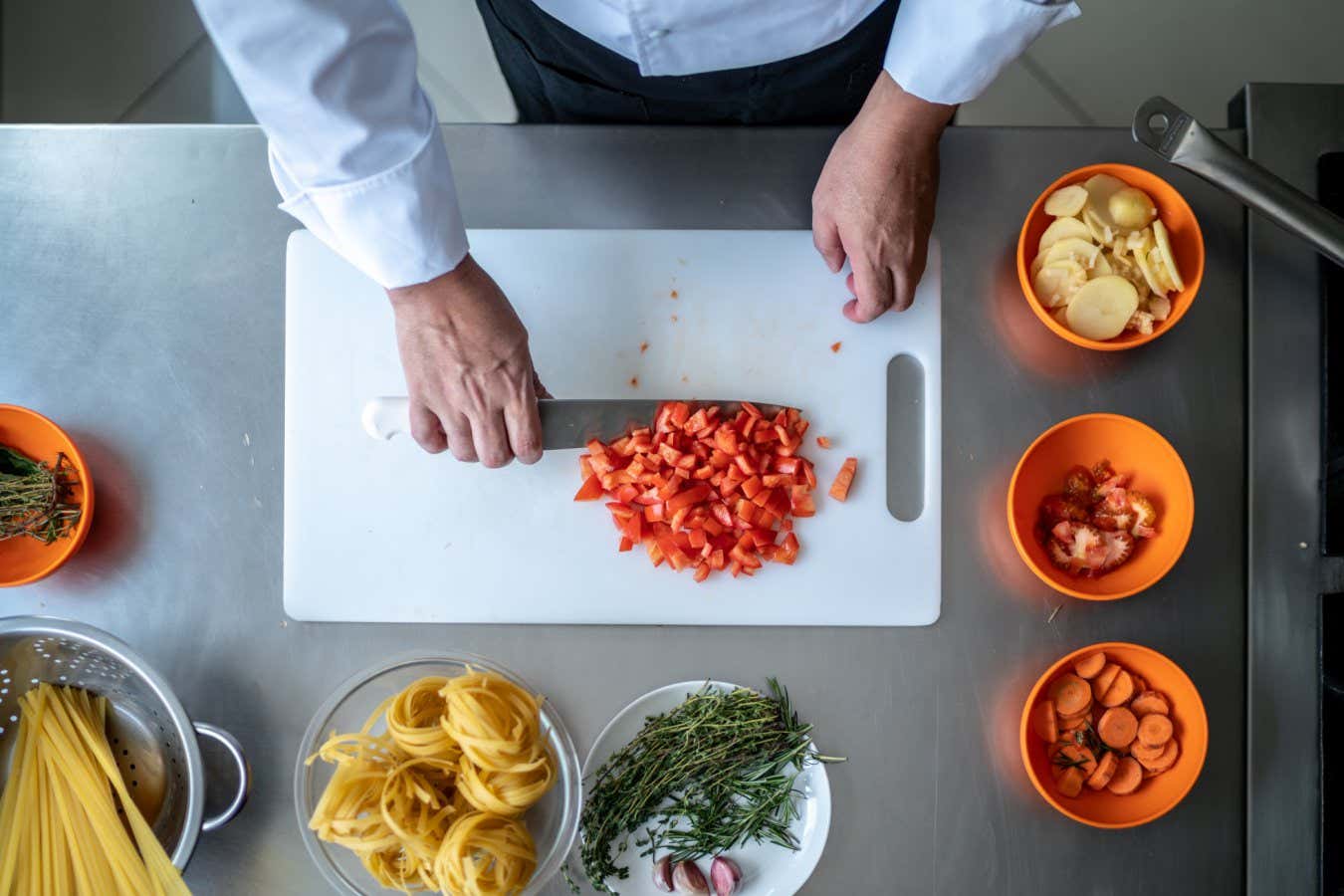
Rule-based cooking is very appealing because it produces highly replicable results
FG Trade/Getty Images
The Score
C. Thi Nguyen
Allen Lane
THIS time last year, I wrote an article for New Scientist about the perfect way to cook the classic pasta dish cacio e pepe, according to physicists. The meal’s smooth, glossy emulsion of black pepper, pecorino cheese and water is hard to make lump-free. Ivan Di Terlizzi at the Max Planck Institute for the Physics of Complex Systems in Germany and his colleagues cooked cacio e pepe hundreds of times until they produced an exacting and foolproof method.
The story proved popular with readers. When I caught up with one of the scientists involved recently and asked him why, he told me it may have been because the research seemed to find order in a “world that looks like a mess if you don’t look very closely with the eyes of rigour and mathematics”.
Seeing the world this way can be seductive, but it can also be dangerous, argues C. Thi Nguyen in his book The Score: How to stop playing somebody else’s game. Nguyen, a former food writer and now a philosophy professor at the University of Utah in Salt Lake City, uses recipes guaranteed to produce the perfect outcome as a warning.
Hidden behind their apparent authority, he writes, they are in fact making a value judgement, “an exercise of taste and preferences” about how food should be. They use scientific rigour, with precise measurements and sequences, to produce replicable results. But in doing so, they reduce the diversity of possible outcomes, and the inherent human messiness that can make food such fun.
Cooking is only one example of how the modern drive to categorise, score and impose order on a chaotic reality, often led by homogenising nation states and centralised bureaucracies, can result in less than ideal outcomes. Nguyen paints a picture of a world that is bursting with them.
Take his own academic career, where he has had to grapple with university and journal rankings. In philosophy, those rankings are determined by websites that order departments according to metrics, such as the prestige of the journals in which their academics publish, which are, in turn, dependent on how well they answer “fairly arcane technical questions”, he writes.
This was the opposite of the “wild, unmanageable questions” that had attracted Nguyen to the field in the first place, but he began to feel the ranking system getting under his skin. He had experienced what he calls “value capture”, where metrics designed to be helpful end up ruling us instead.
One way to cope with the abundance of rules-based systems today is to actively choose to play by the rules, in the form of games, argues Nguyen, an avid hobbyist and games player. The book is full of his extensive experience with play, from Dungeons & Dragons and rock climbing to yoga and yo-yoing.
Nguyen convincingly shows why choosing to abide by the rules in the artificial sandbox of games can help us explore, be open and get exposure to life’s richness, acting as a sort of “spiritual vaccine” for institutional scoring systems that we grudgingly accept in everyday life, such as school exam marks. The idea that games can save us may be a tall order, and it is certainly an unabashedly optimistic and personal world view. But, overall, Nguyen makes a good case for it.
Many of the ideas in his book aren’t new, as Nguyen readily admits, referencing many of the philosophers and academics that shaped his intellectual journey. Their work includes Prisoners of Geography by Tim Marshall, which delves into the “geo” in geopolitics, and Seeing Like a State by James C. Scott, which looks at why scientifically planned societies so often fail.
Nguyen’s playful framing of the arguments, in keeping with the central thesis of his book, makes the debate feel fresh, however. This is a good place to start.
Topics: