
Close Menu
    Trending
    • India denounces ‘hellhole’ remark shared by Trump | Donald Trump News
    • New photos of Mike Vrabel and Dianna Russini emerge
    • AI search demands a new audience playbook
    • How do earthquakes end? A seismic ‘stop sign’ could help predict earthquake risk
    • Trump Announces Cease-Fire Between Israel and Lebanon
    • Google Is Tracking Your Life – Photo Cloud Feeding AI System
    • Rachel Zoe Confronts Amanda Frances In ‘RHOBH’ Reunion Clip
    • China’s DeepSeek says it released long-awaited new AI model
    Benjamin Franklin Institute
    Friday, April 24
    • Home
    • Politics
    • Business
    • Science
    • Technology
    • Arts & Entertainment
    • International
    Benjamin Franklin Institute
    Home»Science»The mystery of how volcanic lightning happens has been solved
    Science

    The mystery of how volcanic lightning happens has been solved

    Team_Benjamin Franklin InstituteBy Team_Benjamin Franklin InstituteMarch 18, 2026No Comments3 Mins Read
    Share Facebook Twitter Pinterest Copy Link LinkedIn Tumblr Email VKontakte Telegram
    Share
    Facebook Twitter Pinterest Email Copy Link


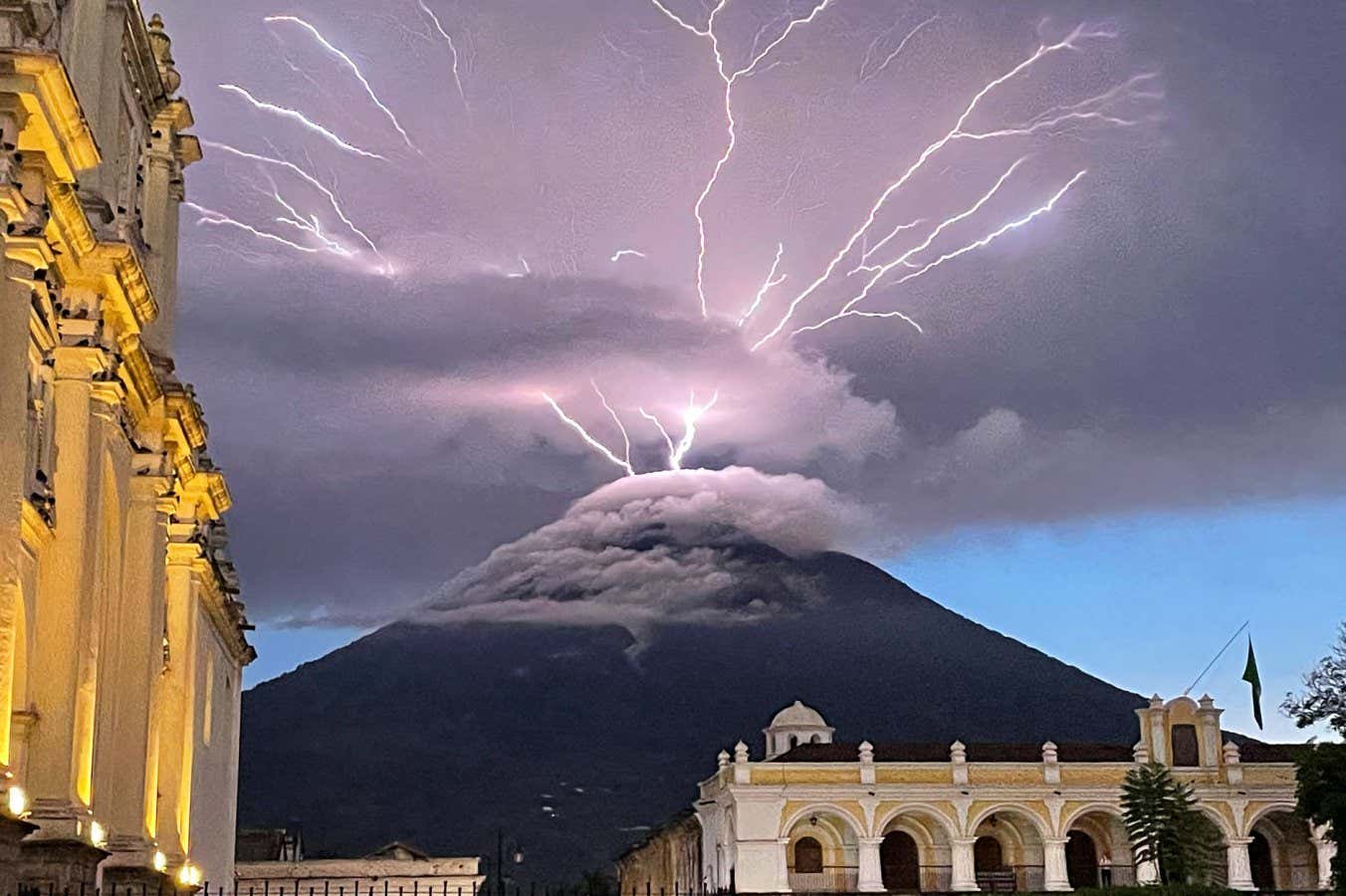
    Lightning strikes over Volcán de Agua in Guatemala

    Mario Dalma Leon/Getty Images

    Physicists have solved a longstanding mystery around the process that creates volcanic lightning: when similar particles rub together, why do some become positively charged while others become negatively charged?

    The exchange of electric charge when two objects touch, called the triboelectric effect, is what causes hair to be attracted towards a balloon after rubbing.

    In a cloud of volcanic ash, swirling particles of silicon dioxide exchange electric charge as they collide. The positively and negatively charged particles separate and lightning occurs when current flows between the two.

    But physicists couldn’t explain what breaks the symmetry between two particles of the same material and causes charge to flow one way or the other.

    “There are a lot of candidates,” says Galien Grosjean, now at the Autonomous University of Barcelona. “People suspect that humidity is important, or roughness, or the crystalline structure.”

    While working at the Institute of Science and Technology Austria in Klosterneuburg, Grosjean wondered if the answer lay in carbon-containing molecules on the surface of the particles. Such molecules are ubiquitous in nature, and materials scientists try to keep these contaminants to a minimum. But Grosjean and his colleagues kept track of what cleaning their samples did to the electrification.

    With ultrasound, they levitated a small particle of silicon dioxide, let it bounce once onto a target plate made of the same material and then measured its charge. “It might charge positive or negative. If positive, we would bake or clean it and redo the experiment – and then it would charge negative,” says Grosjean.

    Analysis of the samples showed that the removal of carbon-containing molecules was indeed the controlling factor.  “We saw that this effect overcomes everything else,” says Grosjean.

    Another giveaway was that a cleaned sample would become positively charged again after about a day, which is also how quickly it would acquire a fresh coat of carbon molecules from the air.

    Daniel Lacks at Case Western Reserve University in Cleveland, Ohio, is impressed by the study. “People know surfaces have a lot of crap on them. But I’ve never seen that come up in triboelectric charging,” he says.

    The discovery could be bad news for physicists, he fears. If carbon contamination determines the charging direction, precisely calculating how particles become charged will be very hard. “Prediction may just be something that will never happen,” says Lacks.

    New Scientist. Science news and long reads from expert journalists, covering developments in science, technology, health and the environment on the website and the magazine.

    Discovery Tours: Geology and volcanology

    From Icelandic volcanoes to Vietnamese caves, unearth the science behind some the most extreme locations on Earth.

    Topics:


    Source link

    Share. Facebook Twitter Pinterest LinkedIn Tumblr Email Telegram Copy Link

    Related Posts

    Science

    How do earthquakes end? A seismic ‘stop sign’ could help predict earthquake risk

    April 24, 2026
    Science

    ‘Kraken’ fossils show enormous, intelligent octopuses were top predators in Cretaceous seas

    April 24, 2026
    Science

    Largest ever octopus was great white shark of invertebrate predators

    April 24, 2026
    Science

    Do you need to worry about Mythos, Anthropic’s computer-hacking AI?

    April 23, 2026
    Science

    How many dachshunds would it take to get to the moon?

    April 23, 2026
    Science

    The Age Code review: Can you slow ageing with your diet? A new book gives it a go

    April 23, 2026
    Editors Picks

    ICC prosecutors charge Duterte with 3 counts of crimes against humanity

    September 23, 2025

    Ashley Tisdale’s Viral Essay Escalates With Cryptic Post

    January 7, 2026

    US wants to sell GM soya and corn to India, farmers wary | Trade War

    December 23, 2025

    New York Mets get positive Juan Soto injury news

    April 5, 2026

    Collaborative AI agents are key to retail supply chains

    December 23, 2025
    About Us
    About Us

    Welcome to Benjamin Franklin Institute, your premier destination for insightful, engaging, and diverse Political News and Opinions.

    The Benjamin Franklin Institute supports free speech, the U.S. Constitution and political candidates and organizations that promote and protect both of these important features of the American Experiment.

    We are passionate about delivering high-quality, accurate, and engaging content that resonates with our readers. Sign up for our text alerts and email newsletter to stay informed.

    Latest Posts

    India denounces ‘hellhole’ remark shared by Trump | Donald Trump News

    April 24, 2026

    New photos of Mike Vrabel and Dianna Russini emerge

    April 24, 2026

    AI search demands a new audience playbook

    April 24, 2026

    Subscribe for Updates

    Stay informed by signing up for our free news alerts.

    Paid for by the Benjamin Franklin Institute. Not authorized by any candidate or candidate’s committee.
    • Privacy Policy
    • About us
    • Contact us

    Type above and press Enter to search. Press Esc to cancel.