

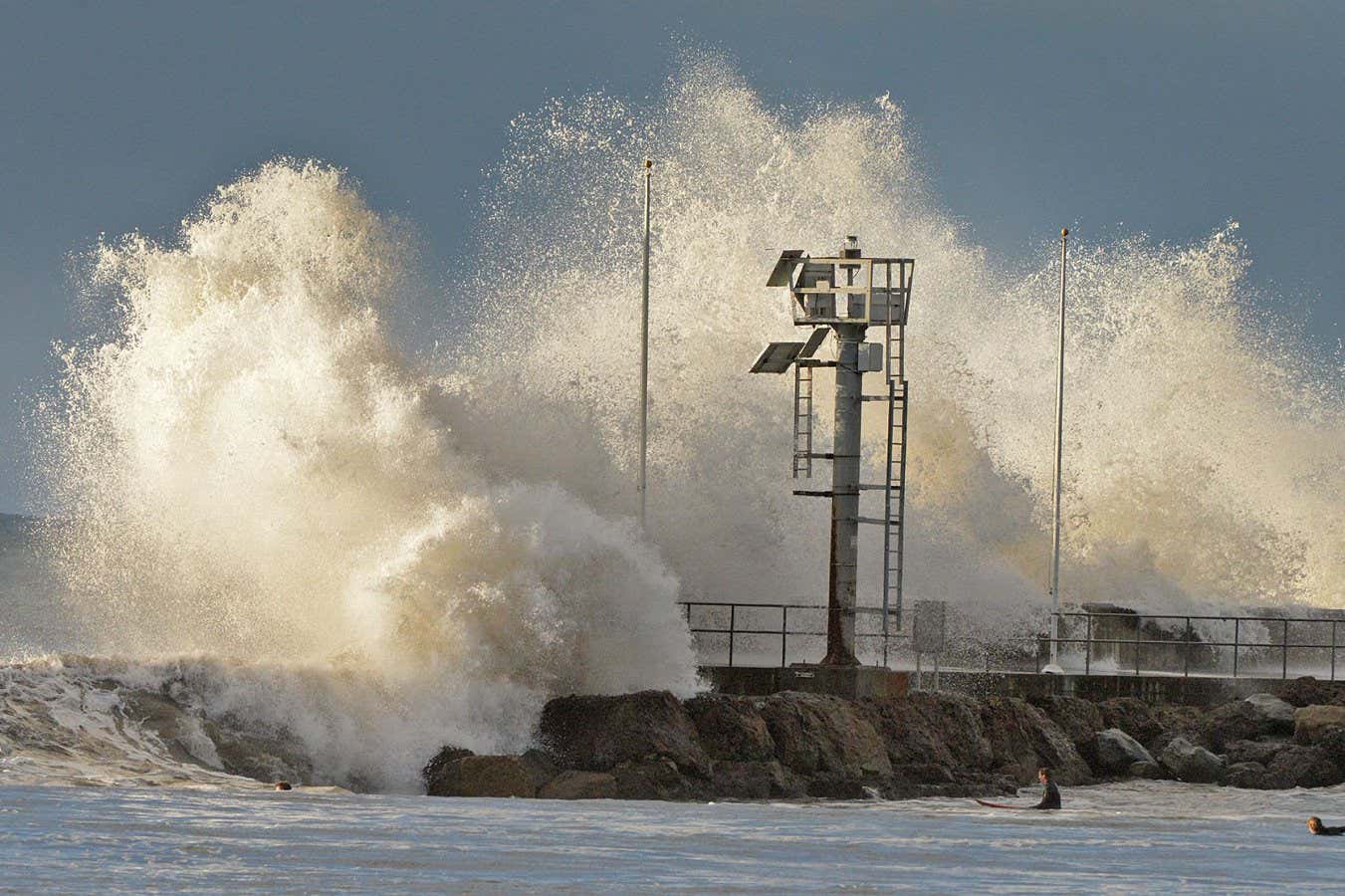
Waves supercharged by El Niño hit the California coast in 2016
Eliason/Zuma Wire/Shutterstock
A “Godzilla El Niño” is coming, according to some newspaper headlines. The actual story is that there is an 80 per cent chance of an El Niño developing by September. Most models forecast a moderate event – but some suggest it could be very strong, perhaps even a so-called super El Niño.
That said, the bigger picture isn’t at all reassuring. However strong this El Niño turns out to be, we can be sure that even more damaging El Niños will occur in the coming decades. Even if future events are no stronger, their effects will be greater in a warmer world.
“Even a standard El Niño event in future will cause larger regional and global impacts,” says Axel Timmermann at Pusan National University in South Korea.
What’s even more alarming is that studies by Timmermann and others suggest that El Niños and La Niñas – known as ENSO events – will also become much stronger and start to drive weather in the Atlantic, too, amplifying their impacts.
“Our latest computer model simulations predict a shift to more regular and much stronger El Niño-La Niña extremes, as well as an intensification of ENSO impacts on remote regions, in particular Europe,” says Timmermann.
The El Niño phenomenon is all about water and winds in the Pacific. During so-called neutral conditions, trade winds blow westwards along the equator, pushing the surface water westwards and piling warm water up along the western Pacific. Cold water wells up next to South America to replace the surface waters being pushed westwards, while warm, moist air rises above the warm waters piled up in the west, producing a lot of rain.
But sometimes the trade winds weaken and even reverse, allowing some of that warm water to spill eastwards. The area of rainfall shifts eastwards, too, which can strengthen the easterly winds – one of the positive feedback loops that cause El Niños to develop. This eastward shift also causes droughts in places such as Australia and Indonesia, and floods in South America.
It’s also why El Niños lead to rapid warming of the surface of the planet. A larger area of warm water leads to more evaporation, and energy from the water is released as latent heat when clouds form, transferring vast amounts of heat from the Pacific into the atmosphere.
The strength of El Niños is determined by just how much and how far warm water moves eastwards towards South America. This is measured in terms of how much warmer than usual the central and eastern Pacific becomes. Definitions vary, but an El Niño is said to be happening when the sea-surface temperature anomaly exceeds 0.5°C. A super El Niño isn’t a scientific term, but it could be used for those above 2°C, while a Godzilla El Niño could refer to those above 3°C, suggests Adam Scaife at the Met Office Hadley Centre in the UK.
As El Niños develop, there are negative feedback loops that also kick in. In particular, more clouds over the central Pacific have a cooling effect, leading to a return to neutral conditions or a shift to La Niña, where the westerly trade winds strengthen and push cooler upwelling water further west than usual.
The three strongest El Niños since records began were in 1982-83, 1997-98 and 2015-16. All three caused immense damage to people and wildlife, with mass die-offs of corals and other marine life.
Each super El Niño also caused trillions of dollars in damages, according to a 2023 study by Christopher Callahan at Indiana University. “Our results show that the magnitude of the economic loss is directly related to the strength of the temperature of the ocean in the Pacific,” says Callahan. “If there is a significant El Niño this year, we should expect trillions in economic losses similar to previous events.”
As the world warms, future El Niños – and super El Niños – will do even more damage. “The science is very clear,” says Richard Allan at the University of Reading, UK.
ENSO-related floods will become more intense because there will be more moisture in the atmosphere, says Allan, meaning more rain falls when it rains. And the droughts will be longer and more intense, too, because soils dry out faster when it is hotter.
Some climate models also suggest warming will amplify the feedback loops that drive ENSO events. That could lead to stronger El Niños and La Niñas with faster transitions between them – greater “climate whiplash” – making it even harder for societies to cope in a warming world.
“It would mean much larger swings between years with larger-than-normal rainfall and years with drought in many regions of the world,” says Malte Stuecker at the University of Hawaiʻi, a member of Timmermann’s team.
Worse still, the team’s study suggests these stronger swings would lead to ENSO events starting to drive and synchronise with a climate phenomenon known as the North Atlantic oscillation. This would lead to big swings between floods and droughts in Europe, too.
“This would be a big regime shift for Europe, as in the current climate, we do not see a large impact of El Niño on weather patterns in Europe,” says Stuecker.
While there’s high certainty that El Niños of the same magnitude will be more damaging, there’s much less certainty about El Niño becoming more intense. “There is quite a bit of disagreement about the future behaviour of El Niño and La Niña,” says Scaife.
Not all climate models project an intensification of El Niños, he says. But many do still agree on the closer links with regions such as the Atlantic, meaning that the impacts of El Niño beyond the Pacific are likely to get even stronger in the future.
Even if ENSO events do become more intense, they won’t continue to intensify indefinitely, says Timmermann. The intensification is driven in part by the rapid warming of the top 100 metres of water in much of the Pacific. Once the underlying waters start to catch up and the temperature difference falls, ENSO events are likely to weaken, he says.
The catch? This weakening might not start to happen until after 2150. Buckle your seatbelt.
Topics: