

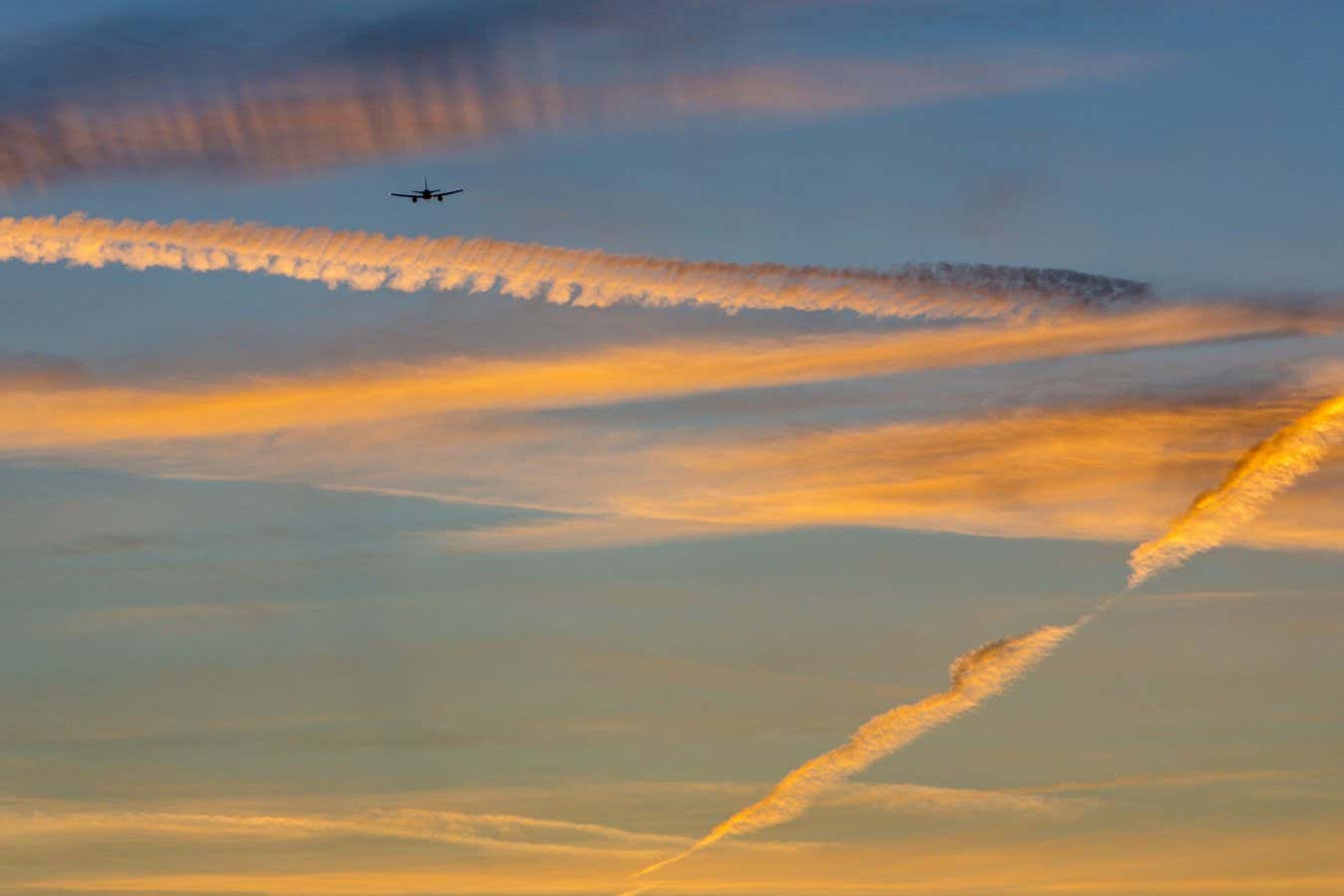
Contrails account for most of the warming effect from flights
Tack/imageBROKER/Shutterstock
A trial involving thousands of flights between the US and Europe has found that planes produce fewer contrails if they follow flight paths recommended by an artificial intelligence to reduce their global warming impact.
The streaks of condensation triggered by soot particles produced by aircraft engines are thought to cause more warming than the carbon dioxide that planes emit. Research has also shown that some ice-rich regions of the upper atmosphere are more likely to form contrails when a plane passes through them, and that AI can predict where these regions will be using detailed weather forecasts.
There have been small-scale trials showing that planes bypassing these regions will produce fewer contrails, but the practice has yet to be applied to commercial flights at scale.
Now, Dinesh Sanekommu at Google and his colleagues have used an AI contrail-forecasting tool to give routing advice in a randomised control trial of more than 2400 real American Airlines flights.
The trial involved flights heading eastward from the US to Europe and ran for around 17 weeks, from January to May 2025. The direction was only one-way because these flights would take place at night, which is when contrails have been found to have a clearer warming effect. During the day, contrails can have a cooling effect because they reflect sunlight back into space.
Each flight route between two cities was randomly assigned to one of two groups. For the first group, air traffic dispatchers had an option in their flight-planning software to pick an AI-optimised, low-contrail route, but for the second, no alternative was suggested.
Although dispatchers in the first group always had the option of picking a low-contrail route, only 112 out of 1232 flights in this group actually ended up taking the alternative path because of operational concerns, such as cost or safety, says Sanekommu.
According to an AI analysis of satellite imagery of flight paths, there was a 62 per cent lower amount of visible contrails for flights that took the contrail-optimised route suggested to air traffic dispatchers. When all flights that had the option of taking a contrail-optimised route are included, the effective overall reduction in contrail formation was 11.6 per cent compared with the control group.
“It validated the thesis of, if we could figure out how to safely and correctly integrate into the flight planning process, then this is a scalable route to consider contrail avoidance across many flights,” says Sanekommu.
The team estimates that the flights’ warming effect was reduced by 13.7 per cent in the entire group given a suggested route and 69.3 per cent in the flights that took the optimised route. There was no statistically significant difference in fuel consumption between the groups.
“This is probably the best you can do, at least with the tools we have at the moment,” says Edward Gryspeerdt at Imperial College London. “It does indicate that this is possible. The 62 per cent reduction in satellite-observed contrails that they see is unlikely to have happened by chance.”
However, it is unclear how much the 11.6 per cent figure can be improved in real-world operations, because of the intricacies of flight planning, says Gryspeerdt. “You can’t necessarily just scale this up to be a 60 per cent reduction in contrails from every flight everywhere, but even a 10 per cent reduction in contrails is still a non-negligible effect.”
Article amended on 20 March 2026
We have updated this story to more accurately describe changes to flight paths
Topics: