
Close Menu
    Trending
    • Katie Holmes And Joshua Jackson Spark ‘Soul-Level’ Love Chatter
    • Singapore Airlines, Southwest Airlines partner to expand access to nearly 120 US destinations
    • Trump warns Netanyahu: ‘You’ll be on your own’ if attacks on Iran continue | US-Israel war on Iran News
    • Cristiano Ronaldo, ‘The Bosnian Diamond’ headline the World Cup 40-and-over club
    • How housing market inventory is shifting across every state
    • What is a ‘normal’ memory slowdown, and when should I worry?
    • Ariana Grande And Ethan Slater Are ‘Still Friends’ Following Split
    • US says BYD, Baidu, Alibaba and other tech giants are aiding China’s military
    Benjamin Franklin Institute
    Tuesday, June 9
    • Home
    • Politics
    • Business
    • Science
    • Technology
    • Arts & Entertainment
    • International
    Benjamin Franklin Institute
    Home»Science»World’s oldest cold virus found in 18th-century woman’s lungs
    Science

    World’s oldest cold virus found in 18th-century woman’s lungs

    Team_Benjamin Franklin InstituteBy Team_Benjamin Franklin InstituteFebruary 14, 2026No Comments4 Mins Read
    Share Facebook Twitter Pinterest Copy Link LinkedIn Tumblr Email VKontakte Telegram
    Share
    Facebook Twitter Pinterest Email Copy Link


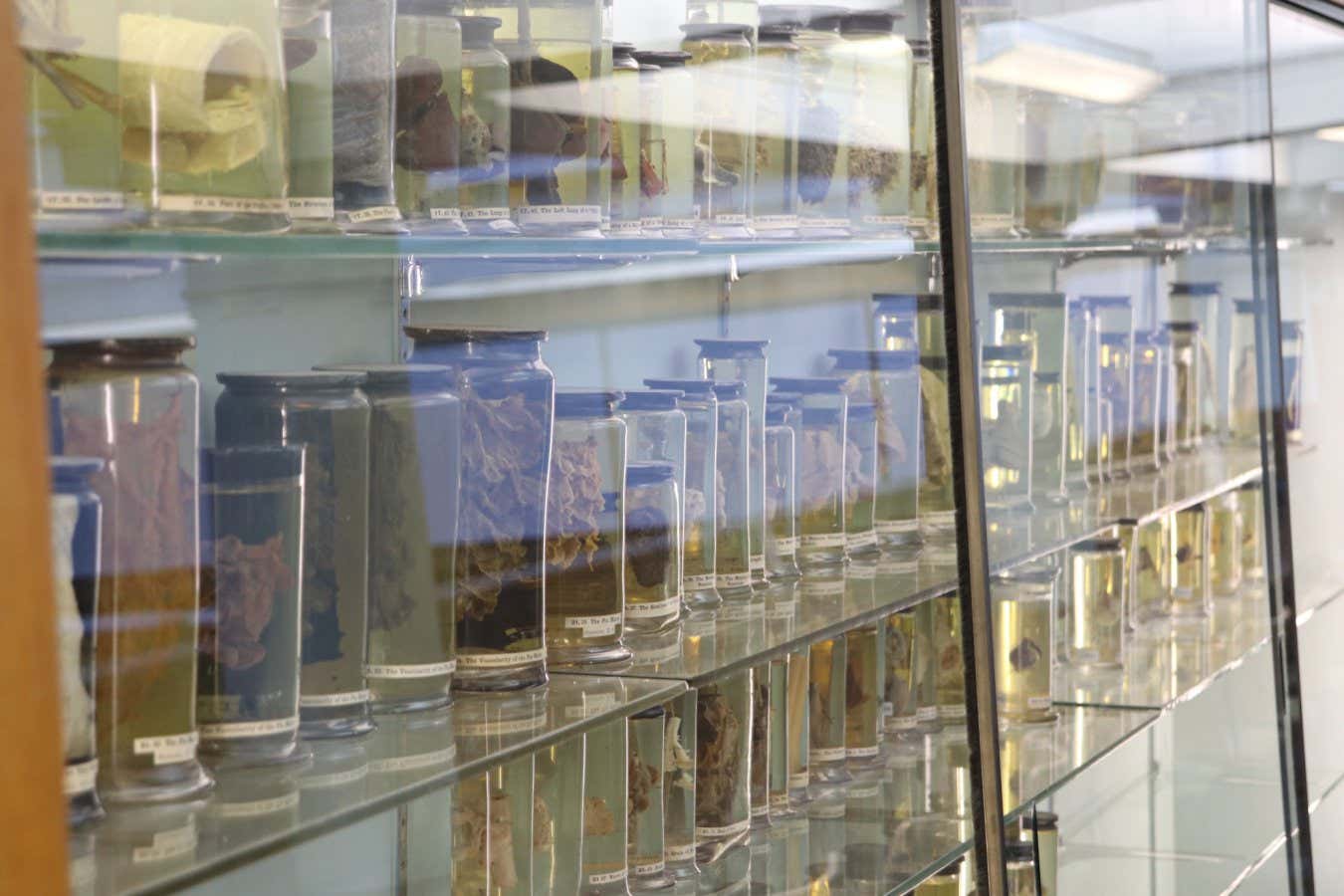
    Historic anatomical preparations from the late 1700s in the Hunterian Anatomy Museum

    Anatomy Museum © The Hunterian, University of Glasgow

    A cold virus that infected a woman in London about 250 years ago has been identified by genetic analysis, making it it the oldest confirmed human RNA virus.

    DNA sequencing has enabled scientists to find traces of some viruses up to 50,000 years old from ancient human skeletons. But many viruses, including the rhinoviruses that cause common colds, have a genome made from RNA, which is much less stable than DNA and usually degrades within a few hours after death.

    Our cells also produce RNA as part of the process of reading the genetic code and translating it into proteins.

    In recent years, scientists have been pushing back the age at which they have been able to recover ancient RNA, with one team recently extracting RNA from a woolly mammoth that died 40,000 years ago.

    “Until now, most ancient RNA studies have relied on exceptionally well-preserved materials, such as permafrost samples or desiccated seeds, which greatly limits what we can learn about past human disease,” says Erin Barnett at the Fred Hutchinson Cancer Center in Seattle, Washington.

    Since the early 1900s, many tissues in pathology collections have been preserved in formalin, which protects RNA from complete and rapid degradation. Barnett and her colleagues decided to search pathology collections across Europe for human specimens older than this that may have been well enough preserved for RNA to have survived.

    At the Hunterian Anatomy Museum at the University of Glasgow, UK, the team found lung tissue samples, preserved in alcohol rather than formalin, from two individuals – a woman from London who died around the 1770s and a second person whose sex is unknown who died in 1877. Both had documented evidence of severe respiratory disease.

    The scientists then set about isolating both RNA and DNA from the lung tissue of both individuals. Barnett says the RNA recovered from both lungs was “extremely fragmented”, with most pieces averaging only about 20 to 30 nucleotides long.

    “To put that in perspective, RNA molecules in living cells are usually more than 1000 nucleotides long,” she says. “So instead of working with long, intact strands, we were piecing together information from many tiny fragments.”

    Slowly, however, the researchers were able to reconstruct the entire RNA genome of a rhinovirus from the 18th-century woman. They also found evidence that she was inflicted with bacteria that cause respiratory disease, such as Streptococcus pneumoniae, Haemophilus influenzae and Moraxella catarrhalis.

    They then compared the old RNA virus they had reconstructed to a database at the US National Institutes of Health that contains records of millions of viral genomes, including many rhinoviruses collected from around the world.

    This showed that the historical virus genome falls within the human rhinovirus A group and represents an extinct lineage that is most closely related to the modern genotype known as A19. “By comparing it to present-day viruses, we estimate that this historical virus and modern A19 last shared a common ancestor sometime in the 1600s,” says Barnett.

    “The stories of these two individuals are largely unknown, and we hope that this study serves to help recognise them,” she says.

    “It represents a really important discovery since it demonstrates the possibility of recovering RNA from wet collections that pre-date the use of formalin,” says Love Dalén at Stockholm University in Sweden.

    “This is the first phase in what will become an explosion in the study of RNA viruses. Many RNA viruses evolve fast, which means that studying them on timescales of several hundred years will yield highly important insights into virus evolution,” he says.

    Topics:


    Source link

    Share. Facebook Twitter Pinterest LinkedIn Tumblr Email Telegram Copy Link

    Related Posts

    Science

    What is a ‘normal’ memory slowdown, and when should I worry?

    June 9, 2026
    Science

    Wildlife thrives in solar farm built on restored peatland

    June 8, 2026
    Science

    You don’t need to worry about recursive-self-improving AI – yet

    June 8, 2026
    Science

    Understanding anorexia’s grip on the brain could unlock new therapies

    June 8, 2026
    Science

    Why GLP-1 drugs might reduce cancer risk

    June 8, 2026
    Science

    Landmark pancreatic cancer treatment paves way for targeting other tricky tumors

    June 8, 2026
    Editors Picks

    Sense of Relief Spreads Among European Leaders Over De-Escalation of Greenland Crisis

    January 22, 2026

    Let these nine romantic animals inspire you on Valentine’s Day

    February 15, 2026

    Venezuela starts ‘exploratory process’ to re-establish formal ties with US | US-Venezuela Tensions News

    January 9, 2026

    Meghan Trainor Cancels Tour After Emotional Family Decision

    April 17, 2026

    China’s Xi headed to North Korea in bid to shore up ties | Politics News

    June 5, 2026
    About Us
    About Us

    Welcome to Benjamin Franklin Institute, your premier destination for insightful, engaging, and diverse Political News and Opinions.

    The Benjamin Franklin Institute supports free speech, the U.S. Constitution and political candidates and organizations that promote and protect both of these important features of the American Experiment.

    We are passionate about delivering high-quality, accurate, and engaging content that resonates with our readers. Sign up for our text alerts and email newsletter to stay informed.

    Latest Posts

    Katie Holmes And Joshua Jackson Spark ‘Soul-Level’ Love Chatter

    June 9, 2026

    Singapore Airlines, Southwest Airlines partner to expand access to nearly 120 US destinations

    June 9, 2026

    Trump warns Netanyahu: ‘You’ll be on your own’ if attacks on Iran continue | US-Israel war on Iran News

    June 9, 2026

    Subscribe for Updates

    Stay informed by signing up for our free news alerts.

    Paid for by the Benjamin Franklin Institute. Not authorized by any candidate or candidate’s committee.
    • Privacy Policy
    • About us
    • Contact us

    Type above and press Enter to search. Press Esc to cancel.