

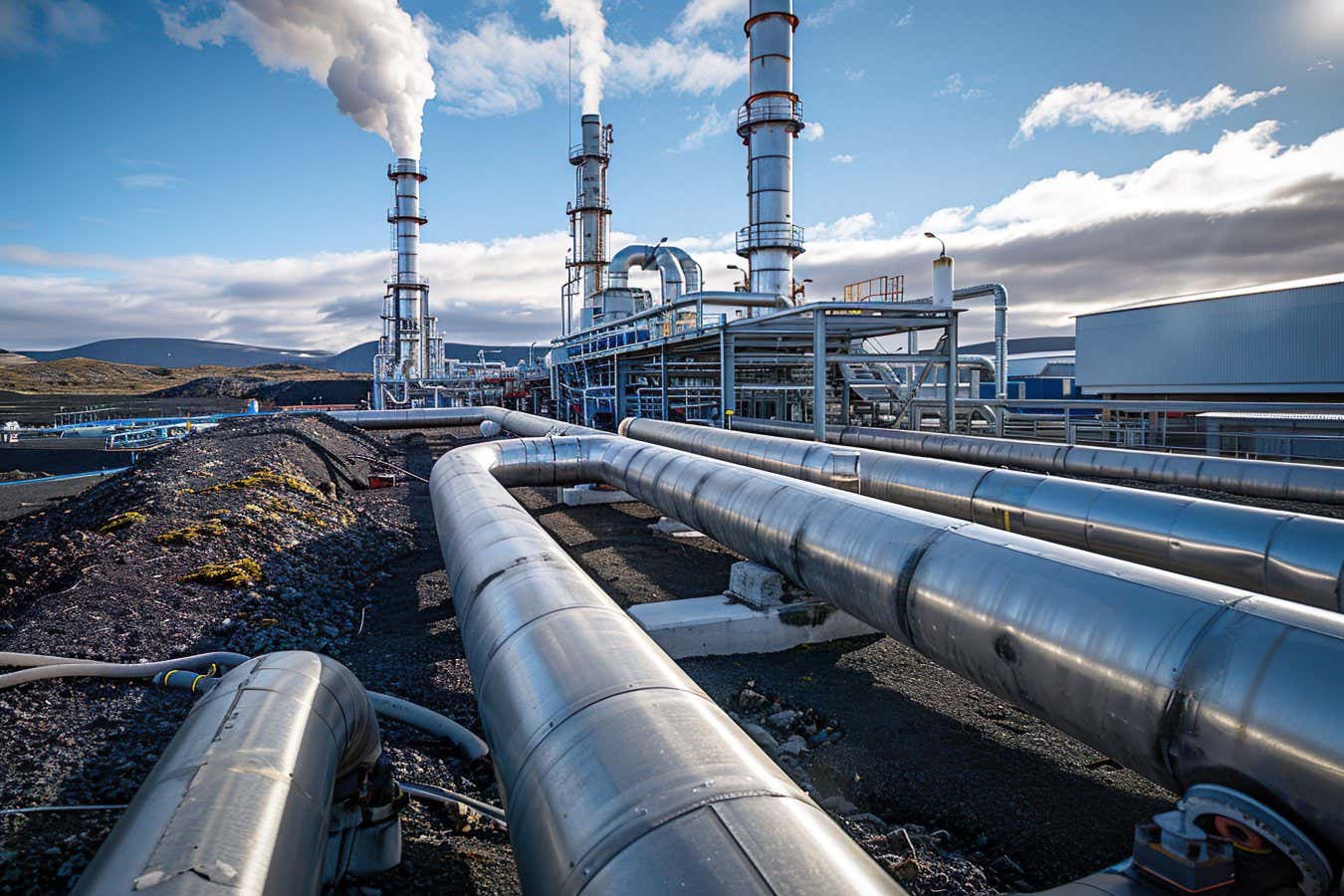
The Carbfix facility in Iceland
Oksana Baliukeviciene/Alamy
We desperately need clean hydrogen for processes that cannot be powered by renewable electricity – and it might be possible to generate vast quantities from rocks deep underground while locking away carbon dioxide at the same time.
Researchers at the University of Texas at Austin have shown that this process works for one common rock type in lab studies. They now want to work with companies on field trials.
“We hope to demonstrate that we will be able to generate hydrogen economically while sequestering CO2,” says team member Orsolya Gelencsér. It might even be possible to generate geothermal energy at the same time, she says.
Burning hydrogen produces only water, so doesn’t cause global warming. Hydrogen could therefore play a major part in achieving net zero, for instance by helping to decarbonise industrial processes such as fertiliser production and steel-making.
The problem is that almost all hydrogen is currently made from fossil fuels, meaning lots of CO2 is emitted during its production. One way to avoid these emissions is to use wind or solar power to split water, yielding hydrogen and oxygen.
This is starting to be done, but hydrogen made this way is more expensive for now. Producing it at scale would also require vast amounts of renewable energy, which means less of this green energy would be available for other purposes, such as replacing coal-fired power plants.
Hence, the recent surge of interest in natural or geological hydrogen. Several processes can generate hydrogen in rocks, and in the right conditions, the gas can accumulate and be extracted in similar ways to natural gas. This could be clean and cheap, but no one yet knows just how much natural hydrogen is there for the taking. While some researchers think there could be vast amounts waiting to be tapped, others – including Gelencsér – believe natural hydrogen resources may be limited.
The only place where nearly pure natural hydrogen is being extracted and exploited is in a village in Mali called Bourakébougou, and then only on a tiny scale.
“I think it’s a very special case,” says Gelencsér. Hydrogen is typically produced at low rates and, because its molecules are tiny, it is rare for overlying rocks to provide a good seal and allow it to accumulate, she says.
So, many groups around the world are now working on ways to generate hydrogen from rocks, rather than waiting for it to happen naturally. This approach is known as stimulated hydrogen production, and trials of various methods are already under way.
One way to do this is simply to pump water underground. Water reacts with certain rock types to form hydrogen in a process called serpentinisation, which is the source of a lot of natural hydrogen. Pumping in more water speeds up the process.
What Gelencsér and others have realised is that any CO2 added to the water should react with the rocks and get locked away in the form of carbonates. A company called Carbfix is already mineralising CO2 in Iceland by adding it to water being pumped underground at a geothermal power plant.
Gelencsér and her colleagues have now done lab tests using a type of volcanic rock that is rich in iron. They placed rock samples in a pressured container at 1.2 to 1.7 megapascals and heated to 90°C to simulate conditions at depth, and added either water with CO2 or water with the inert gas argon as a control. The CO2-rich water released more hydrogen, probably because CO2 forms carbonic acid that dissolves part of the rock and so allows more water to react with the rock. There was CO2 mineralisation, as expected, and hydrogen production could be boosted further by adding nickel chloride as a catalyst, Gelencsér told a recent meeting of the European Geosciences Union in Vienna.
The researchers were able to release around 0.5 per cent of the hydrogen it was theoretically possible to obtain from reacting water with the rock. They think that they need to get this up to 1 per cent to make the process feasible. One way to do this would be to go deeper, where temperatures are higher, as this enhances serpentinisation, says Gelencsér. That would cost more, but it might also be possible to exploit the higher temperatures for geothermal power.
Globally, there are huge volumes of iron-rich rock of this kind, which, even at 1 per cent efficiency, could potentially yield far more hydrogen than the 100 million tonnes currently produced around the world.
“It’s good work,” says Barbara Sherwood Lollar at the University of Toronto.
“There is definitely growing interest in approaches that combine stimulated geologic hydrogen production with CO2 mineralisation,” says Aliaksei Patonia at the University of Oxford in the UK. “A number of groups and start-ups are exploring variations of this concept.”
If companies could charge to lock away CO2 in this manner, as Carbfix is, the extra revenue would reduce the risks and make projects more appealing to investors, says Patonia. But it remains to be seen if any of the approaches will be viable.
Sherwood Lollar thinks we should be exploiting the small amounts of natural hydrogen we know about as well as exploring stimulated hydrogen production. Her team has just shown that a mine in Timmins, Ontario, is emitting around 140 tonnes of hydrogen per year, for instance, which could be exploited locally.
“There’s no silver bullet,” she says. “Every one of these potential approaches can contribute and should contribute – and we need to move quickly on them.”
Topics: