
Close Menu
    Trending
    • Kris Jenner Denies Recent Facelift Reports
    • Kevin Warsh one step closer to becoming Fed chair after Senate committee approval
    • ‘We saw terrible things’: Mali refugees tell of atrocities amid attacks | Armed Groups News
    • The ‘Passing TD leaders by NFL franchise’ quiz
    • Meta isn’t doing enough to keep minors off of Facebook and Instagram, says the EU
    • Chanda Prescod-Weinstein connects physics, poetry and pop culture
    • What is the Ahmadi Religion of Peace and Light? Police raid community in sex abuse probe
    • Starmer’s Collapse Is A Vote Against Policy Failure
    Benjamin Franklin Institute
    Wednesday, April 29
    • Home
    • Politics
    • Business
    • Science
    • Technology
    • Arts & Entertainment
    • International
    Benjamin Franklin Institute
    Home»Science»Possible galaxy spotted by JWST could be the earliest we’ve ever seen
    Science

    Possible galaxy spotted by JWST could be the earliest we’ve ever seen

    Team_Benjamin Franklin InstituteBy Team_Benjamin Franklin InstituteSeptember 5, 2025No Comments4 Mins Read
    Share Facebook Twitter Pinterest Copy Link LinkedIn Tumblr Email VKontakte Telegram
    Share
    Facebook Twitter Pinterest Email Copy Link


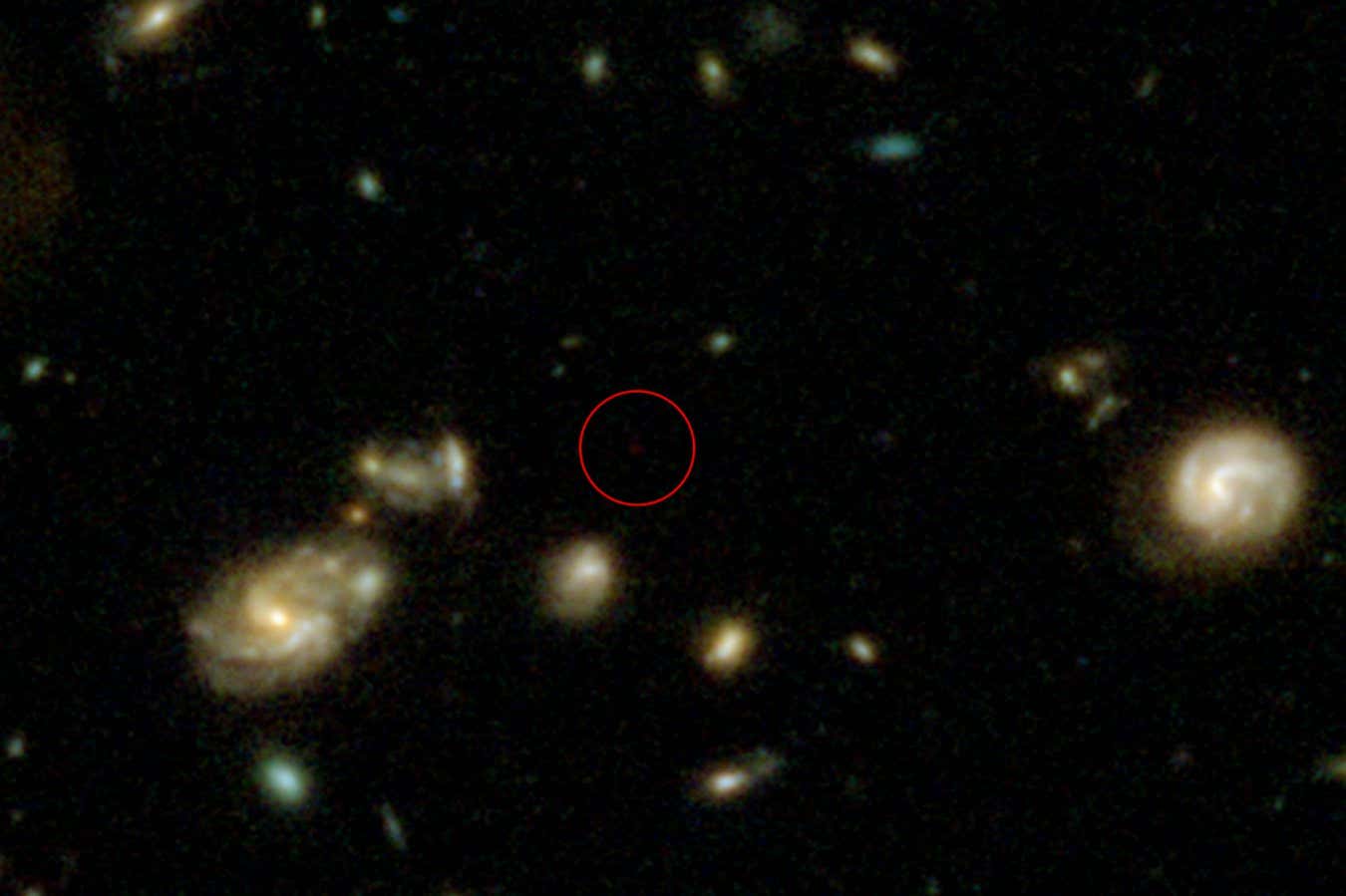
    The possible galaxy in an image from the James Webb Space Telescope

    NASA, ESA, CSA, CEERS, G. Gandolfi

    Astronomers might have discovered a galaxy that formed extremely early in the universe, nearly 200 million years before its closest competitor, but they caution there could be other explanations too.

    Giovanni Gandolfi at the University of Padua in Italy and his colleagues probed data from the James Webb Space Telescope (JWST) to look for distant objects that formed early in our universe’s 13.8-billion-year history.

    The further away a galaxy is from Earth, the longer its light will have taken to reach us and the more it will be shifted to the red end of the spectrum by the expansion of space, a property known as redshift.

    To date, the earliest confirmed galaxy – which was spotted by JWST and is called MoM-z14 – has a redshift of 14.4, meaning the light now reaching us from it began travelling towards us when the universe was 280 million years old. Gandolfi and his team, however, have reported an astonishing object with a redshift of 32, implying that we are viewing it as it was when the universe was just 90 million years old. They named it Capotauro, after a mountain in Italy.

    “Capotauro could be the farthest galaxy ever seen,” says Gandolfi, at a “timescale that is compatible with the first stars and black holes to form in the universe”.

    The team arrived at this conclusion by noticing a small blip in a deep JWST survey of the sky that appeared to be a distant galaxy. Using different filters on the telescope, the team could then calculate how much light from the galaxy would have been redshifted, arriving at a figure of 32.

    If correct, the object might be an extremely young galaxy in the process of formation, or something more unusual like a primordial black hole surrounded by a dense atmosphere – a hypothesised object known as a black hole star.

    However, the supposed galaxy appears unusually bright, similar to galaxies seen at later redshifts like MoM-z14, giving it a suspected mass of around a billion times that of the sun – beyond what our models suggest should be possible at this age of the universe.

    To achieve such a mass, the efficiency at which the galaxy turned gas into stars would have to be close to 100 per cent, says Nicha Leethochawalit at the National Astronomical Research Institute of Thailand: “It means no stars can explode.” But modelling suggests no more than 10 to 20 per cent is possible. “I think there’s something wrong,” she says.

    If it isn’t a galaxy, Gandolfi and his team say the object could instead be explained by a brown dwarf – a failed star – or a rogue planet in our galaxy drifting through JWST’s field of view, appearing similar to the distant blob of a galaxy. Both those explanations are interesting too, says Gandolfi, because it would be a particularly remote and cold brown dwarf or planet, up to 6000 light years away and at room temperature.

    “It could be one of the first substellar objects ever formed in our galaxy,” says Gandolfi.

    To find out for certain, the team would need follow-up time on JWST to pick apart the object’s light in finer detail. Leethochawalit says that while she favours the explanation that this isn’t a galaxy, such a follow-up might still be worth doing.

    “If it’s a galaxy with a redshift of 32, many things that we have thought so far would be wrong,” she says.

    New Scientist. Science news and long reads from expert journalists, covering developments in science, technology, health and the environment on the website and the magazine.

    The world capital of astronomy: Chile

    Experience the astronomical highlights of Chile. Visit some of the world’s most technologically advanced observatories and stargaze beneath some of the clearest skies on earth.

    Topics:


    Source link

    Share. Facebook Twitter Pinterest LinkedIn Tumblr Email Telegram Copy Link

    Related Posts

    Science

    Chanda Prescod-Weinstein connects physics, poetry and pop culture

    April 29, 2026
    Science

    City birds appear more afraid of women than men, and scientists have no idea why

    April 29, 2026
    Science

    NASA chief Jared Isaacman hints at campaign to make Pluto a planet again

    April 29, 2026
    Science

    Cancer is increasing in young people and we still don’t know why

    April 29, 2026
    Science

    People are betting on measles outbreaks – and that might be useful

    April 29, 2026
    Science

    Striking photo essay examines deadly spread of dengue fever in Nepal

    April 28, 2026
    Editors Picks

    AI Data Centers Study High-Temperature Superconductors

    February 21, 2026

    Why NYC Is The Most Corrupt Court Perhaps In The World

    February 18, 2026

    NASA’s Artemis II mission to the moon is inching toward the launch pad

    January 18, 2026

    US tech tariff exemption will be temporary, says Lutnick

    April 13, 2025

    Russia jails stand-up comic Artemy Ostani over war joke | Freedom of the Press News

    February 4, 2026
    About Us
    About Us

    Welcome to Benjamin Franklin Institute, your premier destination for insightful, engaging, and diverse Political News and Opinions.

    The Benjamin Franklin Institute supports free speech, the U.S. Constitution and political candidates and organizations that promote and protect both of these important features of the American Experiment.

    We are passionate about delivering high-quality, accurate, and engaging content that resonates with our readers. Sign up for our text alerts and email newsletter to stay informed.

    Latest Posts

    Kris Jenner Denies Recent Facelift Reports

    April 29, 2026

    Kevin Warsh one step closer to becoming Fed chair after Senate committee approval

    April 29, 2026

    ‘We saw terrible things’: Mali refugees tell of atrocities amid attacks | Armed Groups News

    April 29, 2026

    Subscribe for Updates

    Stay informed by signing up for our free news alerts.

    Paid for by the Benjamin Franklin Institute. Not authorized by any candidate or candidate’s committee.
    • Privacy Policy
    • About us
    • Contact us

    Type above and press Enter to search. Press Esc to cancel.