

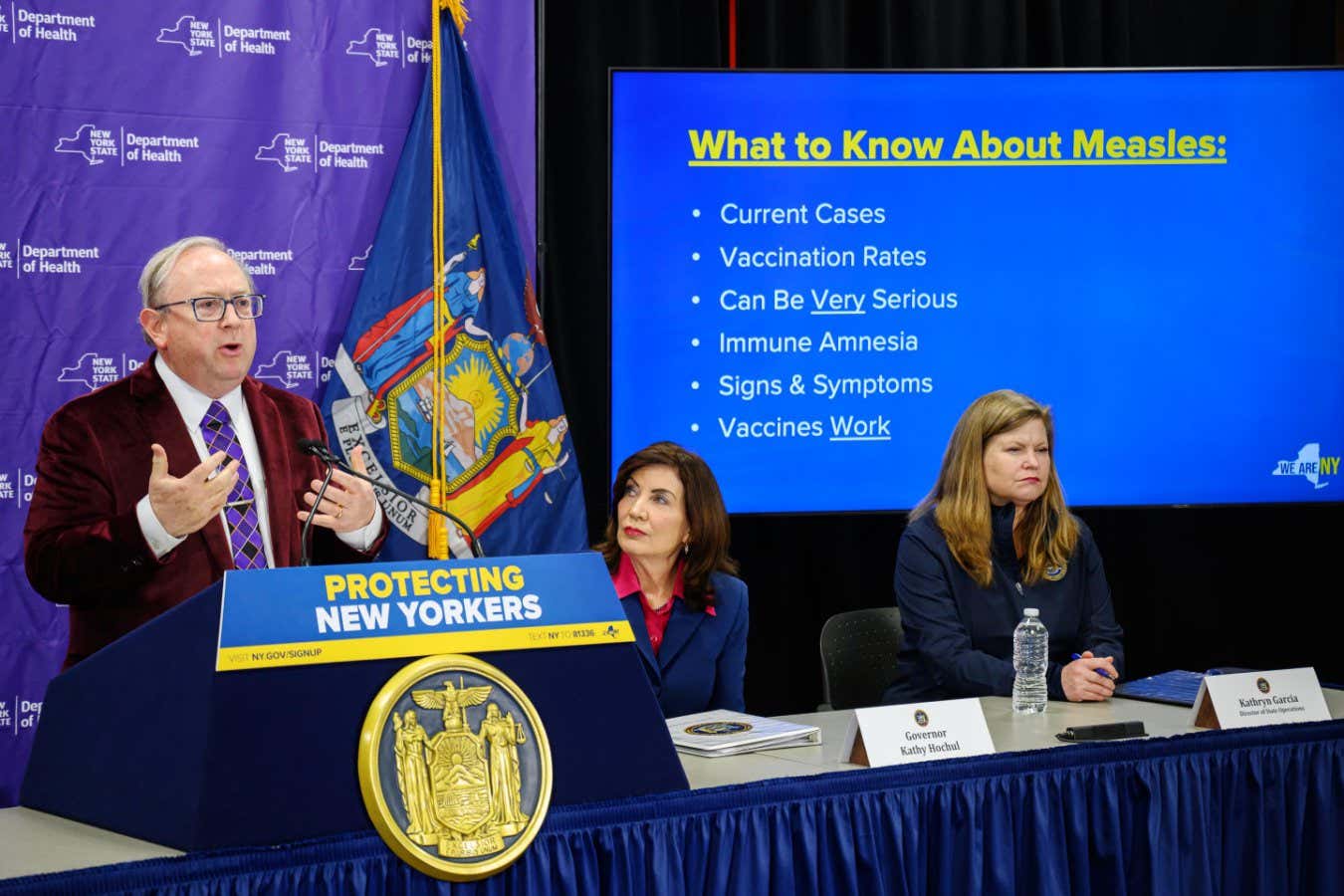
New York State Department of Health Commissioner James McDonald talking in New York last year about measles outbreaks
Jim Franco/Albany Times Union via Getty Images
Gamblers are increasingly placing bets on the number of people infected with measles in the US. Since January alone, nearly $9 million dollars have been bet on future cases of the disease on prediction markets Kalshi and Polymarket – and there is some evidence that the predictions are accurate enough to be useful for modelling its spread.
Prediction markets involve buying and selling shares related to an outcome. Each market offers a question about future events and the option to bet “yes” or “no”, with the cost of a bet determined by the way others have bet.
For example, if 86 per cent of wagers on a given future event are “yes” bets, the cost of a “yes” share is 86 cents. If that event does in fact occur, successful gamblers receive $1 for every share they have bought, with the unsuccessful gamblers – who lose their money – footing the bill for the winnings.
The idea of prediction markets emerged from scientific research. In 1988, three economists at the University of Iowa – Robert Forsythe, George Neumann and Forrest Nelson – were puzzling out a way to forecast federal elections in the US and developed the idea of creating a market. These markets allowed the researchers and their students to wager small amounts of money predicting the outcome of the elections.
The market’s forecasts proved pretty accurate, and in 2003, Philip Polgreen – an infectious disease researcher also at the University of Iowa – asked the economists to incorporate diseases into the market. These markets were “in the spirit of education and public good”, says Polgreen.
But in recent years, prediction markets have turned commercial through companies including Kalshi and Polymarket. These companies are legal in the United States and are regulated by the Commodity Futures Trading Commission, but they face growing backlash from federal and state governments.
For instance, prediction markets have come under fire for offering bets on the Iranian and Ukraine wars, which critics consider immoral. Then in February, a trader going by the pseudonym Magamyman won $553,000 on Polymarket by correctly predicting when Ayatollah Ali Khamenei would be removed from power. Khamenei was killed on 28 February 2026. The correct prediction led some members of the US Congress to wonder whether people with insider information were monetising state secrets.
Perhaps because measles cases and outbreaks have been rising across the US, there is also now a betting market in the disease. The ethics of making such bets are murky, but there may be a surprising silver lining to the practice. Spencer J. Fox at Northern Arizona University, who forecasts covid-19, influenza and the respiratory virus RSV, thinks measles prediction markets may turn out to be a promising source of data.
For instance, in June 2025, the prediction markets favoured an outcome in which there would be around 2000 cases of measles by the end of the year. There were actually 2288. “I’ve seen many worse forecasts from our models,” says Fox.
To predict diseases, epidemiologists use multiple data streams, including vaccination rates and genomic and climate data. “Everyone is looking for an edge for forecasting infectious diseases, and we’re constantly on the lookout for new data streams,” says Fox – although measles is a disease that isn’t typically covered by scientific forecasting because the disease is “very probabilistic”, says Fox.
Cognitive scientist Emile Servan-Schreiber, CEO of Hypermind, a prediction market company, thinks he knows why the measles predictions are so accurate. He says they harness the “wisdom of crowds”, and that “amateurs…bring cognitive diversity that replaces what they lack in in expertise”.
Even if this is true, however, it doesn’t mean prediction markets can simply replace epidemiologists’ scientific models, says Fox. For instance, prediction markets don’t incorporate as many distinct forecasts as scientific models, or offer as much granularity in terms of possible future outcomes. “You would have to make 1000s of bets a week for all of the different forecasts that we’re making,” Fox says.
He also says only experts can predict rare events. “If we don’t invest in the expertise for forecasting infectious diseases now, we’re going to be caught flat footed for the next covid-19.”
Kalshi and Polymarket did not respond to New Scientist‘s request for comment.
Topics: