
Close Menu
    Trending
    • How do earthquakes end? A seismic ‘stop sign’ could help predict earthquake risk
    • Trump Announces Cease-Fire Between Israel and Lebanon
    • Google Is Tracking Your Life – Photo Cloud Feeding AI System
    • Rachel Zoe Confronts Amanda Frances In ‘RHOBH’ Reunion Clip
    • China’s DeepSeek says it released long-awaited new AI model
    • China’s DeepSeek unveils latest models a year after upending global tech | Technology News
    • Malik Nabers’ reaction to Cowboys drafting Caleb Downs should thrill Dallas fans
    • AI is replacing creativity with ‘average’
    Benjamin Franklin Institute
    Friday, April 24
    • Home
    • Politics
    • Business
    • Science
    • Technology
    • Arts & Entertainment
    • International
    Benjamin Franklin Institute
    Home»Science»NASA changed an asteroid’s orbit around the sun for the first time
    Science

    NASA changed an asteroid’s orbit around the sun for the first time

    Team_Benjamin Franklin InstituteBy Team_Benjamin Franklin InstituteMarch 7, 2026No Comments3 Mins Read
    Share Facebook Twitter Pinterest Copy Link LinkedIn Tumblr Email VKontakte Telegram
    Share
    Facebook Twitter Pinterest Email Copy Link


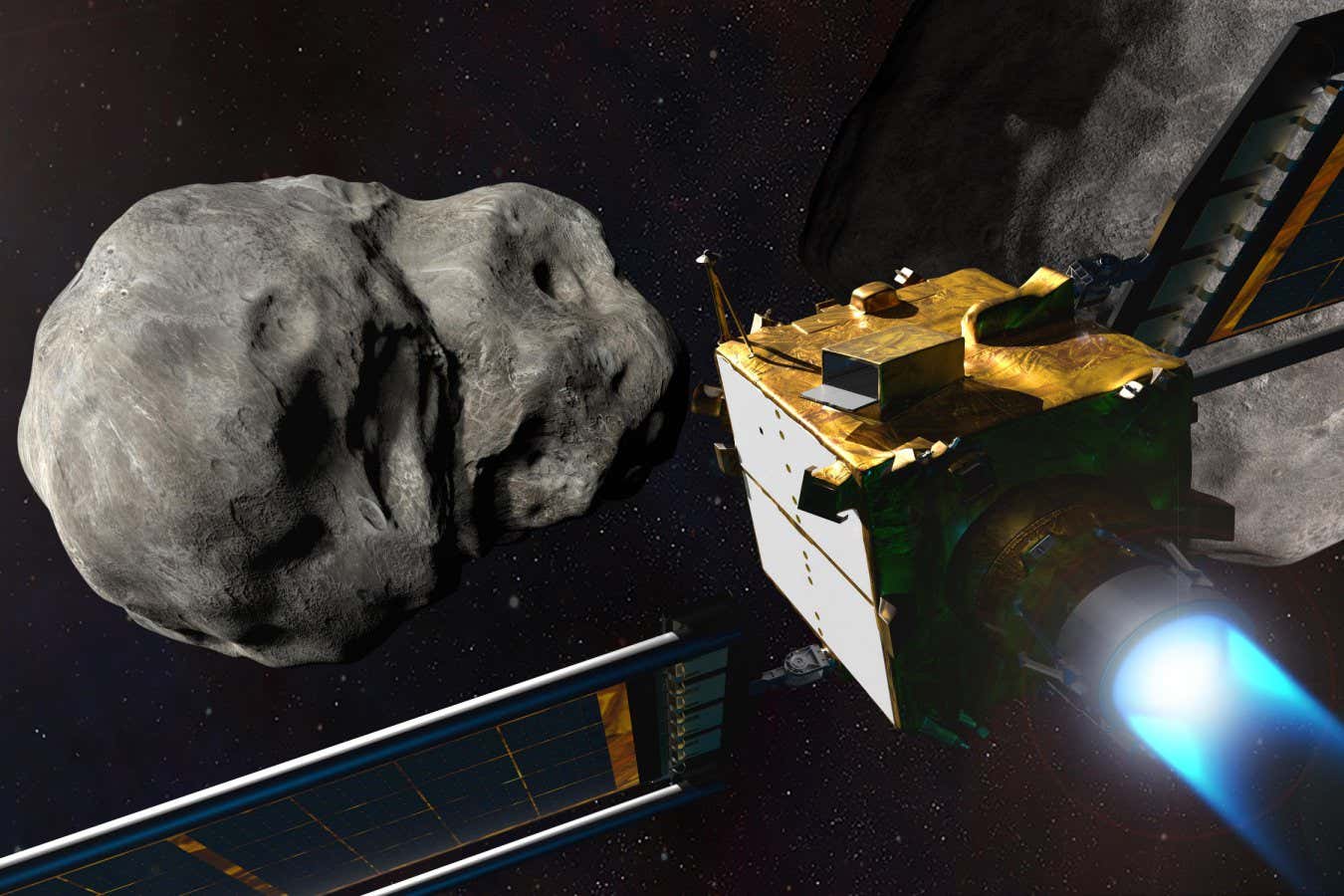
    NASA gave the Didymos system a nudge

    Steve Gribben/Johns Hopkins APL/NASA

    Humanity has shifted an asteroid’s orbit around the sun for the first time. This was achieved by NASA’s Double Asteroid Redirection Test (DART) mission in 2022, but the effect has only now been measured.

    DART’s target was a small asteroid called Dimorphos, which orbits a larger one called Didymos. The spacecraft crashed into the smaller rock in an effort to shift its orbit around the larger one, testing whether this method, called a kinetic impactor, would be an effective way to change an asteroid’s trajectory if it were heading towards Earth and send it careening past safely.

    The mission was a smashing success, shortening the length of Dimorphos’s orbit by 32 minutes. In the years since then, astronomers have continued to watch the system, and with nearly 6000 observations, they have been able to calculate the change in the pair’s overall orbit around the sun: it has slowed down by 11.7 micrometres per second, or around 40 millimetres per hour. That is expected to decrease the radius of its orbit by about 360 metres.

    “It doesn’t sound like a lot, but the whole idea behind these kinetic impacts is that if you do one early enough, a small impact makes a large change in the overall position,” says Rahil Makadia at the University of Illinois Urbana-Champaign, part of the team monitoring the asteroids’ orbits. “It’s a very tiny number, but if you let it accumulate over decades, then it can grow into a big one.”

    The slowdown had two causes: the initial impact by the spacecraft and an additional push from the jet of debris sent up from Dimorphos’s surface in the aftermath. Makadia and his colleagues calculated that the two effects were about equal to one another, which in turn allowed them to calculate the masses and densities of the asteroids. Dimorphos is about half as dense as Didymos, which adds credence to the idea that it is a so-called rubble pile that formed from material flung off of Didymos due to its rotation.

    All of this information will prove useful should we ever need to deflect a hazardous asteroid for real. “We now have one solid anchoring point to predict any future kinetic impact missions,” says Makadia. And the European Space Agency’s Hera spacecraft, which is on its way towards Didymos and is expected to arrive in November, should give us even more precise measurements that will guide any future attempts to protect Earth from incoming asteroids.

    Topics:


    Source link

    Share. Facebook Twitter Pinterest LinkedIn Tumblr Email Telegram Copy Link

    Related Posts

    Science

    How do earthquakes end? A seismic ‘stop sign’ could help predict earthquake risk

    April 24, 2026
    Science

    ‘Kraken’ fossils show enormous, intelligent octopuses were top predators in Cretaceous seas

    April 24, 2026
    Science

    Largest ever octopus was great white shark of invertebrate predators

    April 24, 2026
    Science

    Do you need to worry about Mythos, Anthropic’s computer-hacking AI?

    April 23, 2026
    Science

    How many dachshunds would it take to get to the moon?

    April 23, 2026
    Science

    The Age Code review: Can you slow ageing with your diet? A new book gives it a go

    April 23, 2026
    Editors Picks

    What to read this week: Emma Chapman’s mind-expanding Radio Universe

    April 16, 2026

    CeeDee Lamb sends message to Cowboys about George Pickens

    February 5, 2026

    Allegations against ICC war crimes prosecutor still under review

    March 22, 2026

    Kelce expected to return, but Chiefs need another answer for passing attack

    March 9, 2026

    Boris Johnson Urges The West To Pressure Putin

    February 26, 2026
    About Us
    About Us

    Welcome to Benjamin Franklin Institute, your premier destination for insightful, engaging, and diverse Political News and Opinions.

    The Benjamin Franklin Institute supports free speech, the U.S. Constitution and political candidates and organizations that promote and protect both of these important features of the American Experiment.

    We are passionate about delivering high-quality, accurate, and engaging content that resonates with our readers. Sign up for our text alerts and email newsletter to stay informed.

    Latest Posts

    How do earthquakes end? A seismic ‘stop sign’ could help predict earthquake risk

    April 24, 2026

    Trump Announces Cease-Fire Between Israel and Lebanon

    April 24, 2026

    Google Is Tracking Your Life – Photo Cloud Feeding AI System

    April 24, 2026

    Subscribe for Updates

    Stay informed by signing up for our free news alerts.

    Paid for by the Benjamin Franklin Institute. Not authorized by any candidate or candidate’s committee.
    • Privacy Policy
    • About us
    • Contact us

    Type above and press Enter to search. Press Esc to cancel.