
Close Menu
    Trending
    • Apple just straight up robbed Google
    • These small lifestyle tweaks can add a year to your life
    • Paul Hardcastle Jr: Who is the son of the 80s icon who was involved in fatal motorbike accident?
    • Is small the new big?
    • Paul Rudd Reacts To NSFW Compliment In Chaotic Podcast Moment
    • Scott Adams, Dilbert cartoonist who satirised office life, dies at 68
    • What’s at stake in Uganda’s presidential election? | Elections
    • Mike Tomlin’s Steelers tenure was massive success, but both sides needed change
    Benjamin Franklin Institute
    Wednesday, January 14
    • Home
    • Politics
    • Business
    • Science
    • Technology
    • Arts & Entertainment
    • International
    Benjamin Franklin Institute
    Home»Trending News»Luke Skywalker’s planet orbited two stars. How about brown dwarfs instead?
    Trending News

    Luke Skywalker’s planet orbited two stars. How about brown dwarfs instead?

    Team_Benjamin Franklin InstituteBy Team_Benjamin Franklin InstituteApril 18, 2025No Comments4 Mins Read
    Share Facebook Twitter Pinterest Copy Link LinkedIn Tumblr Email VKontakte Telegram
    Share
    Facebook Twitter Pinterest Email Copy Link


    WASHINGTON: In a memorable image from the 1977 film Star Wars, the young hero Luke Skywalker gazes at two suns setting above the horizon on his desert planet Tatooine. Astronomers since then indeed have discovered worlds, called circumbinary planets, orbiting two stars.

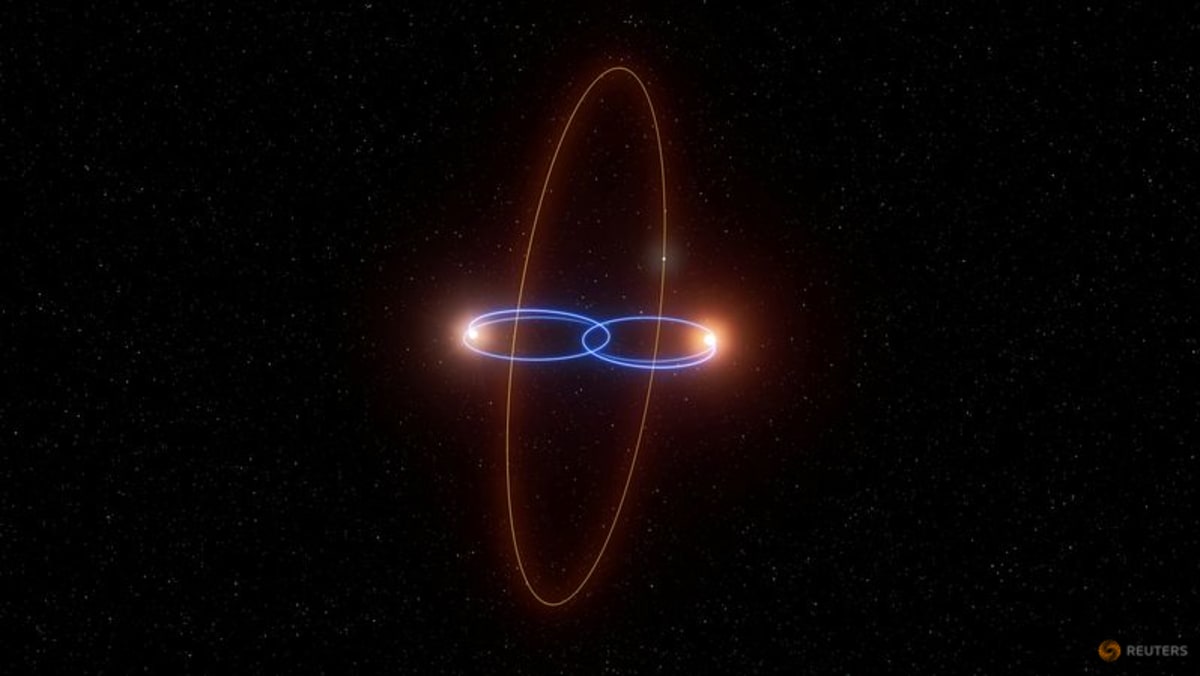
    But for sheer exoticism, it would be hard to top a newly described circumbinary planet located relatively nearby in our Milky Way galaxy. It orbits not two stars but two brown dwarfs – celestial objects too small to be a star and too big to be a planet. And its orbit is unlike any other such planet on record.

    Brown dwarfs could be considered wannabe stars that during their formative stages did not reach the mass necessary to ignite nuclear fusion at their core like a star. But they are more massive than the biggest planets and are modestly luminous.

    Using the European Southern Observatory’s Chile-based Very Large Telescope, researchers have found evidence of a planet roughly 120 light-years away – probably a gas planet at least four or five times the mass of Earth – orbiting two brown dwarfs, each about 35 times more massive than Jupiter. A light-year is the distance light travels in a year, 9.5 trillion km. Jupiter is our solar system’s largest planet.

    The two brown dwarfs are gravitationally bound and orbit near to each other – as close as just 4 per cent of the distance between Earth and the sun. The planet, named 2M1510 (AB) b, orbits around this pair. Another brown dwarf is present in this system, but is too far away – about 250 times the distance between Earth and the sun – for its gravitational pull to measurably disturb the other two.

    Of the approximately 5,800 planets beyond our solar system – called exoplanets – confirmed to date, only 16 are circumbinary. And until now, none of those were found to be orbiting brown dwarfs, rather than regular stars.

    The nature of this planet’s orbit also is unique. Rather than following the plane established for the orbit of the two brown dwarfs, the planet instead orbits almost nearly perpendicular from the plane – called a polar orbit – in a journey lasting at least 100 days.

    “A satellite on a polar orbit around the Earth is one that would pass over the north and south pole. It would therefore be on an orbit that is inclined at 90 degrees to the rotation axis of the Earth,” said Thomas Baycroft, a doctoral student in astronomy at the University of Birmingham in England and lead author of the study published in the journal Science Advances.

    No planet in our solar system has a polar orbit. The several exoplanets known to follow such a path orbit only a single star.

    When two stars, or in this case two brown dwarfs, orbit each other, it is called a binary system, like the fictional one in Star Wars. The view by an observer from this planet, however, would be unlike the one that Luke Skywalker saw.

    “This would be different from the Tatooine image. Both brown dwarfs would be identical and red. Since they are brown dwarfs they are fainter than the sun in general, though how bright they would appear in the sky also depends on how close the planet is to them,” Baycroft said.

    These binary brown dwarfs each have a mass approximately 4 per cent that of the sun and are only about 0.1 per cent as luminous.

    “This appears like an exotic configuration for a planetary system. Probably the most important discovery since the first exoplanet has been how diverse planetary systems are. They seem to defy our expectations, which is great – they present a fantastic opportunity to learn,” said University of Birmingham astrophysicist and study co-author Amaury Triaud.

    While scientists previously had hypothesised the existence of exoplanets in a polar orbit around a binary system, this is the first good evidence of that, Triaud said.


    Source link

    Share. Facebook Twitter Pinterest LinkedIn Tumblr Email Telegram Copy Link

    Related Posts

    Trending News

    Scott Adams, Dilbert cartoonist who satirised office life, dies at 68

    January 14, 2026
    Trending News

    Hamas to elect first leader since Sinwar killed by Israel, sources say

    January 13, 2026
    Trending News

    Withdrawal from World Health Organisation makes US, world ‘unsafe’

    January 13, 2026
    Trending News

    World Bank sees resilient global growth in 2026 despite tariffs, but fading dynamism

    January 13, 2026
    Trending News

    Is China a threat to Greenland as Donald Trump argues?

    January 13, 2026
    Trending News

    G7, other allies discuss ways to reduce dependence on Chinese rare earths

    January 13, 2026
    Editors Picks

    ‘He’ll be next’: Donald Trump threatens Colombian President Gustavo Petro | Donald Trump News

    December 11, 2025

    Meghan Markle Trolled Over ‘Needy And Clingy’ PDA With Prince Harry

    September 23, 2025

    Winners, losers from Day 1 of college football transfer portal

    January 3, 2026

    Top 12 productivity books of 2025 to change your relationship with work and time

    December 26, 2025

    Members Of The Royal Family Gathered For The Queen’s Coffin Procession In London

    November 21, 2025
    About Us
    About Us

    Welcome to Benjamin Franklin Institute, your premier destination for insightful, engaging, and diverse Political News and Opinions.

    The Benjamin Franklin Institute supports free speech, the U.S. Constitution and political candidates and organizations that promote and protect both of these important features of the American Experiment.

    We are passionate about delivering high-quality, accurate, and engaging content that resonates with our readers. Sign up for our text alerts and email newsletter to stay informed.

    Latest Posts

    Apple just straight up robbed Google

    January 14, 2026

    These small lifestyle tweaks can add a year to your life

    January 14, 2026

    Paul Hardcastle Jr: Who is the son of the 80s icon who was involved in fatal motorbike accident?

    January 14, 2026

    Subscribe for Updates

    Stay informed by signing up for our free news alerts.

    Paid for by the Benjamin Franklin Institute. Not authorized by any candidate or candidate’s committee.
    • Privacy Policy
    • About us
    • Contact us

    Type above and press Enter to search. Press Esc to cancel.