

Feedback is New Scientist’s popular sideways look at the latest science and technology news. You can submit items you believe may amuse readers to Feedback by emailing feedback@newscientist.com
Going places
Earth is a big planet with a lot of people on it, which means that even the most niche of interests can find their expression somewhere. Feedback has a sneaking fondness for those peculiar tourist attractions to be found along the many winding highways of the US, like Nebraska’s gloriously literal-minded World’s Largest Collection of the World’s Smallest Versions of the World’s Largest Things.
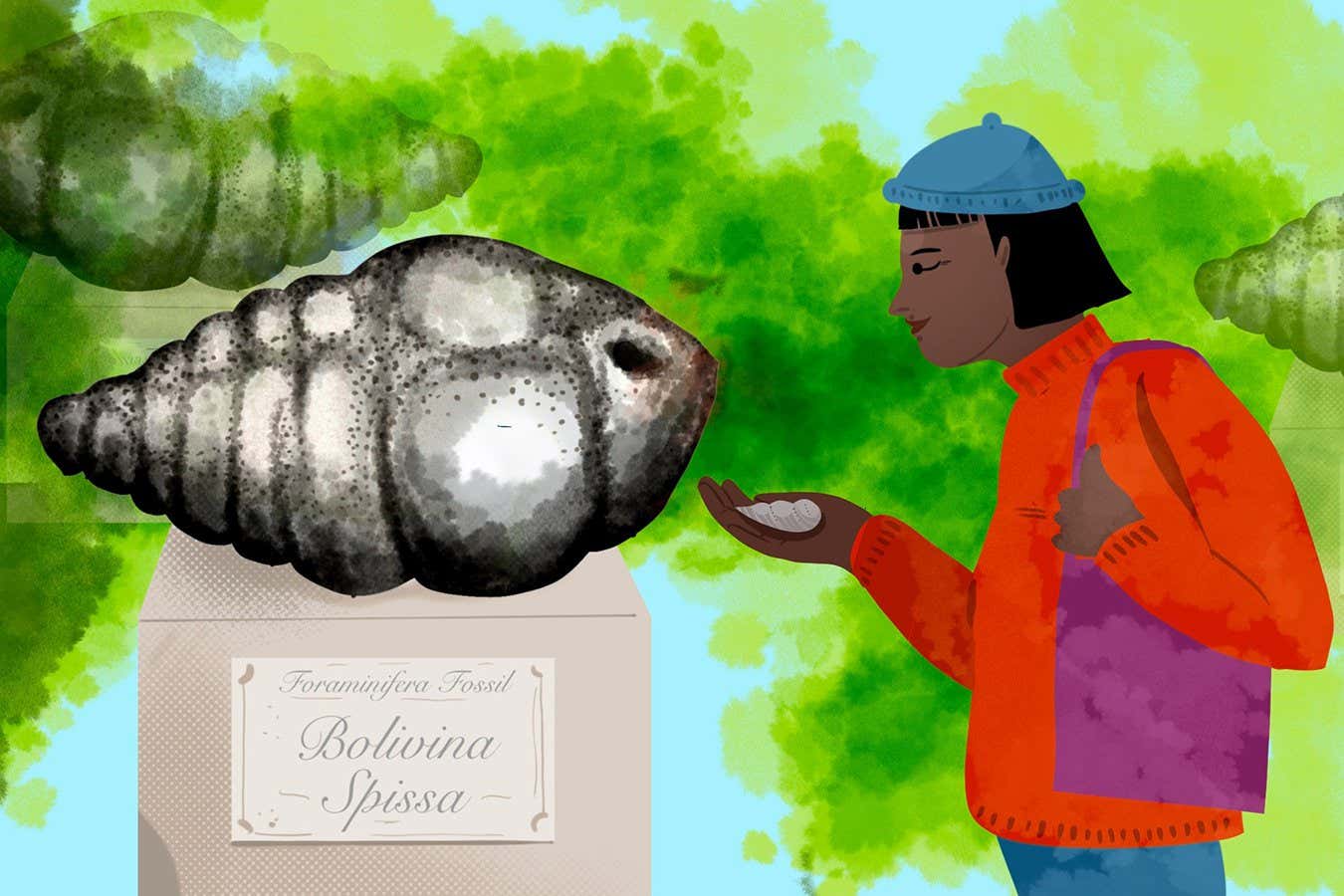
But we weren’t prepared for science historian Richard Fallon to draw our attention to the world’s one and only (as far as we know) sculpture park dedicated to foraminifera. If you don’t know what foraminifera are, they are single-celled organisms, mostly found in the sea, which often have a hard external shell, or test. These tests have been fossilised in huge numbers, so the foraminifera fossil record is extraordinarily detailed.
The tests also come in a huge variety of shapes, hence the Foraminiferal Sculpture Park. It is in Zhongshan, China, and opened in 2009 (Feedback is therefore 17 years late reporting on this, which we will concede is one of our worse response times).
Set in a park on a hillside, the attraction contains 114 large sculptures of foraminifera, among which visitors can wander. The sculptures are a little difficult to describe without thorough knowledge of the terminology of irregular three-dimensional shapes, but if you’ve seen some of Barbara Hepworth’s more curvaceous sculptures, you might be able to imagine something that is, well, actually still wrong, but not a million miles away from the real thing.
If one goes on TripAdvisor, as Fallon and Feedback both did, one will find that the Foraminiferal Sculpture Park has a 5-star rating. Closer inspection, however, reveals that this is based on one review, left by a user named Eudyptes – and we’re going to guess this person is the sort of person who is predisposed to like a sculpture park dedicated to foraminifera, since Eudyptes is the taxonomic name for crested penguins.
Feedback would like to see some more testimony on the matter. Sadly, our editor declined our request to be flown to China and back just to check out the park.Our suggestion that we combine it with a trip to the Sulabh International Museum of Toilets in New Delhi, India, was also rejected.
However, Feedback’s more pressing request is: do readers know of any scientific tourist attractions that are even more niche in nature? To forestall the inevitable emails: no, the Icelandic Phallological Museum and the UK’s Vagina Museum are far too popular and well-known. But is there a museum dedicated solely to mosses, perhaps, or an art gallery that houses only Western blot images?
In the beginning
It’s not uncommon for academics to put jokes and references into the titles of their papers, but it seems rarer for them to cut loose in their abstracts. These introductory paragraphs sum up all the main points of the study, generally in about 200 words. Depending on the academic, they are either models of brevity or an unbearable sludge of jargon.
Physicist Leonard Susskind, however, is having none of that. In March, he posted a paper to arXiv under the following header (which we assume is perfectly cogent if you know about this sort of thing): “Is time reversal in de Sitter space a spontaneously broken gauge symmetry?” Susskind’s answer, to be found towards the end of Susskind’s abstract, is “yes – but with a twist: Time-reversal is indeed a gauge symmetry; but it is hidden by spontaneous symmetry breaking”.
Physics writers can puzzle that one out; Feedback is concerned with the first half of the abstract. Susskind begins by thanking Daniel Harlow and Edward Witten for ongoing discussion, before adding “but frankly in both cases I can’t tell whether they agree with me or not”. Noting that he has “often been accused of imprecision”, especially towards the end of his papers, when he expects readers to have “caught on”, Susskind says that, this time, he has “tried to maintain a level of conceptual if not mathematical rigor throughout”, because “I’m now almost 86 and I can’t wait” for readers to catch up.
His abstract has gone straight into our list of top 10 favourite abstracts. The other prominent contender, flagged in a LinkedIn discussion of Susskind’s effort, is from 2011. Readers with long memories may recall a big fuss at the time over an experiment that seemed to show neutrinos travelling faster than light, which led to a lot of discussion before eventually being explained by some loose wiring.
In all the literature on the topic, one paper was published under the heading “Can apparent superluminal neutrino speeds be explained as a quantum weak measurement?”
The abstract was just two words long: “Probably not”.
Getting a bit cheesy
Feedback must issue a heartfelt, grovelling apology. We missed a trick, and it was a trick so obvious that we still can’t believe we didn’t think of it.
A few weeks ago, we examined the ongoing efforts of accounting firm PwC to estimate the future size of the lunar economy. 21 March Feedback was a little snarky about the idea of monetising the moon. But in all our irritable scepticism, we didn’t think of the thing that reader Alex Collier thought of, which was that all this lunar entrepreneurialism means the moon really is made of cheddar.
Got a story for Feedback?
You can send stories to Feedback by email at feedback@newscientist.com. Please include your home address. This week’s and past Feedbacks can be seen on our website.