

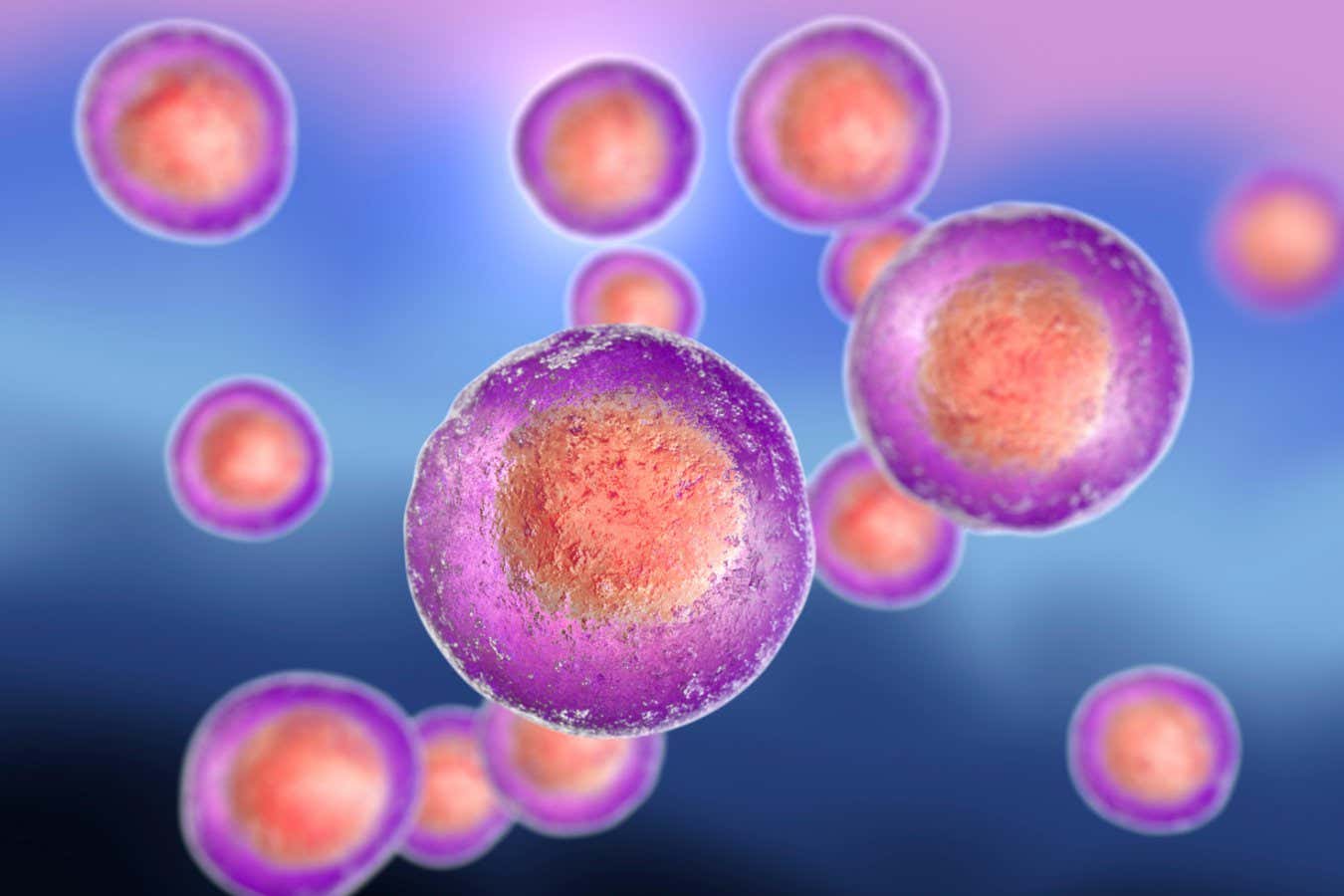
Stem cells could make good on the promise of partial reprogramming for rejuvenation therapies
KATERYNA KON/SCIENCE PHOTO LIBRARY/Alamy
I’ve covered the ageing field for many years and seen a lot of promising rejuvenation therapies get hyped up then fall flat on their faces. Ground zero for this repeated cycle was resveratrol, a natural compound once touted by biotech company Sirtris Pharmaceuticals as a miracle anti-ageing drug. In 2008, pharmaceutical giant GlaxoSmithKline bought the company for $720 million, only to pull the plug five years later after the compound turned out to be a dud. Similar disappointments have bedevilled caloric restriction, drugs targeting the ageing master switch MTOR and senolytics designed to clear out zombie cells that are a key driver of ageing.
So when I heard about the first clinical trial of a new class of rejuvenation drugs, I tried not to get too excited. But the more I looked, the more I started to think, maybe this time it’s different. Make a mental note of “partial reprogramming”, because it could be the one that finally lives up to the hype.
The story starts in 2006, when Shinya Yamanaka at Kyoto University in Japan published a landmark paper in the journal Cell. He and his colleague Kazutoshi Takahashi had discovered that by adding just four genes to mature skin cells, they could rewind them back to an embryonic state. This gave them pluripotency, meaning they had regained the capacity to turn into almost any cell type. They called these miraculous cells induced pluripotent stem cells (iPSCs), and launched what quickly became one of the hottest tickets in biosciences.
The therapeutic potential of iPSCs was immediately obvious. Any disease caused by damaged or degenerating cells – of which there are probably thousands, including many of the diseases of old age – could, in principle, be cured. Take cells from the person, create iPSCs from them and implant them back into the target organ – say, a heart damaged by a cardiac arrest or a brain ravaged by Alzheimer’s. The iPSCs would naturally differentiate into healthy, youthful cells and fix the damage. In other words, rejuvenation. What is more, the technique promised a source of stem cells without ethically questionable practices such as cloning or the destruction of embryos.
It was also immediately obvious that the path from lab to clinic would be lengthy, arduous and possibly futile. Yamanaka’s research was in mice, and there was no guarantee it would work on human cells. The cells were embryo-like, but not identical to natural pluripotent cells. The process was also highly inefficient, with fewer than 1 in 1000 treated cells becoming pluripotent. And then there was the big C: Yamanaka used a retrovirus to ferry the genes into the cell because these viruses integrate their DNA into the host’s genome. That means the genes can be expressed but it also carries the risk of triggering carcinogenic mutations. On top of that, the genes – dubbed Yamanaka factors – are all growth-promoting and stay switched on permanently, which multiplies the cancer risk. One in particular, c-Myc, is strongly associated with many forms of cancer.
For these reasons and others, many commentators dismissed the therapeutic potential of iPSCs (although their scientific value has never been in doubt; Yamanaka shared the Nobel prize for his discovery in 2012). In 2008, Tom Okarma, president of biotech company Geron in California, told New Scientist: “These, at best, are proxies for natural [embryonic stem cells]. They can never be used… It’s technically infeasible as well as ridiculously costly.”
One by one, however, the hurdles have been cleared. Yamanaka himself demonstrated that the technique worked on human cells, and also that he could induce pluripotency without c-Myc. Other teams devised ways to get the genes into cells without retroviruses, using adenoviruses instead. In 2016, a new concept arrived – partial reprogramming. Instead of inserting the genes and letting them stay active and hence potentially dangerous, why not switch them on for a time and then switch them off? Or repeatedly switch them on and off? That might push cells back some of the way to pluripotency and still be rejuvenating, while reducing the risk of them running riot. It worked.

Glaucoma damages the eye’s optic nerve
Stanford University/Science History Images/Alamy
Which brings us back to the clinical trial, the first time that partial reprogramming has been tested in humans. The target is glaucoma, an age-related degenerative eye condition, and a similar condition called non-arteritic anterior ischemic optic neuropathy (NAION).
The 18 participants – 12 with glaucoma and six with NAION – will each receive a single injection into the eye of a non-infectious virus carrying the Yamanaka factors minus c-Myc. These will be activated for 56 days using an oral drug, then switched off. It is a phase I trial, so the aim is to prove that the treatment is safe. If so, the trial moves on to phase II, to see whether it stalls or reverses the degeneration. If it does – which we won’t know for many years – the company behind the drug, Life Biosciences in Massachusetts, intends to go after a whole raft of other diseases. Many other companies are also in the partial reprograming game.
So, watch this space. Partial reprogramming may just be the next big flop waiting to happen. But if it succeeds, we’re in a new world. As João Pedro de Magalhães, then at the Institute of Ageing and Chronic Disease at the University of Liverpool, UK, told me in 2019: “If just one company becomes successful, given that slowing down ageing would impact so much in medicine and society, that would be transformative.”
Topics: