

Islamabad, Pakistan – At the start of this year, Pakistan had more imported liquefied natural gas (LNG) than it could use. Demand had been falling for three straight years, from a peak of 8.2 million tonnes in 2021 to 6.1 million tonnes by late 2025, as cheap solar panels flooded the market and factories cut back.
The government quietly sold excess gas shipments to other countries and shut down domestic gas wells to prevent pipelines from bursting under the pressure of oversupply. Gas that could not be diverted would be pushed into household networks at a financial loss, adding billions to an already crippling debt pile in the energy sector.
Recommended Stories
list of 4 itemsend of list
Then the war came. On February 28, the United States and Israel launched hundreds of strikes against Iran in an operation named Epic Fury. The strikes targeted Iranian missiles, air defences, military infrastructure and leadership. Supreme Leader Ali Khamenei was killed in the opening assault.
Iran retaliated by firing hundreds of missiles and drones across the region, and as a result, traffic passing the Strait of Hormuz, the narrow waterway through which roughly a fifth of the world’s oil and gas passes, almost came to a halt.
The energy consequences were immediate. As a part of its retaliation against US-Israeli attacks, on March 2, Iranian drones hit Qatar’s gas facilities at Ras Laffan Industrial City, the world’s largest LNG export complex.
Qatar, the world’s second-largest LNG exporter after the United States, halted all production and declared force majeure, a legal term meaning it was released from delivery obligations due to circumstances beyond its control.
The conflict escalated further on March 18, when Israel struck Iran’s South Pars gas field, the largest in the world, off Iran’s southern coast.
South Pars and Qatar’s North Field sit above the same underground reservoir, meaning the attack threatened both countries’ gas production simultaneously. Iran struck Ras Laffan again in retaliation.
QatarEnergy said that the hit had forced it to cut LNG production by 17 percent, with repairs expected to take up to five years.
Brent crude, the industry benchmark, was priced at more than $109 a barrel on Thursday,
Oil prices on Thursday climbed to $109 a barrel, while European gas prices jumped 6 percent in a single trading session.
For Pakistan, which secures nearly all its imported gas from Qatar and the United Arab Emirates, and holds no emergency reserves, the shift from surplus to shortage happened almost overnight.
A system built on imports
Pakistan meets its daily gas needs from three main sources. The bulk, about 2,700 million cubic feet per day, comes from domestic gas fields that have been in slow decline for years.
The rest comes from imported LNG, supplied by Qatar under long-term contracts, adding roughly 600 million cubic feet per day when shipments flow normally.
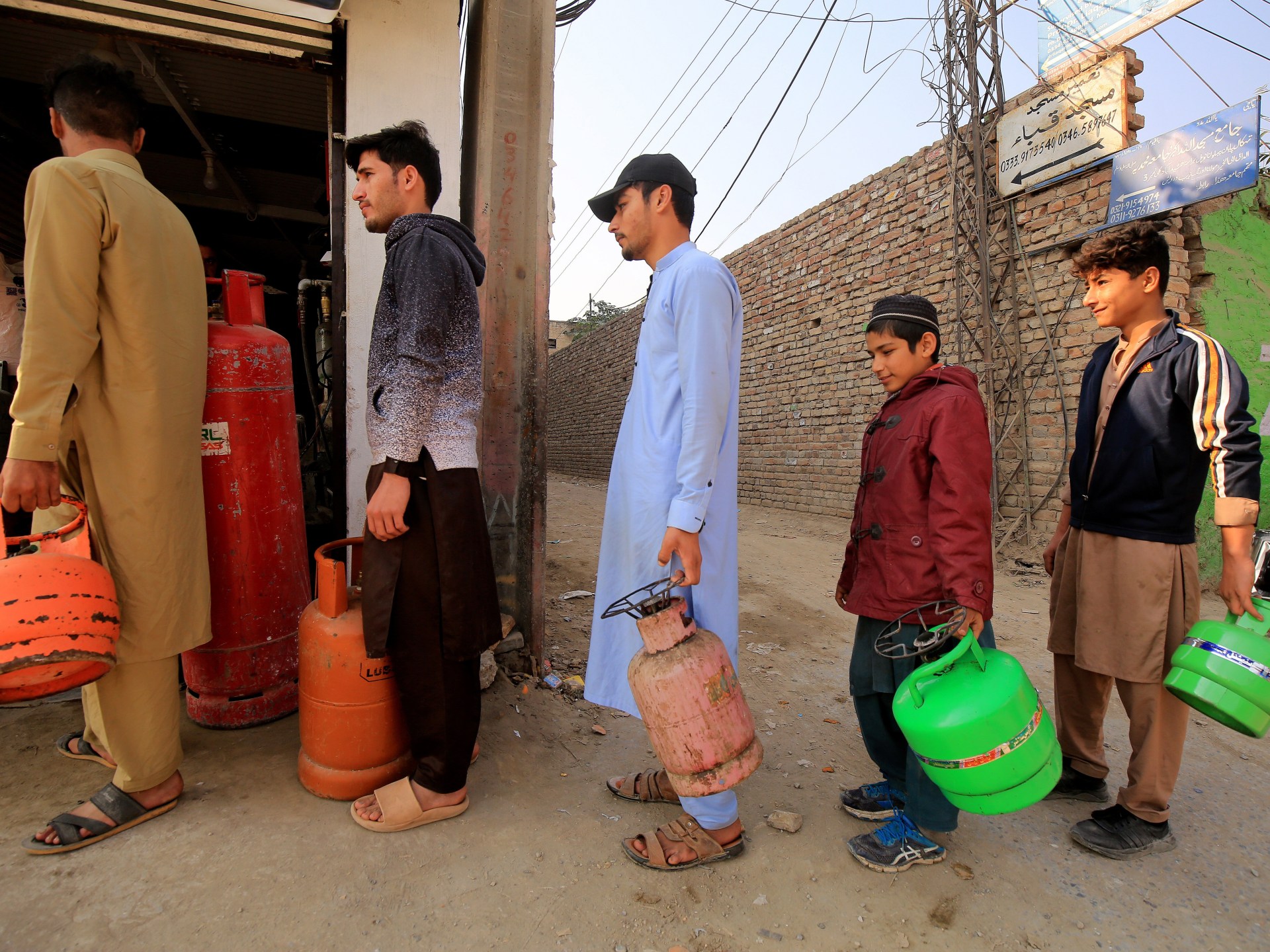
The third source is bottled LPG, used mainly by households in rural areas not connected to the pipeline network. Pakistan gets more than 60 percent of its LPG from Iran, a supply also disrupted by the conflict.
Pakistan began importing LNG in 2015 when domestic production could no longer meet demand. Today, imported LNG powers roughly a quarter of the country’s electricity, with the power sector its largest consumer.
Qatar and the UAE together account for 99 percent of Pakistan’s LNG imports, according to energy analytics firm Kpler.
Of that, Pakistan’s LNG supply is dominated by two long-term government-to-government agreements with Qatar, one spanning 15 years and the other 10. Together, they cover nine shipments a month.

From glut to scarcity
Monthly cargo data from Pakistan’s energy regulator, OGRA, reflects the impact of the war. The country received between eight and 12 LNG shipments a month through 2025 and into early 2026, with 12 arriving in January alone. In March, the month the war began, only two shipments arrived.
Prices have been affected too. According to data compiled by researcher Manzoor Ahmed of the Policy Research Institute for Equitable Development (PRIED), on February 13, state-owned entities Pakistan State Oil and Pakistan LNG Limited procured eight combined cargoes at an average cost of $10.47 per MMBtu, totalling $257.1m.
MMBtu is the standard international unit used to measure and price natural gas and LNG.
By March 12, the two cargoes that did arrive cost $12.49 per MMBtu, a 19 percent increase in a month, reflecting tightening global conditions even before the war’s full impact.
Pakistan had already been consuming less gas. Its share of Asian LNG markets fell from roughly 30 percent in 2020 to about 18 percent in 2025, driven largely by the rapid expansion of solar power. Millions of Pakistanis, frustrated by high electricity costs and frequent blackouts, have installed rooftop panels in recent years.
By 2025, the country had 34 gigawatts of solar capacity, with an estimated 25 gigawatts feeding into the national grid. Overall electricity demand from the grid fell nearly 11 percent between 2022 and 2025.
Gas-fired power plants built to run on imported LNG were left underutilised, especially during daylight hours.
“Of course, solarisation helps manage daytime demand, reducing the need for running thermal power plants,” said Haneea Isaad, an energy analyst at the Institute for Energy Economics and Financial Analysis (IEEFA), who has tracked Pakistan’s gas sector for years.
But the contracts with overseas gas suppliers still needed to be adhered to — so Pakistan kept buying and paying, she told Al Jazeera.
Ahmed of PRIED pointed to two compounding challenges. First, the nature of Pakistan’s gas supply contracts were such that the government had to “buy LNG even when demand collapsed,” he told Al Jazeera.
Second, “rapid solar growth and suppressed grid demand were underestimated, and their effect on overall planning was not accounted for,” the Islamabad-based analyst added.
LNG consumption dropped by 1.21 million tonnes in 2025 alone. With no large storage capacity, surplus gas was pushed into domestic pipelines at a loss.
The resulting circular debt in the gas sector now stands at 3.3 trillion rupees, approximately $11bn. By January, Islamabad was negotiating to offload 177 unwanted gas shipments projected through 2031, a liability of $5.6bn.
Isaad of IEEFA said the surplus was predictable.
“Pakistan’s energy planning has mostly been bound by long-term contracts with very little flexibility,” she said. Once considered necessary for energy security, these rigid contracts, she added, have become a financial albatross in a market increasingly prioritising flexibility and low-cost generation.
She described the government’s pre-war response, diverting excess cargoes, as “reactive crisis management” that prioritised short-term fixes over better forecasting and procurement flexibility.
Supply shock
Qatar’s LNG shipments to Pakistan have stopped almost completely since March 2. Of the eight shipments scheduled that month, only two arrived. The six expected in April are unlikely to reach the country.
At a public hearing of the National Electric Power Regulatory Authority, Central Power Purchasing Agency chief executive Rehan Akhtar said LNG supplies were under force majeure, though coal imports from South Africa and Indonesia remained unaffected.
Officials have warned of near-zero LNG availability in the coming months, even if the war ends quickly. LNG accounts for more than 21 percent of Pakistan’s power generation.
“With Pakistan’s LNG supply completely halted after Qatar’s declaration of force majeure, LNG plants are effectively out of the running order,” Isaad said.
The government has responded by restoring domestic gas production that had been deliberately curtailed during the surplus period.
Isaad said Pakistan had been holding back roughly 350 to 400 million cubic feet per day of domestic gas to accommodate LNG imports.
“There will also be the option to rely on other power generation sources such as imported coal and hydropower,” she added. But, she warned, “even with hydropower, imported coal and restored domestic gas production covering some of the gaps left by LNG, there might still be an energy shortage.”
For now, mild weather and increased solar output have provided temporary relief.
“So far, Pakistan has somehow miraculously survived any prolonged energy shortages in the power sector through a combination of mild weather and a pre-existing reduced reliance on imported LNG,” Isaad said. “But peak summer months may be a different story.”

Summer pressure
With an energy crisis looming, Pakistan is bracing for a few hours of daily planned power cuts this summer, alongside other energy conservation measures and higher electricity costs.
According to the National Electric Power Regulatory Authority’s State of Industry Report 2025, peak electricity demand last summer exceeded 33,000 megawatts.
Winter demand currently stands at about 15,000 megawatts, partly because solar panels now generate between 9,000 and 10,000 megawatts daily, reducing reliance on the grid.
Furnace oil, the main backup fuel, now costs 35 rupees per unit, about $0.12, and its price has more than doubled since the Strait of Hormuz disruption.
Analysts say the burden will fall unevenly. Consumers reliant on grid electricity will face both higher bills and outages, while industries dependent on gas will see production disruptions. Those with rooftop solar and battery storage will be best insulated.
Isaad is blunt about the options before Pakistan. “Returning to the spot market might not be feasible, given the dire financial consequences,” she said. “Even if it does, competition with wealthier nations may once again price Pakistan out. Furnace oil could be another option, but that will be prohibitively expensive to run.
“The only option the government may be left with is load-shedding [planned power blackouts], probably around two to three hours daily.”