

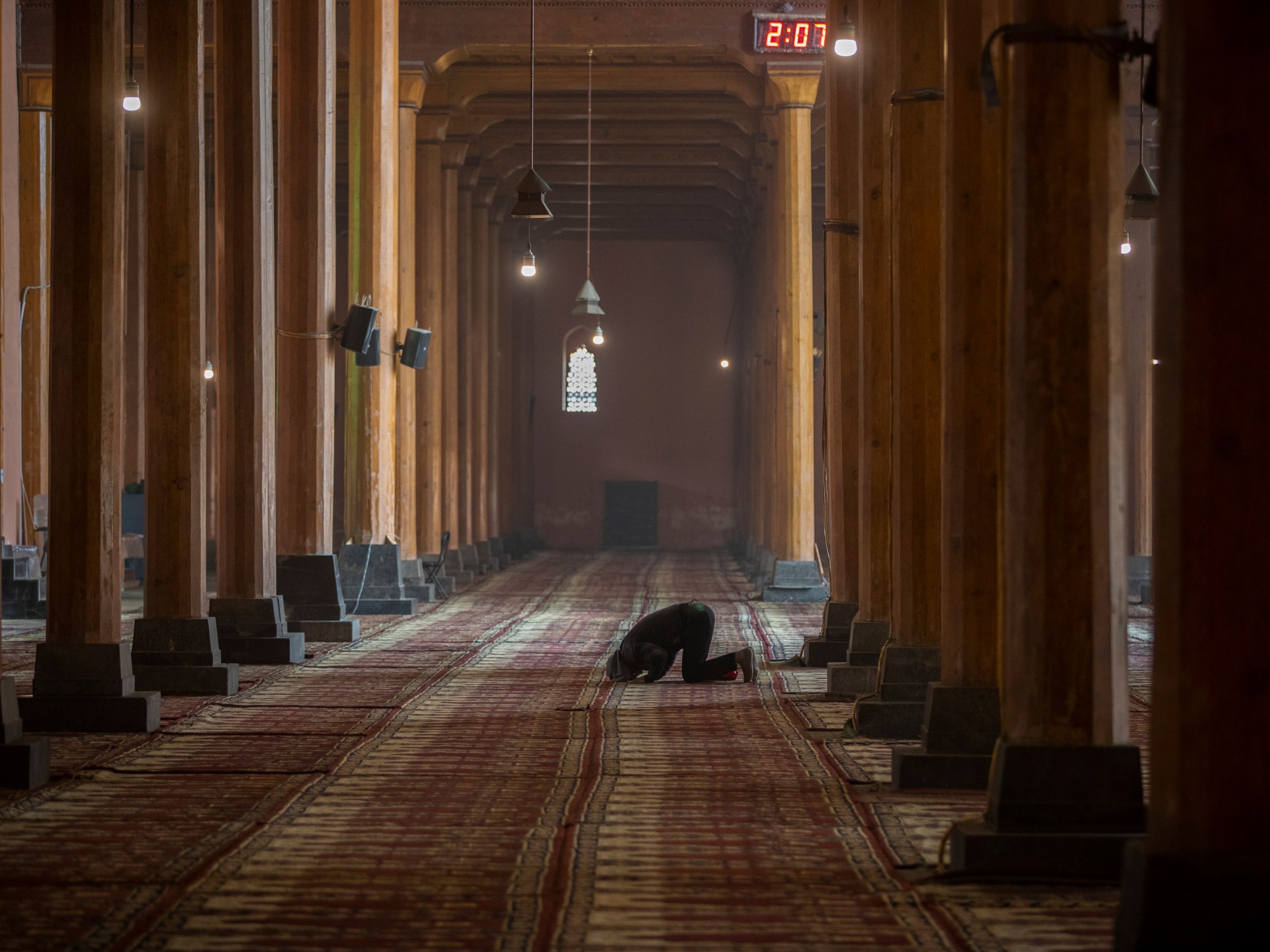
Mohammad Nawaz Khan regrets the day his father, Sanaullah Khan, a retired government employee, agreed to head the managing committee of the neighbourhood mosque in Indian-administered Kashmir’s main city of Srinagar.
Khan’s worries began earlier this month after the police started distributing a four-page form, literally titled “profiling of mosques”, to their functionaries, triggering fears of increased surveillance and allegations of a discriminatory policy towards the residents in the disputed Muslim-majority region.
Recommended Stories
list of 4 itemsend of list
One page of the form collects information about the mosque itself, seeking information about the “ideological sect” it belongs to, the year it was founded, its sources of funding, monthly expenditure, the number of people it can congregate, and details on ownership of the land on which the structure stands.
The remaining three pages collect personal details of the people – imams, muezzins, khatibs and others – associated with the mosque, including their mobile numbers, emails, passport, credit card and bank account details. The more insidious columns in the form ask the respondents to declare if they have relatives abroad, the “outfit” they are associated with, or even the model of their mobile phone and their social media handles.
A similar form has also been shared with the people running “madrasas” (religious schools) in the region.
“This is not a place where you can live in peace. Every now and then, we are asked to fill out one form or another,” Nawaz, 41, told Al Jazeera as he sat inside his grocery shop in Jawahar Nagar area of Srinagar.
“They are asking for unusually detailed information about religious institutions and those linked to them. The form seeks details about sectarian affiliation, funding sources, land ownership, charitable activities, and much more,” he said.
“I do not understand why the police need this much personal information. Keeping such detailed records is not safe for families like mine. In a conflict area like Kashmir, this can have serious consequences.”
Residents say the police exercise feels less like a routine survey and more like an attempt by the state to exert control over Kashmir’s religious institutions that have traditionally managed their own affairs.
The Mutahida Majlis-e-Ulema (MMU), the largest umbrella body of Islamic religious groups in Kashmir, has opposed the profiling of mosques, calling it an attempt to control religious institutions.
“Mosques are sacred places meant for worship, guidance and community service, and their internal religious affairs cannot be subjected to intrusive scrutiny,” the MMU said in a statement, urging the government to stop the exercise, which it said “creates fear and undermines trust within the Muslim community”.
‘Makes you worry’
Hafiz Nasir Mir has been working as an imam for about 15 years and currently leads the daily prayers at a mosque in Srinagar’s Lal Bazar area. He also received the form but has not filled it in yet due to privacy concerns.
“If this were just paperwork, the police would not have been asking for so many personal details again and again,” Mir, 38, told Al Jazeera.
“They also want information about relatives who live outside Kashmir or even outside India. These are private family matters and not things meant for police records … When the authorities start asking for such details at this level, it makes you worry about how the information might be used later.”
The Himalayan region of Kashmir is claimed by both India and Pakistan, who control parts of it and have fought three wars over it since their independence from British rule in 1947. China also controls a sliver of Kashmir’s land.
Article 370 of the Indian Constitution granted Indian-administered Kashmir partial autonomy over matters related to education, employment and land ownership. In 2019, however, Prime Minister Narendra Modi’s right-wing government scrapped the law and divided the region into two federally-governed territories – Jammu and Kashmir, and Ladakh.
Since then, New Delhi’s direct control over Kashmir has seen restrictions on religious freedoms, including the denial of other rights.
The region’s main mosque, Srinagar’s Jamia Masjid, was shut for nearly two years in the aftermath of the 2019 move, and still sees frequent closures and limits on the number of people allowed to congregate for Eid prayers.
India says the restrictions are temporary, calling them preventive measures to maintain law and order and curb “cross-border militancy” – a reference to Pakistan’s alleged support for Kashmiri rebels. Pakistan rejects India’s allegation, saying it provides only diplomatic backing to the Kashmiris’ struggle for self-determination.
A political analyst told Al Jazeera the profiling of mosques raises serious questions about privacy and religious freedom.
“A balanced approach is needed, with clear rules, transparency, judicial oversight and involvement of local communities to maintain trust while ensuring security for everyone,” he said on condition of anonymity over fears of reprisals from the authorities.
“Many people also see the exercise as discriminatory, saying it places pressure on Muslim institutions without similar scrutiny of other faiths.”
‘Turning mosques into crime scenes’
Mehbooba Mufti, former chief minister of the region who once led a coalition government with Modi’s Bharatiya Janata Party (BJP), criticised the police exercise, calling it “discriminatory” and aimed at “creating fear among Muslims”.
“By doing so, they are turning mosques into crime scenes. Can the government do the same with [Hindu] temples, [Sikh] gurdwaras or churches?” she asked, holding a copy of the police form during a news conference in Srinagar.
Imran Nabi Dar, spokesman for the region’s governing party National Conference, said the party wants the profiling to stop. The region has had an elected government since 2024 – its first since the revocation of Article 370 in 2019 – but most executive powers rest with the New Delhi-appointed lieutenant governor.
“The authorities have already carried out several surveys in the Kashmir valley. There is no need to conduct another one unnecessarily,” Dar told Al Jazeera. “Once government representatives meet the lieutenant governor, we will raise the issue with him. We cannot stop the profiling ourselves because the police are not under our control, as Jammu and Kashmir is a union territory.”
Defending the profiling of mosques, Altaf Thakur, spokesman for the BJP in Kashmir, said surveillance was necessary for accountability and transparency.
“Past experience tells us that mosques were used in Kashmir by maulvis [prayer leaders] to ask people to come out and hold pro-Pakistan rallies. Though it was stopped in 2019, some elements still use mosques as a political platform and for propaganda,” he said.
“There is nothing wrong with finding out who funds mosques, the nature of the land they are built on, and the ideology they follow,” Thakur said. “We need to know what is taught in these mosques.”
Mir, the imam at the Lal Bazar mosque, fears the authorities would soon ask them to get their sermons approved by them before the prayers. “I can say we, the prayer leaders, will be asked to deliver mandatory Friday sermons only after getting approval from the concerned police station.”