

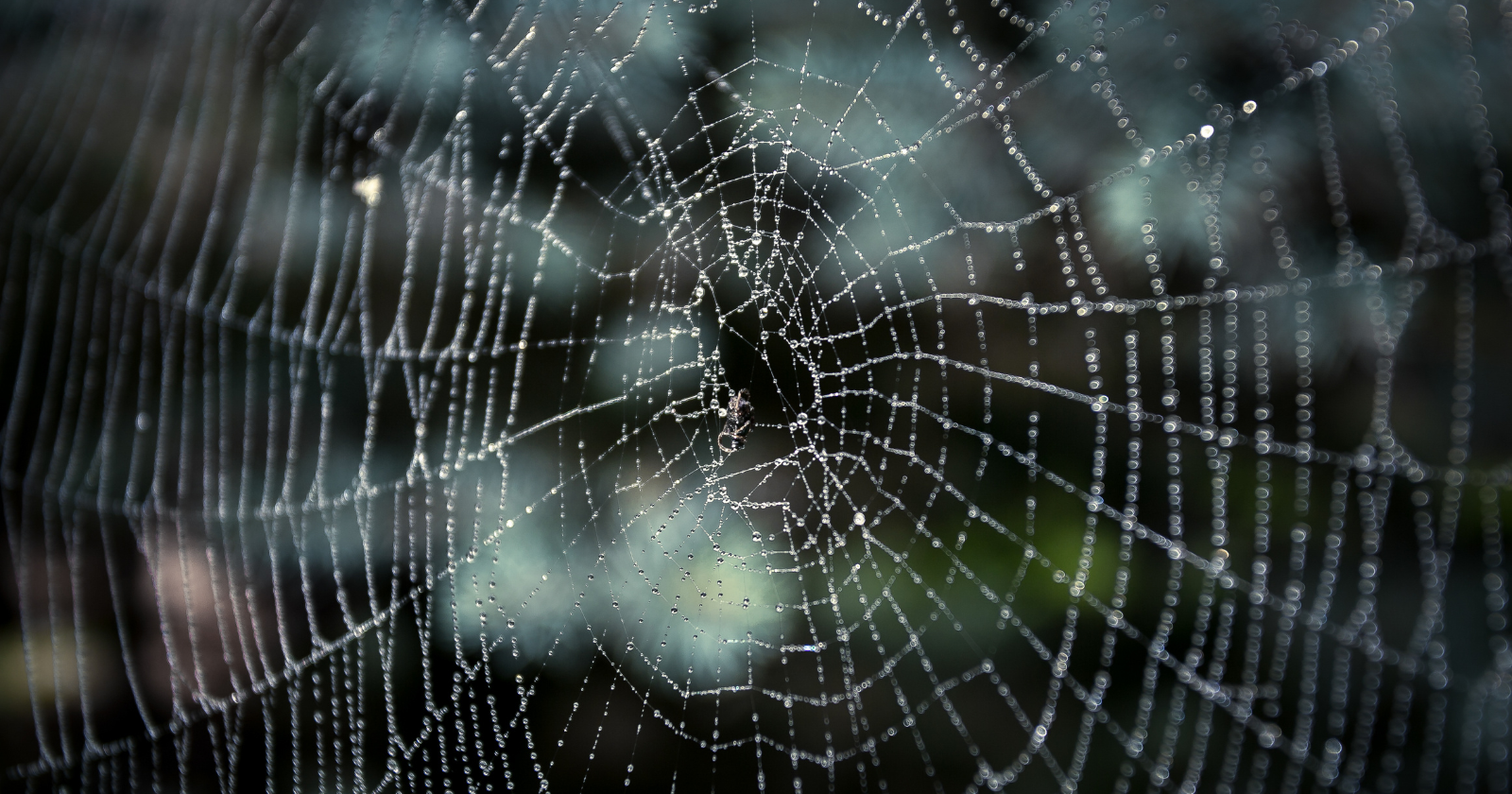
Along a narrow passage in a cave complex on the mountainous border between Albania and Greece, there is a wall covered in silk.
The silk stretches for approximately 106 square metres — about the size of half a tennis court, or a small city apartment. It is not a single conventional spiderweb of the kind most people picture. It is a dense, carpet-thick collection of funnel-shaped webs, layered on top of and around each other, occupying every available surface of stone and forming a single continuous fabric of arachnid architecture that has probably never been equalled anywhere else on Earth.
Living inside that architecture are approximately 111,000 spiders.
They belong to two species — Tegenaria domestica, the common house spider, and Prinerigone vagans, a much smaller relative — that in every other place on the planet where they have been observed have a straightforward relationship. The larger species hunts the smaller one. When they encounter each other in ordinary environments, one of them ends up in the other’s web.
Inside Sulfur Cave, on the Albanian-Greek border, this does not happen. About 69,000 of the larger species and 42,000 of the smaller one live essentially on top of each other, in the same web, in a space of about 106 square metres, without any observed predation. It is, as far as anyone knows, the only place on Earth where this happens.
A team of European biologists formally described the phenomenon in a paper published in the journal Subterranean Biology in October 2025, following expeditions organised after the site was first identified by Czech cave explorers in 2022.
The specific ecosystem inside
The cave in question is called Sulfur Cave. Its entrance sits in Greece; its deepest sections extend into Albania. Water carrying dissolved hydrogen sulfide flows through the cave complex, giving it a distinct smell of rotten eggs. The interior temperature stays around 26 degrees Celsius year-round.
The pitch-black interior of the cave is coated with slimy microbial biofilms. These biofilms are made up of chemoautotrophic bacteria — organisms that, unlike almost every other life form on Earth’s surface, do not rely on sunlight for energy. They metabolise the hydrogen sulfide directly, converting chemical energy into biological energy in a process called chemosynthesis. The biofilms are the foundation of the cave’s entire food web.
The next link in that food web is what makes the spider colony possible. Feeding on the biofilms are dense swarms of small midge flies — an estimated 2.4 million individuals of Chironomidae species live in the cave complex at any given time. These midges emerge from the biofilm-coated water, drift through the air of the cave in enormous numbers, and provide the spiders with what the study team’s lead biologist, István Urák, described as “a constant party” of available food.
This is the specific condition that makes the truce possible.
Why the predator-prey relationship breaks down
In the ordinary world where these two spider species live — in houses, in gardens, in temperate outdoor environments across Europe — the larger species preys on the smaller one because food is unpredictable. Small insects arrive at spider webs at random. A spider that doesn’t hunt when the opportunity presents itself may not eat again for days. The economic calculation of a predator-prey encounter, even between two spider species that would prefer to eat something else, favours the kill.
Inside Sulfur Cave, that calculation changes.
Midges arrive at the spider colony essentially continuously. There is no scarcity. There is no need to gamble on the next unpredictable meal. A house spider that ignores its smaller neighbour today can, with near-total confidence, expect to find plenty of midges arriving tomorrow. The evolutionary pressure that in every other environment drives Tegenaria to hunt Prinerigone — the pressure of food uncertainty — simply doesn’t apply in this specific place.
Over generations, this appears to have produced a distinct behavioural adaptation. Genetic analysis by the Subterranean Biology team confirmed that the Sulfur Cave populations of both species are genetically distinct from their outdoor cousins. The spiders inside the cave are, in a small but measurable sense, not the same spiders as the ones outside. They have been shaped by the specific conditions of the cave for enough generations to become their own recognisable populations.
The evolutionary biologist Lena Grinsted of the University of Portsmouth, quoted after the study’s publication, described the arrangement as analogous to humans living in an apartment block. Group living, she noted, is genuinely rare in spiders. Most spider species are solitary. What is happening inside Sulfur Cave — thousands of adults of two different species sharing a single continuous web without eating each other — is the sort of behaviour biologists usually associate with social insects like ants or bees, not with arachnids.
The other residents
The colony’s spiders are not the only inhabitants of the cave. The rich biofilm-and-midge foundation supports a small ecosystem that includes centipedes, pseudoscorpions, mites, and beetles — most of which are also fed, directly or indirectly, by the chemoautotrophic bacteria at the base of the food chain.
Sulfur Cave is one of a small class of ecosystems on Earth that operates entirely without sunlight. The other well-known examples are deep-sea hydrothermal vent communities, where similar chemoautotrophic bacteria support tube worms, crabs, and specific fish species around geothermally-heated seeps of hydrogen-sulfide-rich water. In both settings, the same underlying biology applies: bacteria metabolise sulfur, small animals eat the bacteria, and larger animals eat the small ones.
What is unusual about Sulfur Cave, in the class of chemoautotrophic ecosystems, is not just its terrestrial location. It is that at the top of the food chain, in the arachnid trophic level, is a phenomenon that has never been observed anywhere else — thousands of predators and their normal prey, living together in a single continuous structure, apparently at peace.
What this reveals
The Sulfur Cave finding is a specific reminder about how biology actually works.
The predator-prey relationship between Tegenaria and Prinerigone is not written into the genome of either species. It is a behavioural strategy that has evolved because of external environmental pressures — specifically, the scarcity and unpredictability of food in ordinary environments. When those pressures are removed, as they are inside Sulfur Cave, the strategy is no longer adaptive, and something else replaces it.
What replaces it, in this specific case, is a kind of arachnid cohabitation that biologists had never previously documented. The spiders are not being kind to each other. They are simply not hunting each other, because in this specific place there is no reason to. The truce is not moral. It is economic.
And it exists, as far as we currently know, in exactly one place on Earth — a passage of a single cave on a mountainous stretch of land between two countries, where an unusually dense swarm of midge flies, sustained by an unusually productive sulfur-metabolising bacterial colony, has quietly produced one of the strangest ecological arrangements ever documented.
The web is still there. The spiders are still not eating each other. And somewhere in the geology of one obscure Balkan cave, a small pocket of the biosphere is quietly running a different ruleset from everywhere else on Earth.