

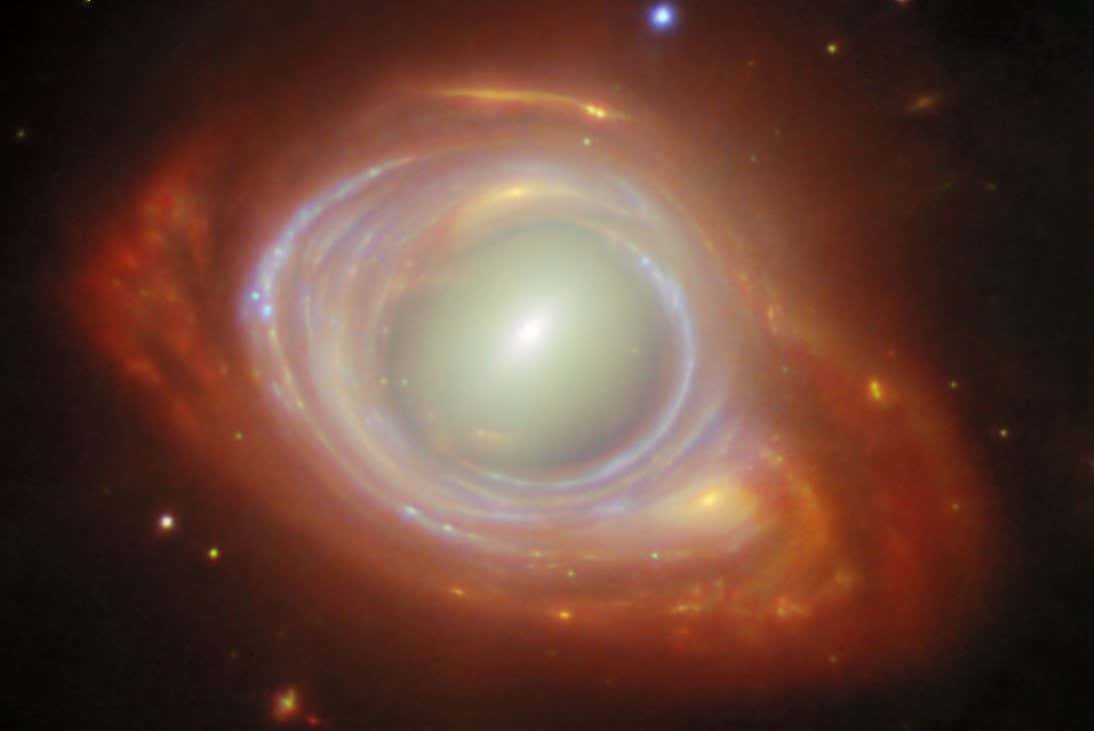
A James Webb Space Telescope image of a rare cosmic phenomenon known as an Einstein ring, two galaxies separated by a large distance.
ESA/Webb, NASA & CSA, G. MahlerA
I have absolutely no authority to do this, but I am going to do it anyway: 2026 will be the year of the galaxy.
Not only will the Vera C. Rubin Observatory’s Legacy Survey of Space and Time get fully under way, but, if all goes according to plan, the NASA Nancy Grace Roman Space Telescope will also launch.
Both Rubin and Roman are instruments designed to look at galaxies, and among their many scientific goals is to conduct something of a galaxy census. They are going to be studying the shapes and behaviour of galaxies. So my prediction is that we will be hearing a lot of news about galaxies in the coming months and years.
I am pretty thrilled about the prospect of so much new galaxy data. But the funny thing about my own excitement is that I wasn’t sold on galaxies in the early stages of my career. As an undergraduate, the only galaxies that interested me were ones that hosted active galactic nuclei (AGN). These are galaxies with supermassive black holes that are swallowing matter so intensely that they radiate a lot of light from this matter as it gets closer and closer to the event horizon. Honestly, I only thought AGNs were neat because of the black hole element.
When I became a PhD student, I had to take multiple courses on galaxies as part of my core curriculum. I found them to be disorienting and unintuitive. Galaxies were classified by their shapes, but each category of shape seemed to have subcategories of shape, which had subcategories of subcategories of shape, and so on. The schematic didn’t feel like it emerged from mathematical logic, and that made me uncomfortable. (This is the part where an experimentalist says: “Wow, she sounds like a theorist!” Spot on, spot on.)
If only I could go back in time and tell my younger self that the challenges we face with categorising galaxy shapes are exactly what should have made me sit up and pay attention.
One reason that this is such a challenging area of research is that, in practice, we only ever see galaxies as two-dimensional images on the sky. We don’t see them in three dimensions, and they rotate so slowly relative to their size that we can’t really see that rotation. All we can observe are frozen snapshots in time. Thus, our categorisations are a matter of taste and scientific judgement.
“
Galaxy shape seems to be an interesting indicator of their evolutionary history – ellipticals tend to have older stars
“
Astronomer Edwin Hubble came up with a system that continues to be influential, with three possible galaxy shapes: spirals with a central bulge like our own, the Milky Way; ellipticals, so named because they are shaped like an ellipsoid, or three-dimensional ellipse; and lenticulars, which look like spirals at their centre, but lack the spiral structure.
Gérard de Vaucouleurs built on this system by introducing subcategories. Why do this? Most basically, this is a great way to look for patterns. The problem, of course, is that your pattern-finding is only as good as your dataset. And 100 years ago, when Hubble was just getting started, the datasets weren’t very good compared with what we have today. For example, back then, we didn’t know that a lot of the matter in a galaxy is invisible matter that we now call dark matter.
Importantly, a galaxy’s shape seems to be an interesting indicator of its evolutionary history. Ellipticals, for example, tend to have older stars in them, and they tend to be closer to the centre of galaxy clusters. We also know the history of how these galaxies are assembled – how they evolve – is strongly tied to the shape of the dark matter halo that encloses them.
It is possible that these shapes can also give us information about the history of dark energy, which is causing the expansion of space-time to accelerate. The Roman space telescope will be on the hunt for this kind of information.
One of the ways Rubin will help us better understand these galactic features is via observations of a particular type of galaxy: dwarf spheroidals. These are spherical galaxies that are low brightness, with old stars and little dust. Dwarf spheroidals tend to pop up as companion or satellite galaxies for larger ones. The Milky Way has several that seem gravitationally bound to it. How many spheroidals end up as companions for larger galaxies might help us understand the evolutionary history of structure in the universe.
Excitingly, the science teams behind Rubin and Roman have been planning how to use the data they collect together. Vera C. Rubin and Nancy Grace Roman were both distinguished astronomers, and while they are no longer with us, in 2026 a whole new generation will continue their mission of seeing galaxies in a new light.
What I’m reading
I’m currently working my way through the Twilight novels.
What I’m watching
If you guessed the Twilight film series, you guessed correctly.
What I’m working on
Desperately trying to finish a draft of my third book, The Cosmos is a Black Aesthetic.
Chanda Prescod-Weinstein is an associate professor of physics and astronomy at the University of New Hampshire. She is the author of The Disordered Cosmos and the forthcoming book The Edge of Space-Time: Particles, poetry, and the cosmic dream boogie
Topics: