

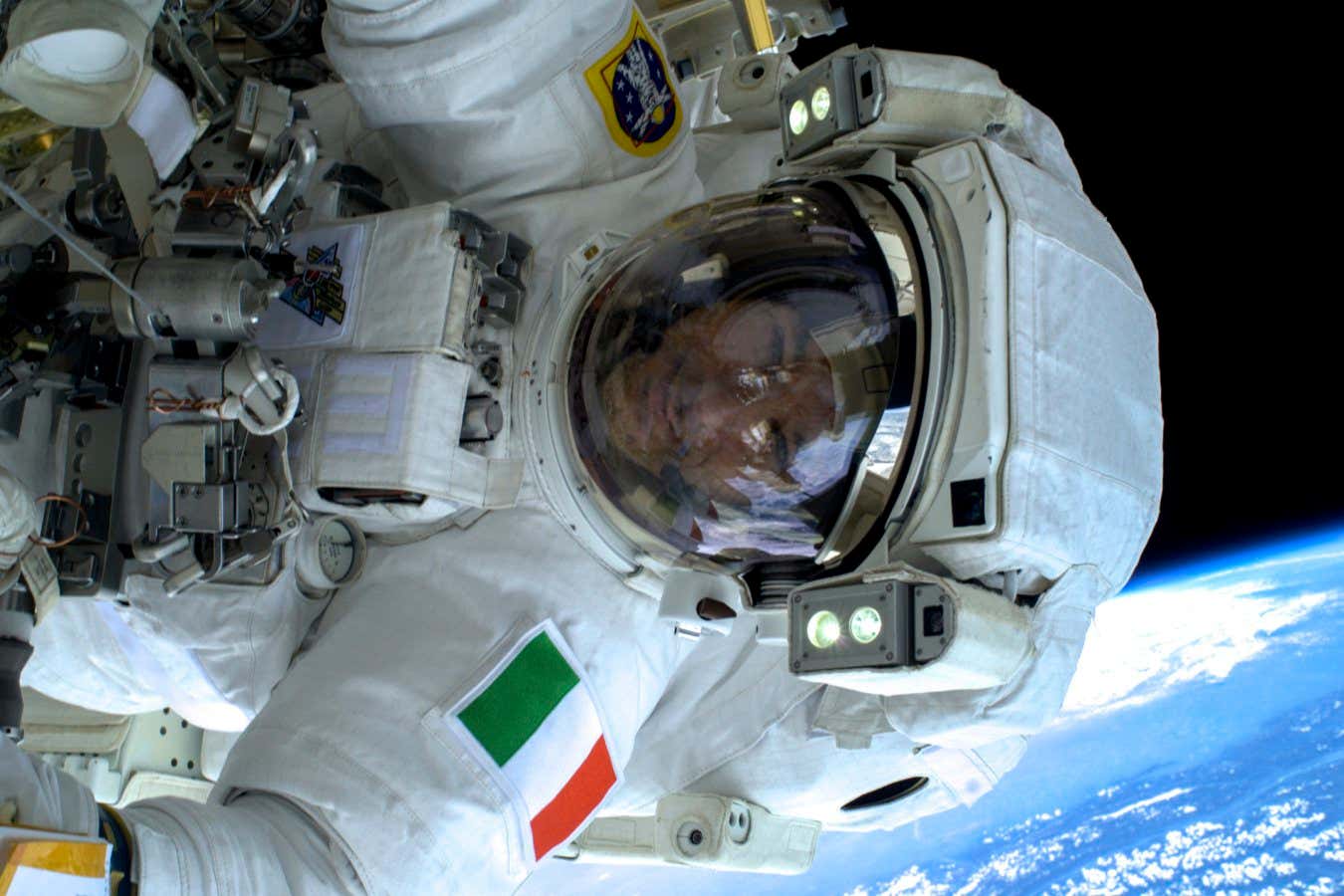
Luca Parmitano during a spacewalk on 9 July 2013
ESA/NASA
When the water reached my face, it spread over my nose and up into my nostrils in an instant. I was almost blinded, I couldn’t hear anything and I couldn’t breathe through my nose. I already knew I needed to reach the airlock and get back inside the International Space Station. The key question: how long did I have before the water reached my mouth and I couldn’t breathe at all?
When you go on a spacewalk, you enter a new world. It’s an incredibly privileged perspective. Inside the ISS and looking through the windows of the cupola, you’re still inhabiting the safe world of the space station. It’s like staring into a large and really beautiful aquarium. But when I leave the ISS for a spacewalk, I am immersed in the void. I’m in an environment that doesn’t need me. If I wasn’t inside my spacesuit, I would be dead within minutes.
The infinite horizon of stars and blackness is so vivid. On one of my spacewalks, I was being moved from one side of the space station to the other on a robotic arm. I was attached to the arm by my feet. I had no frame of reference because the space station was behind me, Earth was behind me. And for the first time in my life, I perceived the three-dimensionality of space. Maybe it was because I was drawing on my knowledge of astrophysics, but I felt I could see this sponge-like tissue of bubbles or voids surrounded by all these massive light sources. Since then, I’ve tried to relive that moment. But I haven’t been able to do it.

It was during Luca Parmitano’s second spacewalk on 16 July 2013 when disaster struck
NASA Johnson
I’ve done six spacewalks so far. The water leak was during my second, on 16 July 2013. It was uncomfortable, for sure, when I first felt the cold fluid on the back of my head. But then, obviously, I still went through the standard procedure. I called the ground: “Hey, I feel water in the back of my helmet, FYI – for your information.” The “FYI” was me saying: I’m still good and I’m still ready to continue with the spacewalk.
I was told to await instructions. Then they asked if I knew where the water was coming from. I didn’t. But by then, I could feel it was accumulating. Water behaves differently when you take away the effects of gravity. Capillarity works really well to move it from one place to another across a surface.
A lot of people, when they think of a spacesuit, they’re imagining movies like Gravity or The Martian. The helmets in those movies are really big. You’ve paid $100 million to have a specific actor, so you need a big helmet to see their face. Nobody wants to see my face, so our helmets are relatively small. There isn’t much space between the helmet and my face. The water was flowing in this small space, and it filled up relatively fast. After my ears became blocked, I couldn’t hear much, and I also began to realise that the people on the ground couldn’t hear me either.
Then the sun set. When you’re flying around Earth, you have a sunset and sunrise every 45 minutes. A spacewalk lasts about six to seven hours, so a lot of it is done at night. The sunset was a complicating factor. I could see what I had directly in front of me even despite the water, because of the illumination from the lights on my helmet. But the moment I tried to look further away, I couldn’t make anything out. I couldn’t focus on distant objects with the water in front of my eyes.
I still didn’t know where the water was coming from. But in that moment, it wasn’t important. What was important was that I had this ticking timer telling me to act. I might have 10 minutes left. Or 5 minutes. Or even just 1 minute. I couldn’t control that, but I could control my behaviour.
Before becoming an astronaut, I was a pilot, then I became a fighter pilot, then a test pilot. I learned on day one of flight school that there are three actions to take in an emergency: I maintain control, I analyse the situation, and I take the proper action.
The proper action was to find my way back to the airlock. The next step was to work out how to do that. There are handles on the outside of the space station that help us move around. I knew I could use those to reach the airlock. I asked myself: can I see the next handle? I can’t see it, it’s too far away. Can I figure out where it is by reaching and feeling with my hand? I can. Following my tether, anchored to the airlock, I can begin moving in the right direction.

Luca Parmitano’s spacesuit began filling with water again during a test after his abandoned spacewalk
NASA
But moving in a spacesuit is harder than you probably think it would be. The suit is pressurised and that pressure is a force reacting against your muscles. To move, you have to fight that force. And your hands and fingers, there are no strong muscles there. So every time you want to hold an object, like a handle, the forces are so strong it feels like you’re having to squeeze a tennis ball.
That last part of the spacewalk felt like a very long time, an eternity. My mind slowed everything down. In reality, it was only 7 minutes before I was back in the airlock. In those 7 minutes, they couldn’t hear me on the ground and they didn’t know how I was doing. But I later found out that they didn’t realise I was in trouble because my heart rate never changed. It stayed steady. I controlled my response.
I can still relive that spacewalk, but it’s not constantly in my head. It’s not something that changed me, although it did change us all operationally. We discovered that a blocked filter caused the failure, so we changed our procedures to look for that before spacewalks. We also added a snorkel to the spacesuits, so if the helmet fills with water, we can use the snorkel to breathe from the air in the body chamber. So this event is never going to happen again. That’s the silver lining.
I would never disagree with somebody saying what astronauts do is extraordinary. What we are able to do is extraordinary. But that doesn’t make us extraordinary people. It makes us normal people who have the training to do an extraordinary job.
As told to Colin Barras
Topics: