

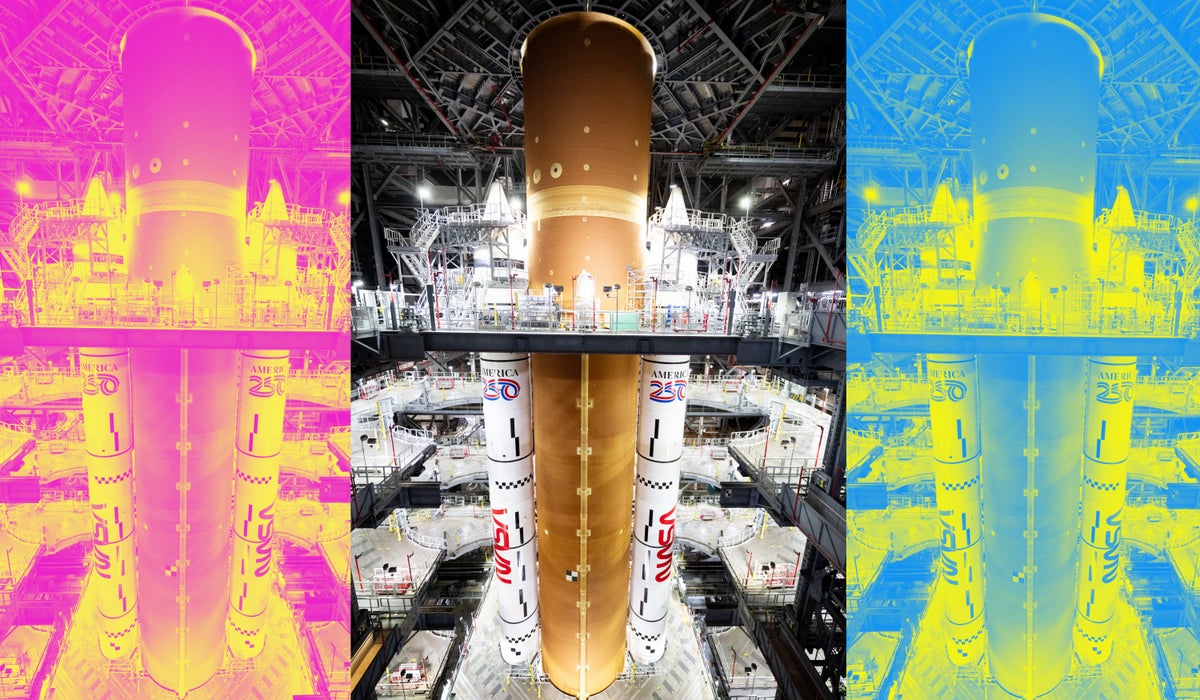
NASA’s historic Artemis II moon mission is almost ready to launch
On Friday NASA laid out the time line for Artemis II, humanity’s first crewed mission to the moon in more than 50 years
NASA’s Space Launch System rocket awaits the arrival of Artemis II crew at NASA’s Kennedy Space Center in Florida.
NASA/Joel Kowsky (photograph); Scientific American (illustration composite)
Artemis II, humankind’s first crewed lunar mission in more than 50 years, is finally nearing reality.
At a press conference on Friday, NASA officials laid out the time line for what will happen both on the days before the mission lifts off and during Artemis II—and immediately afterward. Astronaut safety is the paramount priority, and the time line for launch could change, said John Honeycutt, Artemis II’s mission management team chair, at the event.
“I will tell you, we’re going to fly when we’re ready,” Honeycutt said.
On supporting science journalism
If you’re enjoying this article, consider supporting our award-winning journalism by subscribing. By purchasing a subscription you are helping to ensure the future of impactful stories about the discoveries and ideas shaping our world today.
“Artemis II is a test flight. It truly is exploration,” said Jacob Bleacher, chief exploration scientist at NASA’s Exploration Systems Development Mission Directorate. “There will be a number of firsts that we will be proving out on this flight. I like to say that during exploration, science is our toolbox for survival.”
The update came a day before one of the first major steps to getting Artemis II off the ground: on Saturday, after years of work, delays and anticipation, engineers at NASA’s Kennedy Space Center in Cape Canaveral, Fla., will begin rolling out the fully stacked Space Launch System (SLS) rocket and Orion spacecraft. The journey from the Vehicle Assembly Building to Launch Pad 39B will be a slow, stately crawl over roughly four miles that will take up to 12 hours, culminating in easing the mission’s hulking hardware onto the launch pad.
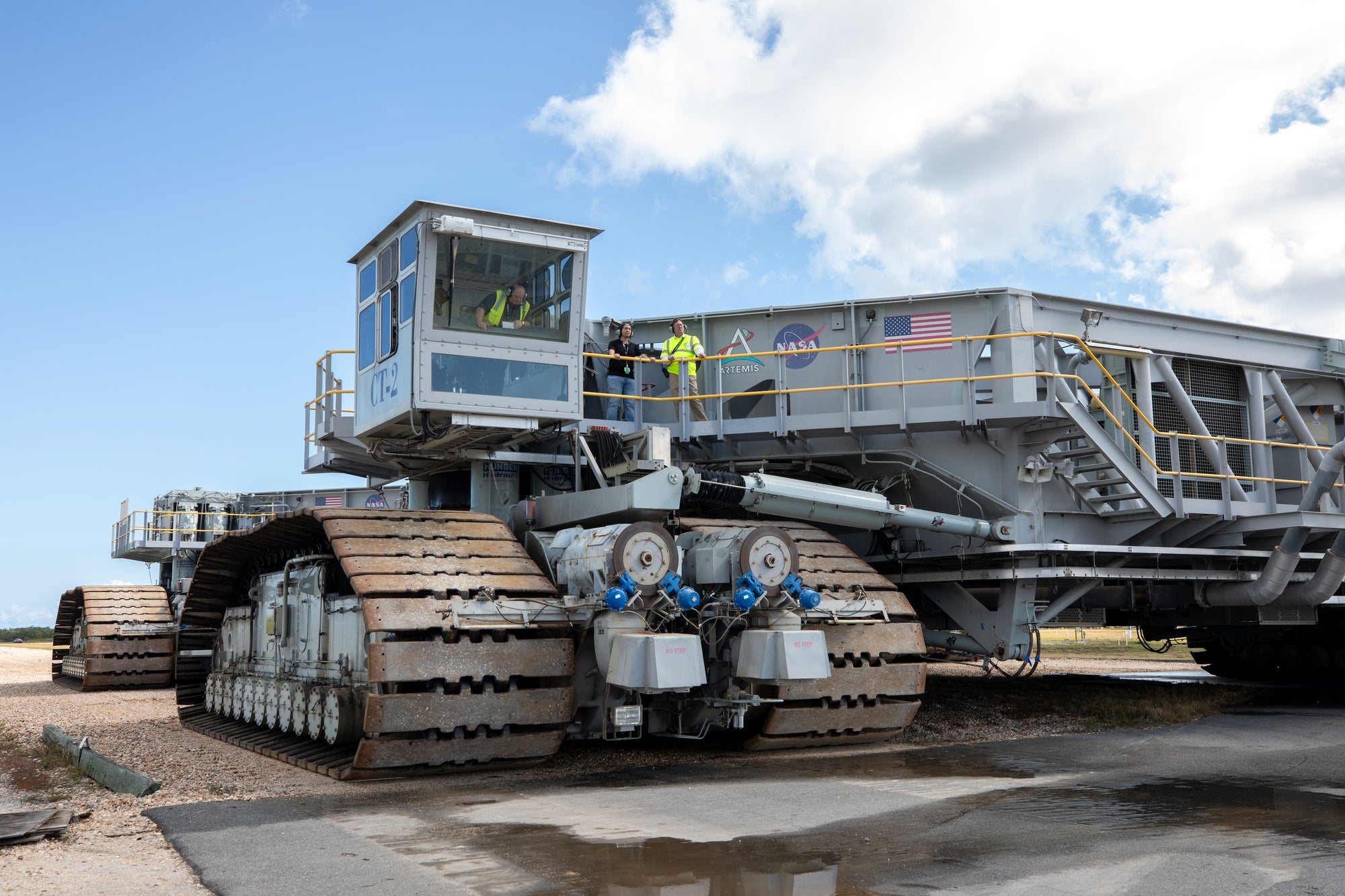
NASA’s Crawler-Transporter 2 moves toward the Vehicle Assembly Building at NASA’s Kennedy Space Center in Florida on January 9, 2026.
Once there, focus will turn to a series of important prelaunch tests. A critical milestone is a “wet dress rehearsal,” during which flight teams will load more than 700,000 gallons of cryogenic propellant and practice the countdown sequence—pushing the spacecraft to its limits without astronauts onboard. During similar preparations for Artemis II’s uncrewed predecessor, Artemis I, persistent problems with hydrogen leaks ultimately delayed that mission’s launch for months. This time NASA is hoping the process will be much smoother. The earliest date in the mission’s launch window is February 6.
If all goes according to plan, Artemis II will lift off on its historic journey carrying four astronauts—NASA’s Reid Wiseman, Victor Glover, and Christina Koch and Canadian Space Agency astronaut Jeremy Hansen—on a 10-day flight around the moon and back: the Orion spacecraft will follow a free-return trajectory that uses the moon’s gravity to loop the crew around and back toward Earth. Reaching about 4,700 miles beyond the lunar farside, the crew will go the farthest from Earth any humans have ever voyaged, ensuring not only rigorous system checks but also breathtaking views of our home planet—and, of course, the moon.
During the mission, the crew will wear sensors to monitor their health and physiological responses to the deep-space environment beyond the moon. And among the myriad experiments packed into Artemis II’s science payloads will be AVATAR (A Virtual Astronaut Tissue Analog Response), a system designed to mimic individual astronaut organs. Artemis II will be the first time AVATAR has been tested so far from Earth.
All that will help ensure future astronauts can “survive and thrive” in deep space, Bleacher said. “Artemis II’s science is the science of us.”
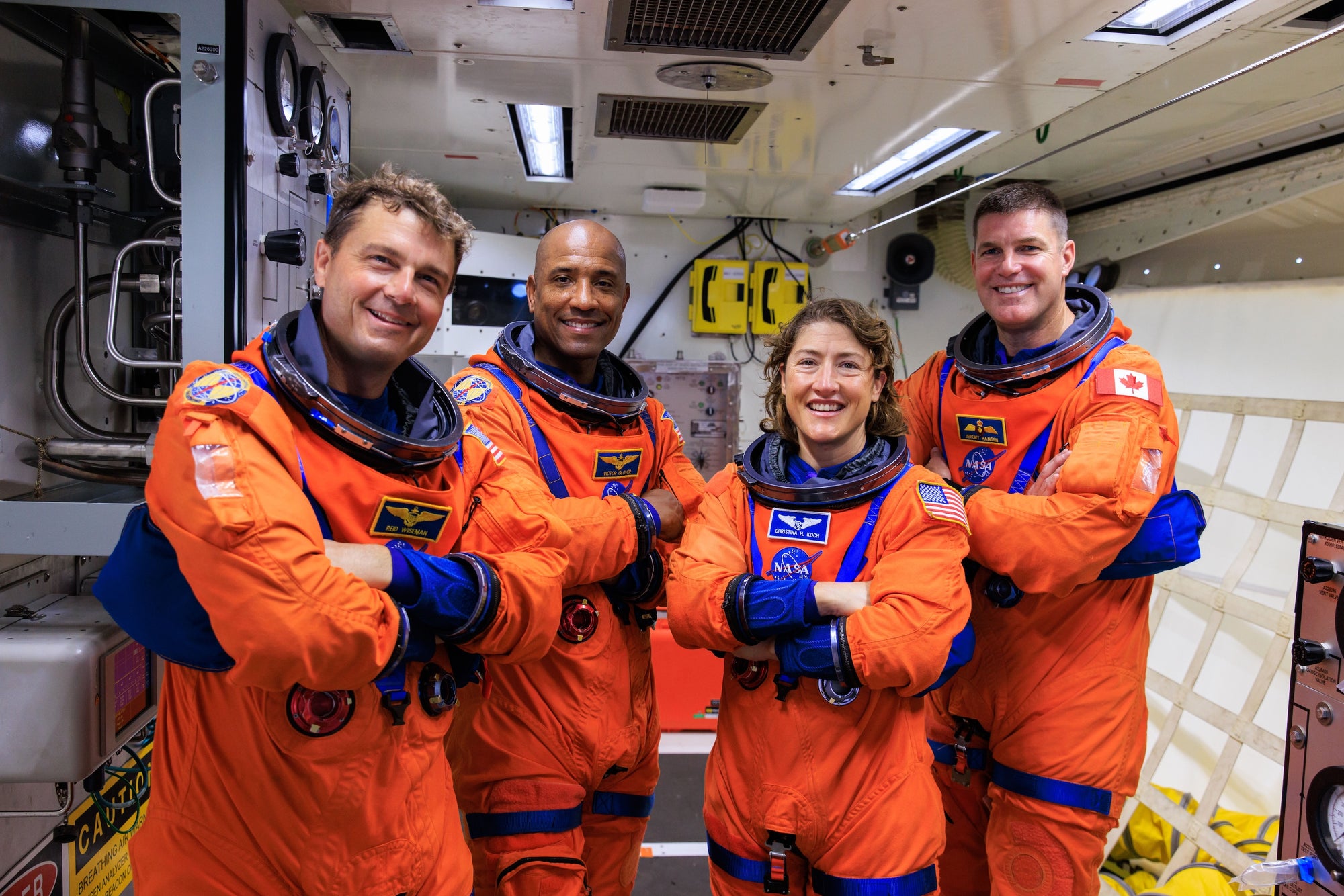
Left to right: Artemis II’s crew members, NASA astronauts Reid Wiseman, Victor Glover, and Christina Koch and Canadian Space Agency astronaut Jeremy Hansen, pose together during a ground-systems test at Kennedy Space Center’s Launch Pad 39B on September 20, 2023.
The mission’s most breathtaking highlight, however, will probably be the view. The crew will dedicate about a day to observing the moon, especially its farside, which can’t be seen from Earth. As the Orion capsule swoops around our natural satellite, Bleacher said, the moon will appear to the astronauts as about the same size as a basketball held at arm’s length. And depending on the spacecraft’s timing and trajectory, he added, “it’s possible they’ll see parts of the moon that have never been viewed by human eyes.”
The mission is the strongest stress test yet of NASA’s Artemis program to return humans to the moon. Artemis II will demonstrate Orion’s life support, navigation and operational systems in a deep-space environment—the first such test since NASA’s Apollo program ended more than a half-century ago.
“We want to put Orion through its paces,” said Artemis II’s lead flight director Jeff Radigan. “This is a test flight, and there’s things that are going to be unexpected, you know. I think we’ve prepared for those as much as we can.”
Of particular concern is the Orion capsule’s heat shield; during the uncrewed Artemis I test, the heat shield shed larger and more numerous chunks of ablative material than expected, raising safety concerns for future missions. NASA officials changed the plan for Artemis II’s atmospheric reentry on its way back to Earth so that its Orion capsule heat shield will experience a shorter, but more intense, period of extreme heating. This tweak, officials say, should help ensure crew safety.
After the nail-biting reentry, Artemis II’s crew will splash down off the coast of San Diego, Calif. But these astronauts’ mission won’t end there—among the plethora of postflight tests that await them in the days after they return will be an “obstacle course” and simulated space walks in pressurized space suits to test the suits’ functionality after going through a gravity transition. These tests will help gauge a crew’s readiness for lunar surface operations.
That work, said NASA’s landing and recovery director for Artemis II Liliana Villarreal, “prepares us for landing on the moon [with Artemis III] and eventually, down the road, going to destinations such as Mars.”