
Close Menu
    Trending
    • Meta isn’t doing enough to keep minors off of Facebook and Instagram, says the EU
    • Chanda Prescod-Weinstein connects physics, poetry and pop culture
    • What is the Ahmadi Religion of Peace and Light? Police raid community in sex abuse probe
    • Starmer’s Collapse Is A Vote Against Policy Failure
    • Cynthia Erivo Pauses Show To Call Out Filming Fan
    • UK police arrest man after two people stabbed in Jewish area of London: Security group
    • How US and Iran are playing a crypto cat-and-mouse game over sanctions | US-Israel war on Iran News
    • Dodgers’ Edwin Diaz shares major injury update
    Benjamin Franklin Institute
    Wednesday, April 29
    • Home
    • Politics
    • Business
    • Science
    • Technology
    • Arts & Entertainment
    • International
    Benjamin Franklin Institute
    Home»Science»Huge hot blobs inside Earth may have made its magnetic field wonky
    Science

    Huge hot blobs inside Earth may have made its magnetic field wonky

    Team_Benjamin Franklin InstituteBy Team_Benjamin Franklin InstituteFebruary 14, 2026No Comments3 Mins Read
    Share Facebook Twitter Pinterest Copy Link LinkedIn Tumblr Email VKontakte Telegram
    Share
    Facebook Twitter Pinterest Email Copy Link


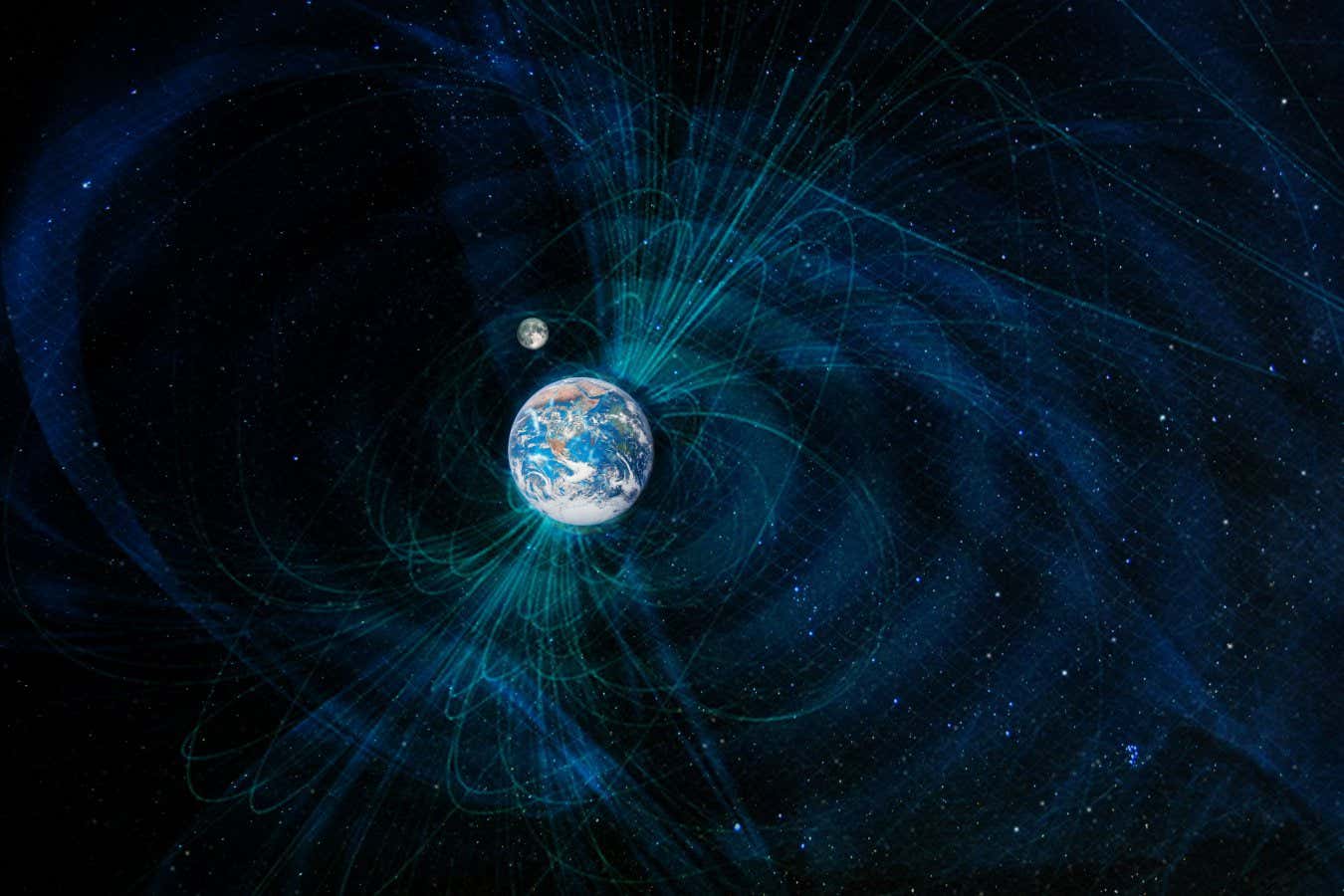
    Earth’s magnetic field extends tens of thousands of kilometres into space

    Getty Images/iStockphoto

    Two vast, mysterious blobs of hot rock around Earth’s core may have been instrumental in producing Earth’s magnetic field and caused it to be slightly wonky for millions of years.

    Scientists have known for decades about two peculiar continent-sized chunks of rock, one beneath Africa and the other under the Pacific Ocean. These blobs, which extend nearly 1000 kilometres from the outer core to the rocky mantle above, must be different from their surroundings because seismic waves travel through them more slowly. But as it is difficult to measure them due to their depth, scientists can’t identify exactly how they differ.

    Andrew Biggin at the University of Liverpool, UK, and his colleagues looked to Earth’s magnetic field for clues. This field has been generated for billions of years by the churning of molten iron within our planet’s core. It extends tens of thousands of kilometres into space, protecting us from solar wind and cosmic radiation.

    The exact shape and form of this magnetic field is determined by the amount of energy, in the form of heat, that moves from the hot core to cooler regions around it. Biggin and his team theorised that by studying how the magnetic field has changed, they could learn about how heat has moved through Earth’s core.

    The researchers collated records of ancient volcanic rocks that have preserved the direction of Earth’s magnetic field at several different points over the past tens or hundreds of millions of years, to gather a picture of how Earth’s magnetic field has changed over time. Then, they ran simulations of how heat flowing through the planet’s core and mantle produced a magnetic field, for scenarios both with and without the giant blobs of hot rock, and compared it with the real magnetic field readings.

    They found that the simulation with the blobs of rock best matched the ancient magnetic data. “These simulations of the convection that’s happening in the core, that’s generating the magnetic field, can reproduce some of the salient features of the [magnetic] field, but only when you impose this strong heterogeneity in the amount of heat that’s flowing out of the top of the core,” says Biggin.

    In other words, these regions have probably been much hotter than the regions around them for hundreds of millions of years, and caused heat flow between the core and the mantle to decrease. This different heat flow would have helped produce and stabilise Earth’s magnetic field, according to the team’s simulations.

    Most geologists assume that, over millions of years, Earth’s magnetic field has been essentially symmetrical, similar to a bar magnet used in a compass. But Biggin and his team also found that the ancient magnetic field wasn’t symmetrical, on average, and contained systematic deviations that persisted over millions of years, which also appear to be a result of these blobs of rocks. This could have implications for how geologists calculate the movement of ancient rocks and tell us about how Earth’s deep structures have changed over time, says Biggin.

    If the team’s findings are correct, then the temperature difference found in the blobs might also exist at points in Earth’s uppermost outer core, which could be detectable via seismic waves, says Biggin.

    But this would be extremely difficult to capture, says Sanne Cottaar at the University of Cambridge. “I have my doubts,” she says. “It’s very challenging for us to map variations within the core, given we have to look through so much mantle material before we see it.”

    Topics:


    Source link

    Share. Facebook Twitter Pinterest LinkedIn Tumblr Email Telegram Copy Link

    Related Posts

    Science

    Chanda Prescod-Weinstein connects physics, poetry and pop culture

    April 29, 2026
    Science

    City birds appear more afraid of women than men, and scientists have no idea why

    April 29, 2026
    Science

    NASA chief Jared Isaacman hints at campaign to make Pluto a planet again

    April 29, 2026
    Science

    Cancer is increasing in young people and we still don’t know why

    April 29, 2026
    Science

    People are betting on measles outbreaks – and that might be useful

    April 29, 2026
    Science

    Striking photo essay examines deadly spread of dengue fever in Nepal

    April 28, 2026
    Editors Picks

    U.S. and Iran’s High-Stakes Nuclear Talks Set to Kick Off

    February 17, 2026

    More Americans than ever love being single. They feel penalized for it by our financial system

    February 12, 2026

    Safety of AI chatbots for children and teens faces US inquiry

    September 14, 2025

    Could Europe Defend Itself Without America?

    February 5, 2026

    How Musk transformed the social media giant in 2024

    December 27, 2024
    About Us
    About Us

    Welcome to Benjamin Franklin Institute, your premier destination for insightful, engaging, and diverse Political News and Opinions.

    The Benjamin Franklin Institute supports free speech, the U.S. Constitution and political candidates and organizations that promote and protect both of these important features of the American Experiment.

    We are passionate about delivering high-quality, accurate, and engaging content that resonates with our readers. Sign up for our text alerts and email newsletter to stay informed.

    Latest Posts

    Meta isn’t doing enough to keep minors off of Facebook and Instagram, says the EU

    April 29, 2026

    Chanda Prescod-Weinstein connects physics, poetry and pop culture

    April 29, 2026

    What is the Ahmadi Religion of Peace and Light? Police raid community in sex abuse probe

    April 29, 2026

    Subscribe for Updates

    Stay informed by signing up for our free news alerts.

    Paid for by the Benjamin Franklin Institute. Not authorized by any candidate or candidate’s committee.
    • Privacy Policy
    • About us
    • Contact us

    Type above and press Enter to search. Press Esc to cancel.