

Key Takeaways
- Colette and Andy Bell started a handyman business in 1998 to tackle small projects for homeowners.
- In 2018, they connected with Ace Hardware, which purchased their business in 2019.
- Colette is now the vice president of franchise development for Ace Handyman Services, and she continues to lead expansion.
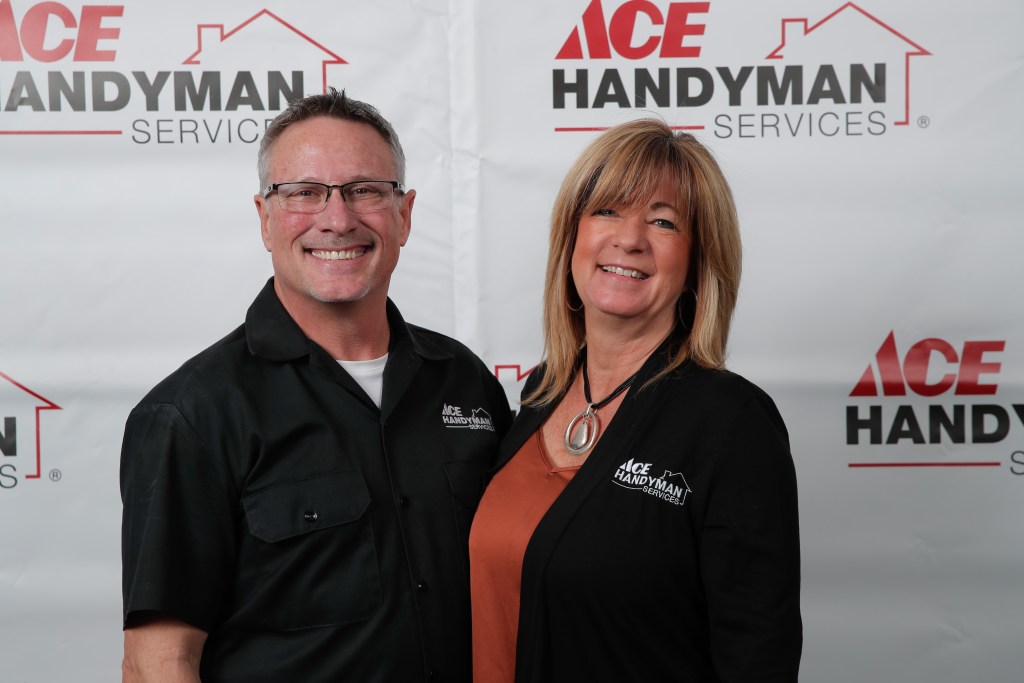
Colette Bell and her husband, Andy Bell, started a handyman business in Denver, Colorado, in 1998 after identifying a unique need.
They found that big specialty contracting companies did not want to do small projects for homeowners. For example, if someone had one sticky window and called a window company, the firm wanted to sell them 25 new windows for their house.
“We found that homeowners had a really hard time finding somebody professional and reliable for small projects,” Colette tells Entrepreneur in a new interview. “That was the niche market we built this business to serve.”
They knew immediately that they had struck gold. Their first year in business, the company “just took off like a rocket,” Colette says.
They ended up franchising the business, called Handyman Matters, in 2001. Andy led the business as CEO while Colette took on multiple leadership roles over the years, including chairman of the board. In 2018, they connected with Ace Hardware, which acquired the business in 2019.
“This is the only career I’ve had my whole life,” Colette says. “For 28 years, I’ve been working on the handyman business.”
Andy is now the CEO and president of Ace Handyman Services, and Colette is the vice president of franchise development, a position she has held since 2019. She continues to lead expansion, helping the brand grow from 119 territories at the time of its 2019 acquisition to 383 territories as of April this year, more than tripling its footprint.
Ace Handyman Services grew by 12% from 2024 to 2025, with total sales exceeding $113 million in 2025.
The following interview with Colette has been lightly edited for clarity and concision.
Growth tactics
What were the main factors that allowed the company to grow so quickly? What did you do to facilitate growth?
We set exact appointment times and coach our employees that “if you’re not early, you’re late.” They need to arrive on time, look professional and wear logoed shirts. If they walk up and see the trash cans still at the curb after pickup, we coach them to move the cans back up the driveway — little things that show we’re there to help with the whole house, not just a single project.
We do extensive follow-up: calling the day after to make sure the customer is happy, and again at 11 months because we offer a one-year warranty. Adding that high level of customer service to a low-tech, fragmented industry made a big difference.
Getting things right with franchising
Looking back at that 2001 decision to franchise, what did you get right about franchising, and what did you underestimate about how hard it would be?
We underestimated everything. But we did get a couple of important things right. One was creating protected territories for franchise owners delineated by ZIP codes. ZIP codes are clearly defined by the post office and have accessible demographic data, so we could build territories using that data. Franchise owners then had protected territories and didn’t have to worry about competition from neighboring owners. We did that from day one.
The other thing we did right, which was more accidental, was our billing model. Even though we’re a handyman business and construction often estimates projects as fixed dollar amounts, we decided to bill customers using a time-and-materials format. Time is universal — an hour is an hour everywhere. Pricing, on the other hand, varies significantly between, say, Connecticut and Arkansas or Illinois and California. Instead of trying to force one universal price structure across the U.S., we made time the constant and allowed each owner to choose their own hourly rate.
That made the business much more feasible in different markets. About 85% of our work is labor and only about 15% is materials, because we focus on small repairs and restorations, not large remodels.
Choosing franchising over corporate locations
What convinced you that this idea would scale better through franchising than through company-owned locations?
We learned that firsthand when we expanded to California. At one point, we were effectively running six corporate locations — three in Colorado and three in California. We quickly realized we couldn’t give every employee, and therefore every customer, the time and leadership they deserved.
It was clear this business model should be available across the U.S. Every homeowner deserves a professional, reliable handyman service for small projects, but there was no way we could build that nationally as a purely corporate chain — especially since we started in our basement with $10,000, every bit of savings we could scrape together.
The franchise model made national expansion possible because it relies on local owners rooted in their communities. Handyman businesses are very community-centric; you’re basically working for your neighbors. Franchising fits the model perfectly.
The biggest surprise about franchising
What is something about franchising that surprised you?
The biggest surprise — though everyone tells you this upfront — is how much the success or failure of the business model depends on the relationship between franchisor and franchise owners. Until you’ve lived it, that doesn’t fully sink in. This relationship has to be strong and reciprocal. It can’t just be the franchisor giving and the franchise owners taking; franchisees also need to contribute ideas and feedback.
Early on, we had franchise owners with fantastic business ideas we never would have developed on our own, and they were willing to share them so we could roll them out systemwide.
A great example was during Covid, when the whole country shut down, and no one could enter customers’ homes. We spent that downtime on conference calls with franchise owners, figuring out how to make the business as touchless as possible.
For instance, we used to take customer signatures on invoices. During Covid, we shifted to reading the contract language aloud and recording “verified by voice” instead of a signature.
Franchise owners helped design new standard operating procedures, which we rolled out to everyone. So when we were designated essential in April and could return to homes, we had safer, smarter procedures in place. That level of support and collaboration is critical in franchising.
The ideal franchisee
For an entrepreneur evaluating Ace Handyman, how do you define the ideal franchisee in terms of background, skills and mindset?
Our owners come from all kinds of backgrounds. One of our top franchisees is a former horticulturalist. We have people from finance, marketing, plant management, a large number of veterans, former teachers, and former coaches and mentors.
The through line is a passion for improving their community and strong leadership skills. As an owner, you don’t go to every customer’s house; our volume is too high for that. The way you deliver great service is through your employees, which means you must be an excellent leader. That includes paying good wages, providing training and mentoring and offering real growth opportunities. Leadership is at the heart of our most successful franchisees.
For us, a red flag is when a prospective owner focuses more on money than culture and people. Our business has robust numbers — you don’t grow otherwise — but if the primary focus is financial, it typically isn’t a good fit.
How much does it cost to start an Ace Handyman franchise?
In our 2026 franchise disclosure document, Item 7 shows startup costs ranging from $132,200 on the low end to $226,000 on the high end. That includes a $70,000 franchise fee.
Long-term vision
When you imagine Ace Handyman Services 10 years from now, what does success look like for the brand, for individual owners and for the customers they serve?
First, success means our current franchise owners are still here. Longevity is very important in franchising. Ace has always believed in generational businesses; many hardware stores have been passed down from great-great-grandparents through multiple generations.
In our system, we already have franchise owners who’ve been with us 24 years. I’m very proud of that. They stuck with us when we were young and figuring things out and contributed ideas, passion and suggestions. We’ve seen transitions where a father handed the business to his daughter and uncles passed locations to nephews.
My goal for the next 10 years is that we’ll not only expand to cover perhaps half of the U.S., but also see more of our locations become generational businesses, with kids taking over for their parents. That kind of longevity would be a real measure of success.
Key Takeaways
- Colette and Andy Bell started a handyman business in 1998 to tackle small projects for homeowners.
- In 2018, they connected with Ace Hardware, which purchased their business in 2019.
- Colette is now the vice president of franchise development for Ace Handyman Services, and she continues to lead expansion.
Colette Bell and her husband, Andy Bell, started a handyman business in Denver, Colorado, in 1998 after identifying a unique need.
They found that big specialty contracting companies did not want to do small projects for homeowners. For example, if someone had one sticky window and called a window company, the firm wanted to sell them 25 new windows for their house.
“We found that homeowners had a really hard time finding somebody professional and reliable for small projects,” Colette tells Entrepreneur in a new interview. “That was the niche market we built this business to serve.”