

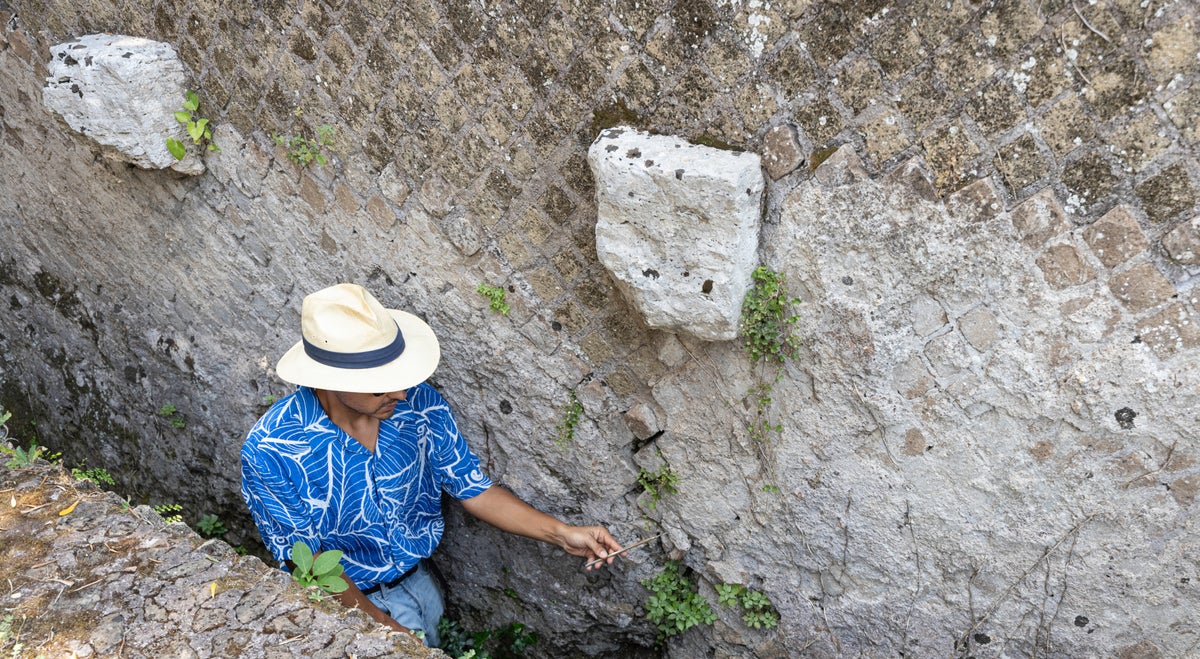
Twenty-seven kilometers east of Rome sit the remains of a communal latrine whose concrete has endured for nearly 2,000 years. It has outlasted the empire that poured it, centuries of weathering and even Italy’s third straight failure to qualify for the World Cup.
It’s an impressive run for a bathroom—especially a communal one.
Now this humble latrine, part of Emperor Hadrian’s sprawling second-century villa at Tivoli, is helping scientists chip away at one of engineering’s favorite mysteries: why some Roman concrete has endured for millennia. A study published this week in Science Advances offers the clearest picture yet of how the material continued to change—and strengthen—long after it was poured.
On supporting science journalism
If you’re enjoying this article, consider supporting our award-winning journalism by subscribing. By purchasing a subscription you are helping to ensure the future of impactful stories about the discoveries and ideas shaping our world today.
Researchers have long credited Roman concrete’s remarkable durability to an ingenious bit of ancient chemistry. Builders mixed lime with volcanic ash, setting off mineral reactions that persisted as the concrete aged. “You can kind of think of it as the Romans using volcanoes to improve their concrete where we use high temperature cement kilns instead,” says Maria Juenger, who studies cement and concrete materials at the University of Texas at Austin and was not involved in the research.
In 2023, researchers at MIT and elsewhere proposed that the bright white chunks scattered throughout Roman concrete—known as lime clasts and long dismissed as evidence of incomplete mixing—could help explain the material’s self-healing properties. When cracks form, water dissolves calcium-rich material from the clasts, which then recrystallizes as calcium carbonate, sealing the fracture.
Studying that chemistry in ancient concrete requires a sample that nobody has patched or restored along the way—a rare commodity at ruins tended by generations of conservators.
The researchers had one particular advantage.
“Nobody restores a latrine,” says Paulo J. M. Monteiro, a civil engineer at the University of California, Berkeley, and senior author of the new study. “So the material sat undisturbed for nineteen centuries, quietly running an experiment no one alive could start.”
Monteiro and his colleagues, led by Xiaohong Zhu of Beijing University of Technology, used high-resolution X-ray imaging, electron microscopy and chemical analyses to map the carbonate minerals inside the ancient concrete at scales down to tens of nanometers. That process is called carbonation, in which carbon dioxide from the air seeps into the concrete and reacts with calcium-rich compounds, leaving behind calcite, a hard crystalline mineral. The team’s scans reveal calcite woven through the material, filling pores and binding its components together.
An X-ray scan (left) and 3D reconstructions (center and right) show the internal structure of a Roman concrete fragment just 20 micrometers across. The web-like network is composed predominantly of calcite.
Zhu et al., Science Advances (2026), CC BY 4.0. Cropped from Fig. 6D.
“Calcite had been suspected as an important binding phase in inland Roman concrete before,” Monteiro says. “What is new is that we can now see how it binds.”
The study, in effect, hands carbonates a promotion.
“It strengthens the idea that carbonates are more dynamic in these systems and play a fundamental role, not a marginal one,” says Admir Masic, the MIT materials scientist whose group led the lime clast work.
Whether those insights can improve modern concrete is less straightforward.
“The elephant in the room is steel,” Juenger says. Unlike Roman concrete, most modern concrete is reinforced with steel bars. Fresh concrete is alkaline enough to shield the metal from rust, but carbonation gradually lowers its pH and weakens that protection. “The same reaction that quietly strengthened Roman concrete is a slow threat to ours,” Monteiro says.
At the same time, engineers are increasingly interested in controlled carbonation, which can lock carbon dioxide into mineral form—no small thing for an industry whose key ingredient, cement, accounts for around 8 percent of global carbon emissions. The paper’s authors caution against expecting quick climate wins from a reaction that, at Hadrian’s Villa, took centuries. “Modern engineers therefore face a delicate balancing act between durability and sustainability,” Monteiro says. “We hope our techniques can help optimize that balance.”
Back in Tivoli, the latrine’s long-running experiment continues.
It’s Time to Stand Up for Science
If you enjoyed this article, I’d like to ask for your support. Scientific American has served as an advocate for science and industry for 180 years, and right now may be the most critical moment in that two-century history.
I’ve been a Scientific American subscriber since I was 12 years old, and it helped shape the way I look at the world. SciAm always educates and delights me, and inspires a sense of awe for our vast, beautiful universe. I hope it does that for you, too.
If you subscribe to Scientific American, you help ensure that our coverage is centered on meaningful research and discovery; that we have the resources to report on the decisions that threaten labs across the U.S.; and that we support both budding and working scientists at a time when the value of science itself too often goes unrecognized.
In return, you get essential news, captivating podcasts, brilliant infographics, can’t-miss newsletters, must-watch videos, challenging games, and the science world’s best writing and reporting. You can even gift someone a subscription.
There has never been a more important time for us to stand up and show why science matters. I hope you’ll support us in that mission.